Synthetic Data in Finance: Uses, Benefits, Risks & Challenges
Learn how synthetic data is used in finance for fraud detection, testing, and credit modeling, plus its benefits, privacy risks, and validation best practices.
Synthetic Data in Finance: Applications, Benefits, Risks, and Challenges
Financial institutions hold some of the most valuable and sensitive data in the economy: transaction histories, credit records, account details, and trading activity. That data could power better fraud detection, risk models, and customer services, yet privacy laws, confidentiality duties, and internal controls often limit how freely it can be shared, copied, or used for testing and development.
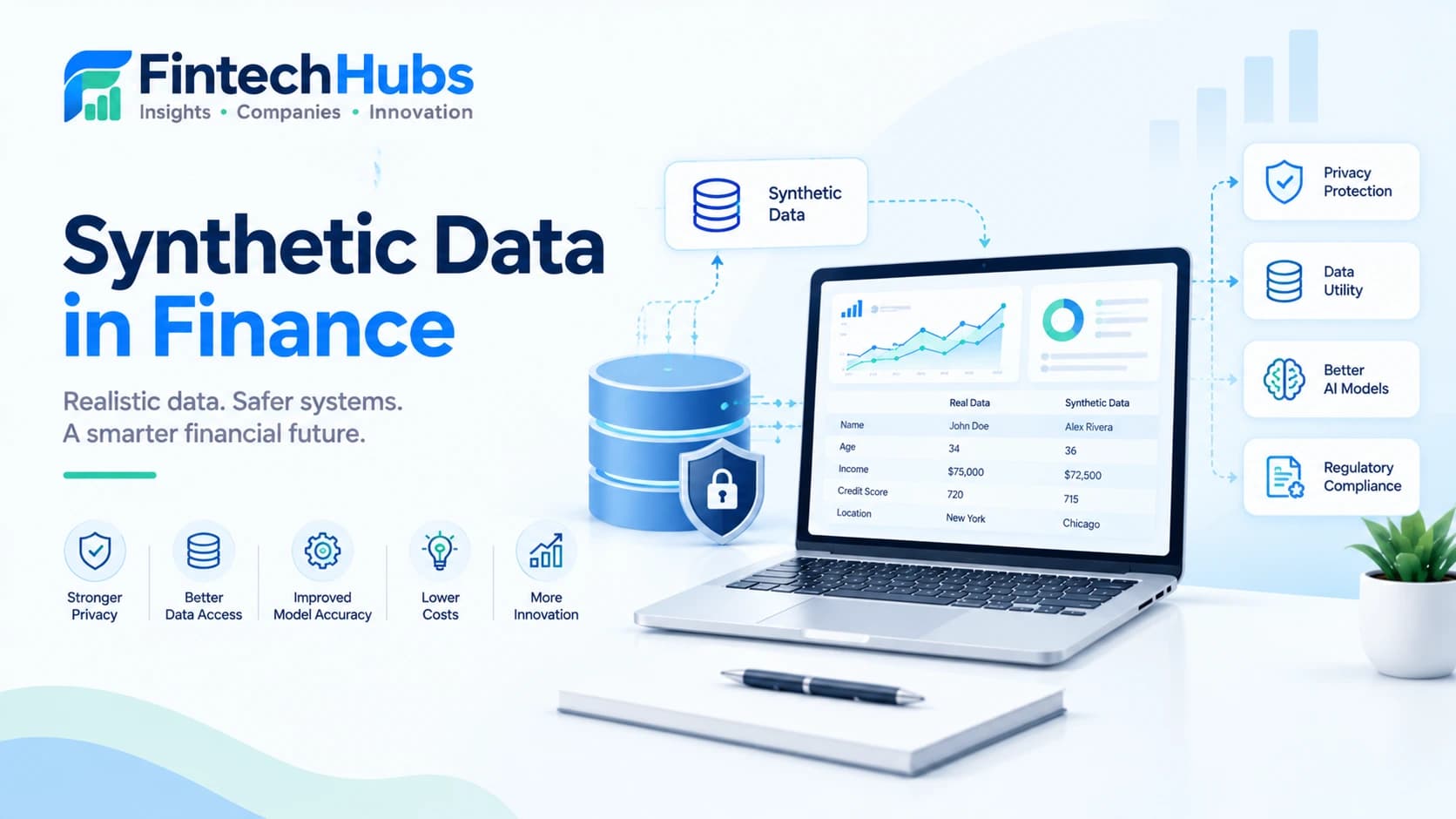
Synthetic data offers a way to work around some of these limits. It is artificially generated data that mimics the statistical patterns of real data without directly reproducing real individuals' records. In finance, it is increasingly used for model development, software testing, research collaboration, and stress scenarios.
This guide explains what synthetic data is, how it is created, where it is used in finance, and what benefits, risks, and challenges organizations should understand before adopting it.
What Is Synthetic Data
Synthetic data is information generated by algorithms or simulations rather than collected from real-world events. A good synthetic dataset preserves the statistical properties, relationships, and structure of the source data, such as the distribution of transaction amounts or the link between income and credit behavior, while not containing actual customer records.
Synthetic data can be:
Fully synthetic: every record is artificially generated
Partially synthetic: only sensitive fields are replaced with generated values
Hybrid: real and synthetic data are combined, for example to add rare scenarios to a real dataset
Synthetic Data vs. Anonymized and Real Data
Dimension | Real Data | Anonymized / Masked Data | Synthetic Data |
|---|---|---|---|
Source | Actual customers and events | Real data with identifiers removed or altered | Generated by models or simulations |
Privacy risk | Highest | Reduced, but re-identification can remain possible | Lower, but not automatically zero |
Realism | Complete | Often degraded by masking | Depends on generation quality |
Rare events | Limited by what occurred | Limited by what occurred | Can be deliberately generated |
Sharing | Tightly restricted | Restricted, often needs review | Easier, subject to risk assessment |
Bias | Reflects real-world bias | Reflects real-world bias | Can inherit or amplify source bias |
Cost of access | Governance-heavy | Moderate | Generation effort, then flexible |
Synthetic data is not a guaranteed-private substitute. Its privacy and usefulness depend on how it is generated and tested.
How Synthetic Data Is Generated
Define the purpose: Decide what the data will be used for (testing, model training, research) and what properties must be preserved.
Prepare source data: Clean and profile the real data, and handle sensitive fields under proper controls.
Choose a generation method: Select rule-based, statistical, simulation, or machine learning approaches.
Train or configure the generator: Fit the model to learn patterns, or define the rules and parameters.
Generate data: Produce the required volume, including specific scenarios if needed.
Validate: Test statistical fidelity, usefulness for the intended task, and privacy risk.
Document and govern: Record methods, limits, and approved uses.
Refresh: Regenerate as source data and business conditions change.
Types of Synthetic Data
5.1 Structured Tabular Data
Customer, account, and transaction tables that mirror relational data.
5.2 Time Series Data
Price histories, balances, and transaction sequences over time.
5.3 Transaction and Behavioral Sequences
Patterns of spending, transfers, and account activity, including fraudulent behavior.
5.4 Text and Document Data
Synthetic contracts, statements, emails, chat messages, and support conversations.
5.5 Image and Document Images
Generated ID documents, cheques, or forms used to train document processing and verification systems, produced with controls to prevent misuse.
5.6 Graph and Network Data
Relationships between accounts, entities, and counterparties for financial crime analysis.
5.7 Scenario and Simulation Data
Economic and market paths under stress, such as interest rate shocks or liquidity events.
Key Applications in Finance
6.1 Fraud Detection Model Training
Real fraud is rare and constantly changing. Synthetic data can add more examples of fraud patterns so models see a broader range of cases, though it must be validated against real outcomes.
6.2 Anti-Money Laundering and Financial Crime Analytics
Synthetic transaction networks can simulate laundering typologies, helping test monitoring rules and train detection models without exposing real customers.
6.3 Credit Risk and Underwriting Models
Synthetic borrower data can supplement limited histories, test model behavior, and explore how models respond to different populations.
6.4 Software Testing and Development
Development and test environments need realistic data. Synthetic data avoids copying production customer data into less secure environments.
6.5 Stress Testing and Scenario Analysis
Generate economic and market scenarios beyond historical experience to examine portfolio and balance sheet resilience.
6.6 Data Sharing and Collaboration
Share synthetic versions of datasets with fintech partners, vendors, researchers, or regulators to enable collaboration while limiting exposure of real data.
6.7 Regulatory Sandboxes and Innovation
Provide realistic datasets for testing new products and algorithms in controlled environments.
6.8 Customer Analytics and Personalization
Develop and test segmentation and recommendation approaches using lower-risk data.
6.9 Model Validation and Benchmarking
Create standard test datasets to compare models or vendor solutions consistently.
6.10 Training AI and Machine Learning Systems
Augment training sets, balance underrepresented classes, and test robustness.
6.11 Document Processing and Identity Verification Testing
Test extraction and verification systems with synthetic documents and cases.
6.12 Market Simulation and Trading Research
Simulate order flow, price dynamics, and market microstructure for strategy testing, with awareness that simulations are simplifications.
Benefits of Synthetic Data
Privacy protection: Reduces direct exposure of real customer data when properly generated and tested
Faster access to data: Fewer approval and legal hurdles for internal and external sharing
Rare event coverage: Can create examples of uncommon fraud types, extreme market moves, or edge cases
Class balance: Helps address datasets where important events are scarce
Lower cost and risk in testing: Avoids copying production data to test systems
Scalability: Generate large volumes on demand
Scenario flexibility: Explore "what if" conditions not present in historical data
Collaboration: Supports partnerships and research with lower confidentiality risk
Reduced data retention concerns: Can lessen the need to keep or move sensitive records
Risks and Challenges
Privacy leakage: If a generator memorizes real records, synthetic outputs can reveal them. Rare or unique records are especially vulnerable.
Re-identification risk: Combined with other data, synthetic records may still enable inference about individuals.
Loss of fidelity: Poorly generated data can miss correlations, rare patterns, or temporal dynamics, leading to misleading results.
Inherited bias: Synthetic data reflects the biases in its source data and may amplify them.
False confidence: Models trained or tested only on synthetic data may perform worse in the real world.
Model collapse and feedback loops: Repeated training on generated data can degrade quality over time.
Difficulty with complex dependencies: Multi-table relationships, long sequences, and network structures are harder to reproduce.
Adversarial misuse: Synthetic identities, documents, or transactions could be misused for fraud if not controlled.
Lack of standards: Evaluation methods and regulatory expectations are still developing.
Governance gaps. Teams may treat synthetic data as exempt from controls when it should still be governed.
Resource needs: Good generation requires data science skill, compute, and validation effort.
Privacy and Regulatory Considerations
Data protection laws: Whether synthetic data falls under privacy regulation can depend on whether individuals remain identifiable. Fully reliable anonymization is hard to prove, so legal review is advised.
Source data governance: Using real data to train a generator still requires a lawful basis, purpose limitation, and security controls.
Re-identification testing: Test for membership inference, attribute inference, and nearest-neighbor similarity to real records.
Model risk management: Models developed with synthetic data are still subject to validation, documentation, and monitoring requirements.
Fair lending and non-discrimination: Assess whether synthetic data distorts outcomes for protected groups.
Explainability and audit: Keep records of how data was generated, tested, and approved.
Third-party sharing: Contracts and risk assessments still apply when sharing synthetic datasets.
Cross-border considerations: Data transfer rules may still be relevant depending on the generation process.
Emerging AI governance: Expectations for AI training data and documentation are evolving.
Requirements vary by jurisdiction and use case. Consult privacy, legal, and compliance professionals.
Quality, Validation, and Evaluation
Synthetic data should be assessed along three dimensions:
Fidelity (does it look like the real data?)
Compare distributions, correlations, and summary statistics
Check time and sequence patterns
Verify business rules and constraints (for example, balances cannot be negative where not allowed)
Utility (does it work for the task?)
Train models on synthetic data and test on real held-out data
Compare performance against models trained on real data
Check that important rare patterns are preserved
Privacy (does it protect individuals?)
Measure similarity to real records and detect copies
Run membership and attribute inference tests
Consider formal methods such as differential privacy where appropriate
Evaluate all three together, since improving one can weaken another.
Implementation Roadmap
Phase 1: Define use cases and risk appetite: Identify where synthetic data adds value and what privacy and quality thresholds apply.
Phase 2: Governance: Establish ownership, approval processes, documentation standards, and acceptable use rules with privacy, legal, and risk teams.
Phase 3: Pilot: Choose a contained use case such as testing data or a fraud model augmentation, and compare results to real data baselines.
Phase 4: Validation framework: Build repeatable tests for fidelity, utility, and privacy.
Phase 5: Scale: Create catalogs of approved synthetic datasets, automate generation, and integrate into development and analytics pipelines.
Phase 6: Monitor and refresh: Track drift, performance, and incidents, and regenerate as source data changes.
Best Practices
Start with a clear purpose and success criteria.
Treat synthetic data as governed data, not as automatically exempt from controls.
Test privacy explicitly, do not assume it.
Validate on real data before relying on models trained on synthetic data.
Combine real and synthetic where appropriate rather than replacing real data entirely.
Preserve rare but important patterns, and check that the generator did not smooth them away.
Document generation methods, parameters, and limitations.
Control access to generators and source data.
Check for bias before and after generation.
Involve legal and compliance early.
Prevent misuse, especially for synthetic identities and documents.
Refresh regularly to reflect changes in customer behavior and fraud patterns.
Tools and Technology Landscape
The ecosystem includes several categories:
Statistical and rule-based generators: For simple structures and test data
Generative models: Such as generative adversarial networks, variational autoencoders, diffusion models, and transformer-based sequence models
Agent-based and simulation tools: For markets, payments, and customer behavior
Privacy-enhancing techniques: Such as differential privacy
Commercial and open-source platforms: Offering tabular, time series, and text generation with built-in quality and privacy reports
Validation tools: For fidelity, utility, and privacy scoring
When evaluating tools, consider supported data types, privacy guarantees, integration with existing data platforms, transparency of methods, and quality of evaluation reporting.
Industries and Use Cases
Retail and commercial banking: Fraud models, test environments, customer analytics
Payments and fintech: Fraud simulation, transaction monitoring tuning, partner data sharing
Insurance: Claims modeling, fraud detection, underwriting research
Capital markets and asset management: Market simulation, strategy research, stress scenarios
Lending: Credit model development with limited histories
Regulators and supervisors: Testing tools and methods with realistic but non-sensitive data
Academia and research: Studying financial behavior without access to real customer records
Future Trends
Generative AI for realistic synthetic data across tables, text, and sequences
Privacy-preserving generation combining differential privacy and stronger testing
Standards and benchmarks for quality and privacy measurement
Synthetic data marketplaces and sharing frameworks between institutions
Regulatory attention to synthetic data's role in AI training and data protection
Synthetic scenarios for climate, cyber, and systemic risk
Greater use in testing agentic AI and automation systems
Stronger controls against synthetic identity abuse
16. Frequently Asked Questions
1. What is synthetic data in finance?
It is artificially generated financial data, such as transactions or customer profiles, that mimics the statistical patterns of real data without directly containing real customers' records.
2. Is synthetic data completely private?
Not automatically. If a generator memorizes or closely copies real records, privacy can be compromised. Privacy must be tested, not assumed.
3. Is synthetic data covered by privacy laws such as GDPR?
It depends on whether individuals can still be identified directly or indirectly. Because this is hard to guarantee, legal assessment is recommended.
4. How is synthetic data different from anonymized data?
Anonymized data starts from real records with identifiers removed or altered. Synthetic data is newly generated, though it may be learned from real data.
5. Can I train AI models only on synthetic data?
You can, but models should be validated on real data. Synthetic-only training can miss real-world complexity and rare patterns.
6. What are the most common use cases in finance?
Fraud and AML model development, software testing, credit modeling, stress testing, and data sharing with partners.
7. What are the biggest risks?
Privacy leakage, poor fidelity, inherited bias, false confidence in model performance, and misuse for synthetic identity fraud.
8. How do you measure the quality of synthetic data?
Evaluate fidelity (statistical similarity), utility (performance on intended tasks), and privacy (resistance to re-identification), and review all three together.
9. Does synthetic data remove bias?
No. It often reproduces or amplifies the bias in the source data unless bias is deliberately measured and mitigated.
10. Do regulators accept synthetic data?
Acceptance varies. Regulated firms should document generation and validation methods, keep model risk controls in place, and consult supervisors or counsel where unsure.
Conclusion
Synthetic data can help financial institutions develop better models, test systems safely, and collaborate more openly, especially when real data is scarce, sensitive, or tightly regulated. Its value, however, depends on careful generation, rigorous validation, and honest recognition of its limits. It is not a shortcut around privacy obligations, and it does not remove bias or guarantee real-world performance. Organizations that treat synthetic data as a governed, tested, and documented asset, and that pair it with real data and strong oversight, are best placed to capture its benefits while managing its risks.
Disclaimer: This article is provided for general informational and educational purposes only. It does not constitute legal, privacy, compliance, financial, or technology advice. Readers should consult qualified professionals and applicable regulations before using synthetic data in regulated environments.
Share this article
Related Articles
ComplyAdvantage vs Dow Jones AML Screening: Features, Data, and Use Cases
Compare ComplyAdvantage and Dow Jones AML screening solutions, including sanctions screening, PEP checks, adverse media, integrations, pricing, and key selection factors.
What Is KYC? Know Your Customer Explained
Learn what Know Your Customer (KYC) means, how the verification process works, and why it matters for fraud prevention, AML compliance, and financial security.
Travel Rule Compliance: Requirements, Challenges & Solutions
Learn about Travel Rule compliance requirements, key challenges, and solutions for crypto businesses. Discover how VASPs can strengthen AML compliance and meet regulatory obligations.