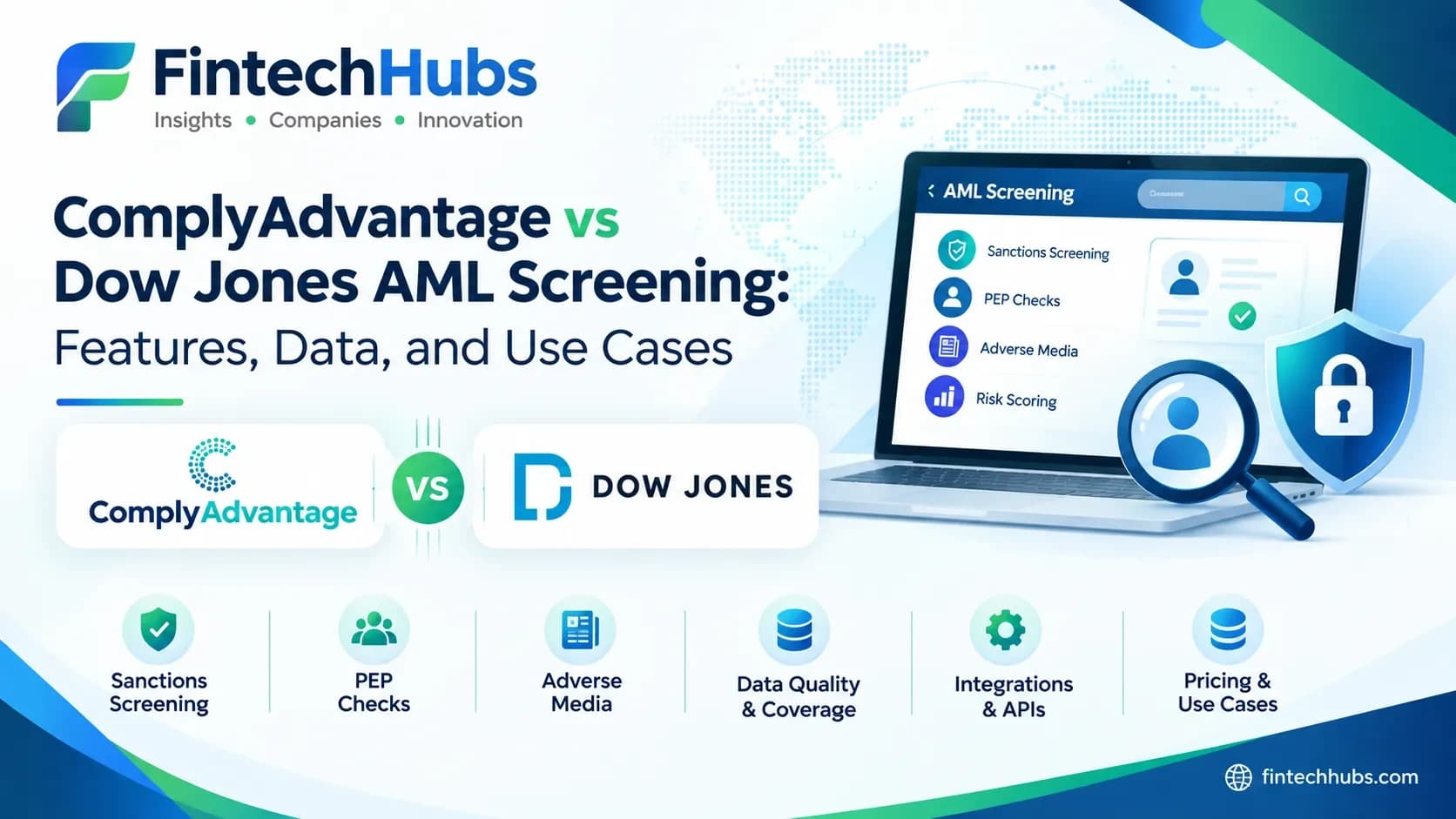
ComplyAdvantage vs Dow Jones AML Screening: Features, Data, and Use Cases
Compare ComplyAdvantage and Dow Jones AML screening solutions, including sanctions screening, PEP checks, adverse media, integrations, pricing, and key selection factors.
ComplyAdvantage vs Dow Jones AML Screening: Features, Data, and Use Cases
For a fintech, the AML screening provider is not a back-office detail. It decides how quickly customers get onboarded, how many alerts your analysts must clear, and how defensible your program looks when a regulator or banking partner asks how you screen. Pick a provider that floods your team with false positives and growth stalls. Pick one with thin coverage and you carry real regulatory risk.
ComplyAdvantage and Dow Jones Risk & Compliance are two names that come up often in this decision, but they are built differently. ComplyAdvantage is a platform company: it combines proprietary risk data with software for screening, monitoring, and case management. Dow Jones is best known as a data and research provider, with decades of editorial heritage behind its risk content, which it delivers through its own tools and through many third-party partners.
This guide compares ComplyAdvantage vs Dow Jones across features, data, workflows, cost, and fit, so you can build a sensible shortlist. Treat it as a starting framework: vendor products change quickly, so confirm current capabilities in a demo and a proof of concept.
1. ComplyAdvantage overview
ComplyAdvantage describes itself as an AI-driven financial crime risk company. Its current flagship is Mesh, an AI-native platform launched in late 2025 that brings customer and business screening, customer risk scoring, transaction monitoring, and payments analysis into one system, connected to a central case management layer for reporting and audit trails.
Screening and monitoring: The platform covers sanctions, PEPs, and adverse media for individuals and companies. Screening can be run once at onboarding or switched to ongoing monitoring, where customers are re-screened automatically against updated data and new matches raise alerts. Screening parameters are configurable, so you can tune match behavior to your risk appetite, jurisdictions, and products.
Payments: In 2026 the company moved payment screening natively into Mesh, with coverage across bank, card, remittance, and crypto payment rails, designed for low latency so legitimate payments are not delayed.
Integrations and ecosystem: ComplyAdvantage is API-first, which suits fintechs that want screening embedded directly in onboarding and payment flows. It also reaches buyers through partners: in March 2026, Sumsub announced that Mesh would power its AML screening across KYC, KYB, and transaction monitoring, including a bring-your-own-key option for existing ComplyAdvantage customers.
2. Dow Jones overview
Dow Jones Risk & Compliance supplies risk data and due diligence tools for anti-money laundering, anti-bribery and corruption, sanctions, and third-party risk. Its content spans sanctions, PEPs and their relatives and close associates, adverse media, state-owned companies, and other high-risk categories.
Data heritage: A defining feature is the link to Factiva, Dow Jones's news archive, which analysts draw on to build and enrich adverse media profiles. Dow Jones has also described independent assurance of its sanctions data, which matters to buyers who need to evidence data quality to auditors.
Products and delivery: Dow Jones offers its data as feeds and APIs, and through RiskCenter, its online screening and research product, which supports ad-hoc searches, batch screening, news screening, tiered alert review, and decision audit trails. It has also launched an AI-assisted adverse media screening and monitoring solution built with Ripjar for continuous, automated screening. Beyond software, Dow Jones offers research and outsourced due diligence services for deeper investigations.
Channel reach: Many compliance vendors and screening platforms embed Dow Jones data, so you may already use it indirectly. That also means you can buy it as a data layer inside another vendor's workflow rather than as a standalone tool.
3. Feature comparison
The table below summarizes the typical positioning of each provider. Individual capabilities depend on the package you buy.
Area | ComplyAdvantage | Dow Jones Risk & Compliance |
Core model | Integrated platform (data plus software) | Data and research provider, with its own tools and many partner integrations |
Sanctions screening | Yes, customer and payment screening | Yes, including ownership and control data and secondary sanctions content |
PEP screening | Yes | Yes, with PEP definitions aligned to FATF guidance and relatives and close associates data |
Adverse media | Yes, AI-supported | Yes, rooted in Factiva and editorial profiles, plus an AI-assisted monitoring option |
Ongoing monitoring | Built in; periodic re-screening with alerts | Available through RiskCenter, API, or partner platforms |
Transaction monitoring | Included in Mesh | Not the core offering; typically sourced elsewhere |
Payment screening | Native in Mesh | Data can feed third-party payment screening engines |
Case management | Central case management in Mesh | Alert review and audit trails in RiskCenter; often handled in the buyer's own system |
API access | API-first | APIs and data feeds available |
What this means in practice: If you want one vendor for screening, monitoring, and case handling, ComplyAdvantage is built for that. If you already have a screening engine or case management system, or you want the data to be a separate decision from the software, Dow Jones fits that modular approach.
4. Data quality and coverage
Data is where the two providers differ most in philosophy.
Source coverage: ComplyAdvantage emphasizes proprietary, end-to-end control of its risk data, from source collection to the alert a customer sees. Dow Jones emphasizes editorially researched profiles backed by a long-running news archive, with Factiva reported to cover tens of thousands of publications in dozens of languages. For adverse media, the depth and licensing of the underlying news sources can matter as much as the matching technology.
Freshness: Sanctions lists change quickly, sometimes within hours of a geopolitical event. Ask each vendor for their documented update cadence, how fast new designations appear in the product, and whether that is measured and reported. Ongoing monitoring is only as good as the data being re-screened against.
Entity matching and false positives: Both providers market fewer false positives, but through different levers. Dow Jones highlights secondary identifiers such as dates of birth, company identification numbers, and securities identifiers to help distinguish similar names. ComplyAdvantage highlights configurable matching and AI-driven models. Neither claim substitutes for testing on your own customers.
How to test it: Run a blind proof of concept with a sample of your real customer names, including common names, non-Latin scripts, and known true positives. Measure true-positive capture, false-positive rate, and analyst time per alert for each vendor. This is the only reliable way to compare data quality for your risk profile.
5. Integration and workflows
Implementation: An API-first platform can often be wired into onboarding quickly by an engineering team. A data-led approach may require more work to build or connect the screening engine, thresholds, and alert queues, unless you consume Dow Jones through a partner platform that has already done that integration.
Alert management: Look closely at how each option handles the daily work of your analysts: alert queues, assignment, escalation paths, bulk actions, and how a decision is recorded. RiskCenter supports hierarchical review across business lines, while Mesh ties alerts to a central case management layer. Which feels better depends on your team size and structure.
Audit trails: Regulators and bank partners expect you to show who reviewed an alert, what they decided, and why. Confirm that decision history is complete, exportable, and retained for the periods your regulators require.
Operational needs: Consider who will own tuning. A small compliance team may want sensible defaults and vendor support, while a large institution may want fine-grained control and its own models. Also check language and regional support, service levels, and how the vendor handles outages.
6. Pricing and total cost
Neither provider publishes a simple public price list, and pricing for both is quote-based. Costs typically depend on:
Licensing model: Subscription, data license, or usage-based.
Screening volume: number of customers, entities, and transactions screened, and how often.
Ongoing monitoring: Monitoring is often billed separately from initial screening, so check how fees apply in year one and in renewal years.
Modules: Adding transaction monitoring, payment screening, or adverse media can change the price substantially.
Implementation and support: Integration effort, premium support, and training.
Analyst time: The hidden cost. A cheaper provider that generates more false positives can cost more once review hours are counted.
When comparing quotes, normalize them to the same scope: same customer volume, same monitoring frequency, same data categories, and the same contract term. Also ask whether buying through a partner platform changes the price compared with a direct contract.
7. Best use cases
Startups and early-stage fintechs: A platform with an API, built-in monitoring, and case management usually gets you to a defensible program fastest. ComplyAdvantage is typically the more natural fit here, either directly or through a KYC partner that embeds it.
Payment providers and money transfer firms: Real-time payment screening and low latency are critical. Evaluate ComplyAdvantage's payment screening, and if you consider Dow Jones, confirm how its data will plug into a screening engine that can meet your throughput needs.
Banks: Banks often have existing screening engines and case management systems. Dow Jones data can slot into that architecture, while ComplyAdvantage may appeal where the bank wants to modernize or consolidate tools. Model risk and data governance requirements will shape the decision.
Large enterprises and multinationals: These buyers often need deep adverse media research, ownership and control data, and sometimes outsourced enhanced due diligence. Dow Jones's research services and Factiva-based content are strong points, though a large firm may also run both: one data source for validation and another for platform workflow.
8. How to choose: a practical checklist
Define scope: List what you must screen: individuals, businesses, payments, and at what lifecycle stages.
Decide platform or data: Do you want a bundled product, or best-of-breed data feeding systems you already own?
Run a proof of concept: Use a representative sample of real names and measure true positives, false positives, and analyst effort.
Check data freshness: Ask for update timelines on sanctions designations and PEP changes.
Review adverse media depth: Look at source coverage, languages, relevance filtering, and how negative news is categorized.
Test integration effort: Estimate engineering time, available SDKs or APIs, and sandbox quality.
Examine workflows: Have your analysts try alert review, escalation, and audit export.
Validate regulatory fit: Confirm coverage for the jurisdictions you operate in and the evidence you can give auditors.
Compare total cost: Include monitoring fees, volume tiers, implementation, support, and analyst time.
Check references: Speak to customers with a similar size and risk profile.
9. FAQs
Is ComplyAdvantage or Dow Jones better for AML screening?
Neither is better in every case. ComplyAdvantage is generally stronger as an integrated, API-first platform, while Dow Jones is generally stronger as a deep, editorially researched data source. The right choice depends on your architecture, volumes, and risk profile.
Can I use Dow Jones data without buying Dow Jones software?
Often yes. Dow Jones data is available through APIs and feeds and is embedded in many third-party compliance platforms.
Do both providers cover sanctions, PEPs, and adverse media?
Yes. Both cover all three categories, though differences in sources, depth, and matching approach affect results, so test them on your own data.
Which provider has fewer false positives?
It varies by customer base and configuration. Both claim to reduce false positives, so measure it in a proof of concept rather than relying on marketing claims.
Does either provider handle transaction monitoring?
ComplyAdvantage includes transaction monitoring in its Mesh platform. Dow Jones is primarily a screening data and research provider, so transaction monitoring is usually sourced separately.
How is pricing structured?
Both are quote-based. Expect pricing to depend on volumes, modules, monitoring frequency, and support level, and request itemized quotes for a fair comparison.
Can a startup afford these tools?
Startups often access screening through KYC platforms that bundle a data provider, which can lower the entry cost compared with a direct enterprise contract.
How often should I re-screen customers?
Use a risk-based approach. Ongoing monitoring that re-screens automatically as lists change is generally preferred over periodic manual re-screening, but confirms what your regulator expects.
Editorial note: Product details reflect public information as of late 2026 and may change. Verify current features, coverage, and pricing with each vendor before making a purchasing decision. This article is general information, not legal or compliance advice.
Share this article
Related Articles
What Is KYC? Know Your Customer Explained
Learn what Know Your Customer (KYC) means, how the verification process works, and why it matters for fraud prevention, AML compliance, and financial security.
Travel Rule Compliance: Requirements, Challenges & Solutions
Learn about Travel Rule compliance requirements, key challenges, and solutions for crypto businesses. Discover how VASPs can strengthen AML compliance and meet regulatory obligations.
Compliance Orchestration in Financial Services Explained
Discover how compliance orchestration unifies KYC, AML, screening, and monitoring into one workflow. Learn benefits, key components, and how to implement it.