Revenue Management System (RMS) Guide 2026: 20 Top Platforms Compared
A complete guide to revenue management systems how they work, key benefits, and an in-depth comparison of 20 leading RMS platforms with G2, Trustpilot & Capterra reviews, pricing insight, and buying advice.
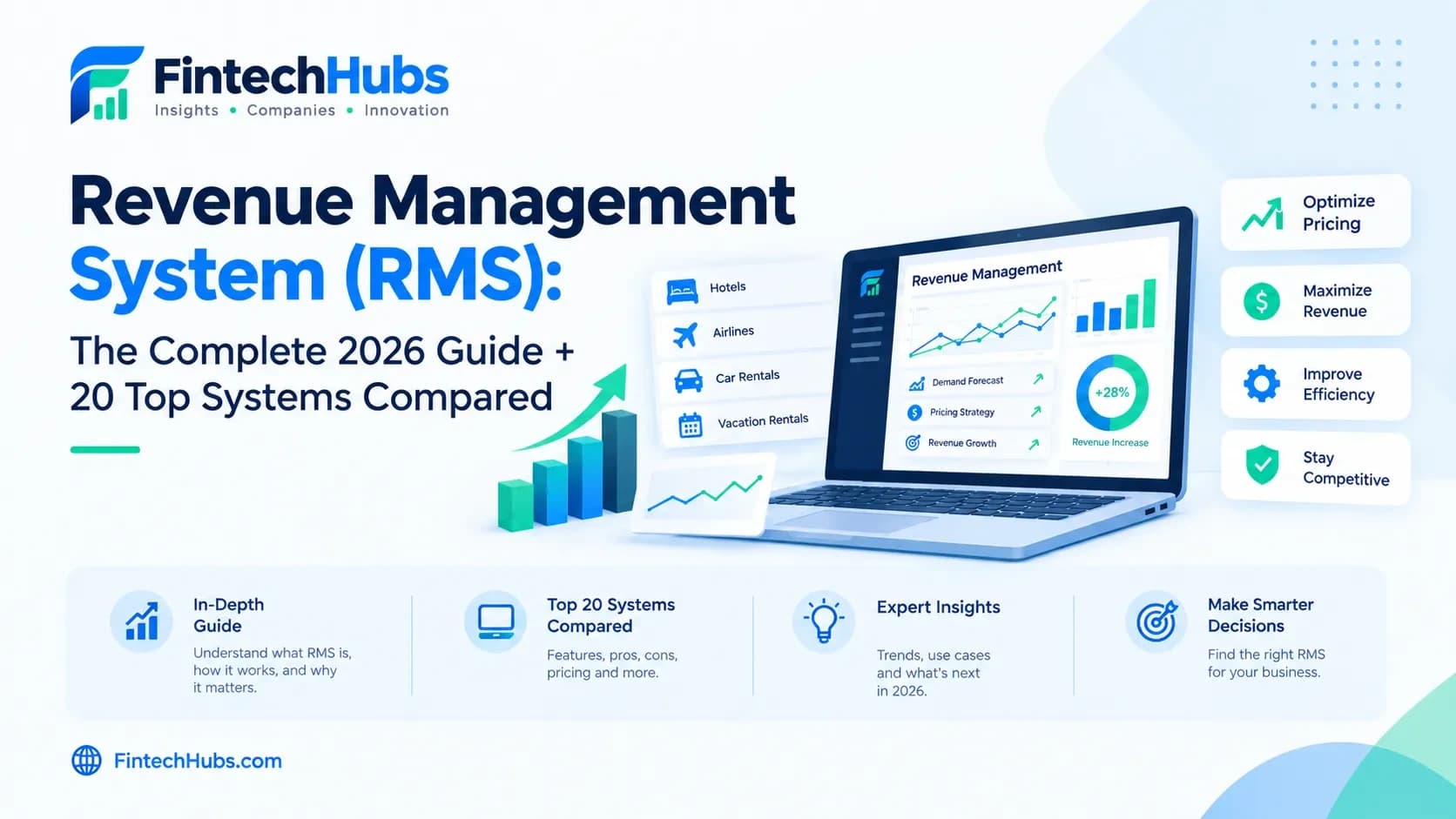
Revenue Management System (RMS): The Complete 2026 Guide + 20 Top Systems Compared
Pricing is no longer something businesses set once and leave alone. Demand shifts by the hour, competitors adjust rates constantly, and guests or customers now expect prices that reflect real-time market conditions. A revenue management system (RMS) is the technology layer that makes this possible: it forecasts demand, analyzes market and competitor data, and recommends or automatically applies the price and inventory strategy most likely to maximize revenue.
This guide explains what a revenue management system is, how it works, why it matters, and what to look for when choosing one. It then compares 20 of the most widely used revenue management systems on the market today, covering their specialization, how each platform actually works, who it is best suited for, and what real users say about them on review platforms including G2, Trustpilot, Capterra, and Hotel Tech Report.
What Is a Revenue Management System?
A revenue management system is software that applies statistical forecasting, machine learning, and market-intelligence data to determine the optimal price for a perishable inventory item: a hotel room tonight, an airline seat on tomorrow's flight, a rental car next weekend at any given moment. Because that inventory cannot be 'restocked' once the date passes, the core objective of an RMS is to sell the right unit, to the right customer, at the right price, at the right time, through the right channel.
While the concept originated in the airline industry in the 1980s, it is most visibly used today in hospitality, where hundreds of RMS vendors from enterprise-grade platforms to lightweight tools for independent hotels compete to help properties optimize Average Daily Rate (ADR) and Revenue Per Available Room (RevPAR).
How a Revenue Management System Works
Although every vendor's algorithm differs, most revenue management systems follow a similar data-to-decision pipeline:
Data collection: The system pulls historical booking data from the PMS or CRS, current pace and pickup trends, and external market signals such as competitor rates, local events, and demand indices (e.g., STR data).
Demand forecasting: Statistical models and machine learning algorithms forecast future demand at a granular level by date, room type, rate code, or channel.
Price and inventory optimization: The system calculates the price and availability controls (open/close rate plans, minimum length of stay, etc.) projected to maximize revenue given that forecast.
Distribution: Approved (or automatically applied) rates are pushed out to the PMS, channel manager, and connected OTAs so pricing stays consistent everywhere a customer might book.
Monitoring and re-forecasting: The cycle repeats continuously some systems update multiple times per day as new booking data and market conditions come in.
Why Businesses Need a Revenue Management System
Revenue and profit growth: Dynamic, demand-based pricing typically outperforms static or manually set rates, often producing measurable RevPAR and ADR gains.
Time savings: Automation removes hours of manual rate-shopping and spreadsheet work each week, freeing staff for guest-facing or strategic tasks.
Consistency across channels: An RMS keeps pricing aligned across the direct website, OTAs, and GDS, reducing rate parity issues.
Better forecasting and planning: Accurate demand forecasts support smarter staffing, budgeting, and marketing-spend decisions.
Competitive resilience: Real-time competitor and market-rate visibility helps properties react quickly to shifting demand rather than losing bookings to faster-moving competitors.
Key Features to Look For in an RMS
Automated, demand-based dynamic pricing with configurable manual-override controls
Accurate, granular demand forecasting (by room type, rate plan, and segment)
Competitor rate-shopping / market-intelligence data integration
Group and event pricing evaluation tools
Open API and pre-built integrations with your PMS, CRS, and channel manager
Multi-property and portfolio-level reporting for groups
Transparent reporting and explainable pricing recommendations
Responsive customer support and structured onboarding
20 Leading Revenue Management Systems Compared
Below is an in-depth look at 20 established revenue management platforms, covering their specialization, how the system works, who it is best suited for, and what verified users say about it across review platforms such as G2, Trustpilot, Capterra, and Hotel Tech Report.
1. IDeaS Revenue Solutions (G3 RMS): A SAS company
IDeaS is one of the oldest and most established names in revenue science, built on SAS's high-performance analytics engine. It is used by more than 16,000 properties across 144 countries, ranging from independent hotels to global casino-resort brands.
Specialization: Enterprise-grade, science-based forecasting and automated pricing/inventory control at the room-type and rate-code level (e.g., Best Flexible Rate, Advance Purchase). IDeaS also offers Smart Space for meetings & events revenue optimization.
How It Works: A machine-learning forecasting engine ingests historical, transactional, and competitive-set data, then produces automated pricing and inventory decisions that push directly into the PMS/CRS. Revenue managers can override recommendations, run group-pricing evaluations, and access advanced reporting dashboards.
Best For:
Large hotels, resorts, and casino-hotel groups
Multi-property enterprise chains needing centralized control
Properties that want a fully automated, 'set-and-verify' pricing engine
Reviews (G2, Trustpilot, Capterra & Hotel Tech Report): IDeaS carries a 4.6/5 average from over 630 reviews on Hotel Tech Report (HT Score 97–98/100, ranked #2 in the 2026 HotelTechAwards Revenue Management category). On Info-Tech/SoftwareReviews its composite satisfaction score sits around 85/100, with especially high marks for quality of features (92) and business value created (91). Reviewers on G2 and Capterra consistently praise its forecasting accuracy and automation but note a real learning curve for teams new to revenue management, and some call out that customization and data-integration setup can be time-consuming.
2. Duetto (GameChanger)
Duetto is a cloud-native, open-architecture RMS built for hospitality groups that want agility, strong business intelligence, and flexible group/catering pricing alongside transient rate optimization.
Specialization: Fully automated, cloud-based dynamic pricing with an open API ecosystem; strong in group and event pricing (BlockBuster) and commercial business intelligence (ScoreBoard).
How It Works: Duetto's GameChanger engine continuously pulls data from the PMS, CRS, channel manager, and market-demand sources (including STR), recalculates optimal rates in near real time, and pushes updates automatically. Scenario modeling lets revenue teams stress-test pricing decisions before they go live.
Best For:
Mid-size to large independent and branded hotels
Multi-property groups and casino resorts
Teams that rely heavily on group and event business
Reviews (G2, Trustpilot, Capterra & Hotel Tech Report): Across roughly 500+ verified reviews aggregated by Hotel Tech Report, Duetto scores about 4.4/5 overall, with a strong 4.64/5 for customer support, 4.69/5 for UI/ease of use, and 4.52/5 for onboarding. Users highlight responsive support and measurable RevPAR gains; the recurring criticism is depth-related complexity for smaller teams and a premium starting price point (reported around $1,000+/month).
3. Atomize
A Scandinavian-born, fully automated RMS known for pushing real-time rate changes with minimal manual intervention, popular with independent and boutique hotels across Europe.
Specialization: Real-time, AI-driven automated pricing with forecasting horizons of up to two years, plus multi-property management and an analytics dashboard.
How It Works: Atomize's algorithm continuously monitors demand signals (pace, pickup, competitor rates) and automatically republishes optimized rates to the PMS/channel manager throughout the day, rather than on a fixed daily cycle.
Best For:
Independent and boutique hotels wanting hands-off automation
Mid-size properties (25–199 rooms)
Hotels in Europe and the Middle East where Atomize has strong regional adoption
Reviews (G2, Trustpilot, Capterra & Hotel Tech Report): Atomize holds an HT Score of 91/100 and ratings between 4.7–4.81/5 across 250–350+ verified reviews, with a 93% likelihood-to-recommend score. Ease of use (4.8/5) and support (4.7/5) are frequently cited strengths; some reviewers note that very small independent hotels may find the feature depth more than they need.
4. RoomPriceGenie
Built specifically for small and independent accommodation providers, RoomPriceGenie focuses on 'set it and forget it' automated pricing rather than deep enterprise analytics.
Specialization: Simple, transparent automated daily pricing with competitor-rate tracking, aimed at owners who don't have a dedicated revenue manager.
How It Works: The system's algorithm recalculates daily rates automatically based on demand, booking pace, and competitor pricing; roughly 95% of clients reportedly let it run fully on autopilot, with a dashboard for manual overrides when desired.
Best For:
Small independent hotels, guesthouses, and B&Bs (10–24 rooms)
Vacation rentals and extended-stay properties
Owner-operators without in-house revenue management expertise
Reviews (G2, Trustpilot, Capterra & Hotel Tech Report): RoomPriceGenie is one of the highest-rated systems in this category, averaging 4.87/5 across 640+ reviews on Hotel Tech Report, and was ranked #1 in the small-hotel segment of the 2026 HotelTechAwards. Ease of use and onboarding both score around 4.8/5, and a 96% likelihood-to-recommend rate reflects strong satisfaction; some users mention that very large or complex multi-brand portfolios may outgrow its simplicity.
5. BEONx (formerly Beonprice)
A Spain-based RMS built for hotel groups that want deeper strategic insight than simple automated pricing tools provide, including its proprietary Hotel Quality Index.
Specialization: AI-driven revenue strategy with adaptive micro-pricing, multi-property management, and open API/STR data integration for larger or multi-property portfolios.
How It Works: BEONx blends demand forecasting with a quality-scoring methodology that benchmarks a property against its competitive set, then recommends micro-segmented pricing adjustments across channels and room categories.
Best For:
Mid-to-large hotel groups, especially in Europe and Latin America
Properties wanting strategic benchmarking, not just automation
Multi-property chains needing centralized oversight
Reviews (G2, Trustpilot, Capterra & Hotel Tech Report): BEONx averages around 4.81/5 from roughly 190 verified reviews on Hotel Tech Report. Reviewers highlight the quality of strategic reporting and personalized support; some comparisons note that its learning curve is steeper than lighter-weight tools built for single independent properties.
6. LodgIQ
An AI/machine-learning revenue platform aimed at hotels that want sophisticated market-demand intelligence with a clean, accessible interface.
Specialization: Machine-learning demand forecasting, sell-out management, and business-mix optimization, with strong market-data ingestion.
How It Works: LodgIQ's models continuously ingest live market-demand and competitive data, forecast future demand patterns, and generate pricing and inventory recommendations designed to optimize business mix rather than transient rate alone.
Best For:
Boutique and city-center hotels
Larger branded chains needing advanced forecasting
Revenue teams that want deep data visualization
Reviews (G2, Trustpilot, Capterra & Hotel Tech Report): LodgIQ scores around 4.67/5 for UI and up to 5/5 overall in some segment comparisons (reviews report a 95% likelihood-to-recommend rate), with support rated as high as 4.88/5. Some reviews mention occasional slow report loading and a smaller review volume compared to larger incumbents like IDeaS or Duetto.
7. FLYR Hospitality (formerly Pace Revenue)
Originally launched as Pace Revenue and rebranded after acquisition by FLYR, this platform blends decision intelligence and commercial business intelligence for hospitality groups.
Specialization: Data-driven decision intelligence combining demand forecasting with broader commercial BI tooling, drawing on FLYR's airline-revenue-management heritage.
How It Works: The platform unifies pricing, distribution, and commercial performance data into a single decisioning layer, applying predictive modeling techniques adapted from airline revenue management to hotel pricing and inventory.
Best For:
Hotel groups wanting integrated BI and RM in one platform
Operators modernizing away from legacy, rules-based systems
Portfolios that value airline-style predictive analytics
Reviews (G2, Trustpilot, Capterra & Hotel Tech Report): As a newer, rebranded entrant, FLYR Hospitality has a smaller public review footprint than legacy players; Hotel Tech Report alternative listings and early user feedback point to positive marks for analytical depth, with reviewers noting the brand transition is still building broad review volume on platforms like G2 and Capterra.
8. Cloudbeds Revenue Management
Cloudbeds is best known as an all-in-one PMS and channel-manager platform; its built-in revenue management module extends that ecosystem with automated pricing rather than functioning as a pure standalone RMS.
Specialization: Integrated dynamic pricing bundled directly with PMS, channel manager, and booking engine convenient for operators who prefer one vendor for everything.
How It Works: Pricing recommendations are generated from the same live reservation and channel data already flowing through the Cloudbeds platform, so rate changes sync automatically across connected OTAs without a separate integration step.
Best For:
Small-to-midsize independent hotels and hostels
Vacation-rental operators wanting one unified system
Properties that prioritize simplicity over deep RM customization
Reviews (G2, Trustpilot, Capterra & Hotel Tech Report): Cloudbeds averages roughly 4.3/5 on G2 and Capterra and around 3.8/5 on Trustpilot across several hundred reviews, with a TrustRadius composite near 6.3/10. Reviewers consistently praise the breadth of the all-in-one platform and OTA connectivity; the most common criticism relates to customer-support response times and the RM module being less specialized than dedicated revenue-only systems.
9. Revinate
Revinate is primarily a guest data platform and CRM, but it plays an important role in the broader revenue-management ecosystem through guest segmentation, benchmarking, and marketing tools that drive direct, demand-aligned revenue.
Specialization: Guest data unification and targeted marketing campaigns that complement rather than replace a dedicated pricing engine.
How It Works: Revinate consolidates PMS, CRM, and survey data into a single guest profile, then uses segmentation and benchmarking tools to help revenue and marketing teams target the right guests with the right offer at the right time.
Best For:
Hotels wanting combined guest engagement and revenue intelligence
Marketing-led revenue teams focused on direct bookings
Groups already using a separate RMS for core pricing
Reviews (G2, Trustpilot, Capterra & Hotel Tech Report): Revinate scores around 6.0/10 on TrustRadius and roughly 4.3/5 on G2, with reviewers praising its audience segmentation and campaign automation; some note it functions more as a CRM/marketing layer than a full pricing-decision engine, so it is often paired with a dedicated RMS.
10. RateGain (OptiMize)
RateGain is a large travel-technology company whose revenue management suite (OptiMize) sits alongside its rate-intelligence and distribution products, giving customers pricing decisions informed by real-time market rate-shopping data.
Specialization: AI-driven pricing recommendations combined with competitive rate intelligence and distribution management under one vendor umbrella.
How It Works: RateGain's rate-shopping engine benchmarks a property against a defined competitive set in real time; that market intelligence feeds directly into pricing algorithms that generate automated rate and inventory recommendations.
Best For:
Hotel chains and larger portfolios wanting RM bundled with distribution tools
Groups that value granular competitor rate-shopping data
OTAs and travel companies needing broader travel-tech integration
Reviews (G2, Trustpilot, Capterra & Hotel Tech Report): Reviewers on G2 and Capterra generally rate RateGain's revenue and distribution products favorably for the depth of market data provided, though several note that the breadth of RateGain's wider product suite means implementation and onboarding can take longer than with single-purpose RMS tools.
11. Infor EzRMS
Infor EzRMS is an established enterprise revenue-management system, often deployed by larger hotel groups already using Infor's hospitality PMS ecosystem.
Specialization: Enterprise forecasting and optimization with strong native integration into Infor's hospitality technology stack.
How It Works: EzRMS applies statistical forecasting models to historical and current demand data, then generates room-type and channel-level pricing recommendations that can flow directly into connected Infor PMS/CRS systems.
Best For:
Larger hotel groups already standardized on Infor's hospitality suite
Properties needing tight PMS-to-RMS integration
Enterprise IT teams that value a single-vendor technology stack
Reviews (G2, Trustpilot, Capterra & Hotel Tech Report): As an enterprise system typically sold through direct/enterprise sales channels, EzRMS has a smaller public review footprint than consumer-oriented RMS tools; feedback available on G2 and industry analyst sites points to solid forecasting accuracy, with adoption strongest among existing Infor hospitality customers.
12. Amadeus Revenue Management
Built on the technology heritage of TravelClick/iHotelier, Amadeus's revenue management tools are part of its broader hospitality commercial-platform ecosystem used by hotel groups worldwide.
Specialization: Demand forecasting and pricing optimization integrated with Amadeus's distribution, CRS, and digital-marketing hospitality products.
How It Works: The system draws on Amadeus's global distribution data alongside property-level history to model demand and generate pricing guidance, with an emphasis on aligning revenue strategy with distribution and marketing channels already managed on the Amadeus platform.
Best For:
Hotel groups already using Amadeus's CRS/distribution suite
Properties wanting revenue strategy tied closely to global distribution data
Mid-size to large chains with multi-channel complexity
Reviews (G2, Trustpilot, Capterra & Hotel Tech Report): Public reviews are concentrated on enterprise software-review sites; feedback generally credits Amadeus's ecosystem-wide data advantage, while some reviewers note that as with most large-suite vendors, getting full value depends on adopting multiple connected Amadeus modules rather than the RMS alone.
13. Sabre SynXis Revenue Manager
Sabre's revenue management tool operates alongside its widely used SynXis CRS, making it a natural fit for hotel groups already reliant on Sabre for central reservations and distribution.
Specialization: Forecasting and pricing optimization tightly coupled with the SynXis central reservation system, useful for chains managing complex, multi-channel inventory.
How It Works: SynXis Revenue Manager analyzes booking pace, historical performance, and market data flowing through the SynXis CRS to generate rate and availability recommendations synchronized across connected distribution channels.
Best For:
Hotel chains and groups already on the SynXis CRS platform
Properties with complex multi-channel and multi-currency distribution
Enterprise revenue teams wanting CRS-native pricing tools
Reviews (G2, Trustpilot, Capterra & Hotel Tech Report): As with other CRS-embedded RM tools, independent review volume on sites like G2 is comparatively limited; enterprise buyers report the tool's strength lies in tight CRS synchronization, while some smaller operators find its full capability set more suited to larger, complex portfolios.
14. PROS Revenue Management
PROS is a cross-industry AI pricing and revenue-optimization company serving airlines, B2B distributors, and travel companies, illustrating that the 'revenue management system' extends well beyond hotels.
Specialization: AI-driven dynamic pricing and revenue optimization for airlines, travel intermediaries, and complex B2B pricing environments.
How It Works: PROS applies machine-learning pricing science across large transaction datasets to recommend optimal prices in real time, with configurable rules for industry-specific constraints such as fare classes or B2B contract pricing.
Best For:
Airlines and travel companies needing fare and capacity optimization
B2B distributors managing complex, high-SKU pricing
Enterprises wanting one AI pricing engine across multiple business lines
Reviews (G2, Trustpilot, Capterra & Hotel Tech Report): On G2, PROS solutions typically score in the mid-to-high 4-star range from enterprise reviewers, who highlight pricing-science sophistication and configurability; common critiques involve the complexity of implementation and the need for dedicated analyst resources to get full value from the platform.
15. Aiosell
Aiosell is a newer, fast-growing RMS focused on full automation and an all-in-one approach that bundles channel management and booking-engine functionality with dynamic pricing.
Specialization: 24/7 automated dynamic pricing bundled with channel management, positioned as an affordable, easy-to-adopt option for independent and budget-to-midscale hotels.
How It Works: Aiosell's engine continuously updates rates across connected OTAs based on real-time demand and occupancy data, aiming to remove manual rate-shopping and daily repricing tasks entirely from the revenue manager's workload.
Best For:
Independent, budget, and midscale hotels in price-sensitive markets
Properties wanting bundled channel management plus pricing automation
Operators in fast-growing Asia-Pacific hospitality markets
Reviews (G2, Trustpilot, Capterra & Hotel Tech Report): Aiosell has been building review volume quickly on platforms like Capterra and Google, with users frequently citing responsive onboarding support and noticeable time savings from automation; as a younger vendor, its long-term review history on G2 and Trustpilot is still comparatively thin next to legacy players like IDeaS or Duetto.
16. Actabl (ProfitSword)
Actabl was formed from the merger of ProfitSword, Hotelligence 360, ALICE, and other hospitality technology brands, positioning it as a broader profitability and business-intelligence platform with strong forecasting roots.
Specialization: Financial forecasting, budgeting, and business-intelligence tools that extend revenue management into full property profitability analysis.
How It Works: The platform consolidates data from PMS, POS, labor, and revenue systems into unified dashboards, letting operators model forecasts and profitability scenarios that go beyond room-rate optimization alone.
Best For:
Hotel groups wanting profitability forecasting alongside room revenue
Operators managing labor and P&L alongside pricing strategy
Enterprise finance and revenue teams needing unified BI
Reviews (G2, Trustpilot, Capterra & Hotel Tech Report): Legacy ProfitSword users on G2 and Hotel Tech Report have historically rated the forecasting toolset highly for accuracy and flexibility; post-merger reviews for the combined Actabl platform are still consolidating, with feedback generally positive on breadth of data but mixed on the pace of integrating the merged product lines.
17. Revolution Plus
Revolution Plus pairs its RMS technology with a consultancy-style, human-supported revenue management service, appealing to hotels that want software plus hands-on strategic guidance.
Specialization: Revenue management software combined with a dedicated revenue manager or consulting layer, blending automation with human oversight.
How It Works: The platform generates data-driven pricing recommendations while a dedicated revenue-management contact reviews and refines strategy with the property, combining algorithmic output with human judgment on complex situations like groups or renovations.
Best For:
Larger hotel chains and resorts wanting hybrid human plus AI revenue support
Properties without an in-house senior revenue manager
Groups that value a consultative relationship over a self-serve tool
Reviews (G2, Trustpilot, Capterra & Hotel Tech Report): Across around 212 reviews aggregated on Hotel Tech Report, Revolution Plus scores roughly 89.93/100 on the HT Score, with ease-of-use ratings around 4.84/5; reviewers frequently mention the dedicated-support model as a differentiator, while some note pricing is less transparent than fully self-service platforms.
18. Rate Yield
Rate Yield is a lean, automation-first RMS built around straightforward rate automation rather than a large feature catalog, appealing to teams that want fast time-to-value.
Specialization: Streamlined automated rate adjustments, bulk pricing changes, and restriction management with a minimal learning curve.
How It Works: The system applies rules-based and demand-responsive logic to automate day-to-day rate changes and restrictions, prioritizing simplicity and speed over the deep customization found in enterprise-grade tools.
Best For:
Mid-size hotels wanting quick automation without a steep learning curve
Revenue teams prioritizing time savings over deep customization
North American independent and small-chain properties
Reviews (G2, Trustpilot, Capterra & Hotel Tech Report): In head-to-head comparisons on Hotel Tech Report, Rate Yield scores particularly well on ease of use (around 4.9/5) and support (as high as 4.97/5), with reviewers highlighting quick onboarding and responsive service; the trade-off noted by reviewers is a narrower feature set compared to AI-heavy platforms like LodgIQ.
19. Hotellistat
A German revenue-management provider known for close, personalized client relationships and steady product development, popular among independent hotels and small groups in the DACH region.
Specialization: Revenue management software paired with hands-on account support, tailored particularly to the German and Central European hotel market.
How It Works: Hotellistat combines demand forecasting with a smaller, dedicated support team that works closely with each property, integrating with major PMS and RMS-adjacent tools such as Fairmas and protel commonly used in the region.
Best For:
Independent hotels and small groups in Germany and Central Europe
Properties valuing a closer, more personal vendor relationship
Hotels wanting a lower entry price than large enterprise RMS suites
Reviews (G2, Trustpilot, Capterra & Hotel Tech Report): Hotellistat has earned very high satisfaction scores in regional comparisons up to 4.81–5/5 though from a smaller review base (around 30 reviews) than global players; reviewers consistently point to proactive, personalized support as its standout strength.
20. OutPerform RMS
OutPerform RMS is positioned as an agile, pricing-focused system built around what its vendor calls an 'agile pricing' methodology, supported by its own training academy for revenue teams.
Specialization: Agile, responsive pricing strategy tools aimed at independent and small-group hotels wanting a lighter-weight alternative to enterprise RMS suites.
How It Works: The platform emphasizes rapid, iterative rate adjustments driven by short-cycle demand data, paired with educational resources to help revenue teams build pricing skills rather than relying purely on a black-box algorithm.
Best For:
Independent hotels and boutique groups wanting an agile pricing approach
Teams that want training resources alongside the software
Properties comparing lighter alternatives to Duetto or Atomize
Reviews (G2, Trustpilot, Capterra & Hotel Tech Report): OutPerform RMS appears in Hotel Tech Report's alternative rankings alongside tools like BEONx and Atomize; comparative reviews describe it as competitive on features and press visibility, with some reviewers rating its customer support and speed-to-ROI as areas where larger competitors currently have an edge.
Side-by-Side Comparison Table
Ratings below are aggregated, approximate figures drawn from the review platforms cited in each profile above (primarily Hotel Tech Report, G2, Capterra, and Trustpilot) and can shift as new reviews are published. Always check the vendor's current review pages before making a final decision.
# | System | Best For | Deployment Focus | Approx. Review Rating* |
|---|---|---|---|---|
1 | IDeaS G3 RMS | Large hotels, resorts, casinos | Enterprise / Multi-property | 4.6 / 5 |
2 | Duetto (GameChanger) | Mid-large hotels & groups | Cloud / Enterprise | 4.4 / 5 |
3 | Atomize | Independent & boutique hotels | SMB / Mid-market | 4.7–4.8 / 5 |
4 | RoomPriceGenie | Small independent properties | SMB | 4.87 / 5 |
5 | BEONx (Beonprice) | Mid-large hotel groups | Mid-market / Enterprise | 4.81 / 5 |
6 | LodgIQ | Boutique & city hotels | SMB / Mid-market | 4.67 / 5 (UI) |
7 | FLYR Hospitality (Pace Revenue) | Groups wanting BI + RM | Mid-market / Enterprise | Emerging |
8 | Cloudbeds RMS | Small-midsize all-in-one users | SMB | 4.3 / 5 |
9 | Revinate | Guest data + marketing-led RM | SMB / Mid-market | 4.3 / 5 (G2) |
10 | RateGain (OptiMize) | Chains needing rate intelligence | Enterprise | Positive, mixed volume |
11 | Infor EzRMS | Infor-ecosystem hotel groups | Enterprise | Limited public data |
12 | Amadeus Revenue Management | Amadeus CRS/distribution users | Enterprise | Limited public data |
13 | Sabre SynXis Revenue Manager | SynXis CRS hotel chains | Enterprise | Limited public data |
14 | PROS Revenue Management | Airlines, B2B, travel companies | Enterprise / Cross-industry | Mid-high 4-star (G2) |
15 | Aiosell | Budget/midscale independents | SMB | Growing, positive |
16 | Actabl (ProfitSword) | Groups needing profitability BI | Mid-market / Enterprise | Historically strong |
17 | Revolution Plus | Chains wanting human + AI support | Mid-market / Enterprise | ~90 / 100 HT Score |
18 | Rate Yield | Fast, simple automation seekers | SMB / Mid-market | 4.9 / 5 (ease of use) |
19 | Hotellistat | DACH-region independents & groups | SMB / Mid-market | 4.81 / 5 |
20 | OutPerform RMS | Independents wanting agile pricing | SMB | Competitive, mixed |
*Ratings are out of 5 unless otherwise noted, and reflect publicly available aggregated review data at the time of writing.
How to Choose the Right Revenue Management System
Match the system to your property size and complexity. A 20-room independent hotel rarely needs the same platform as a 500-room resort with catering and group business.
Check integration compatibility first. Confirm the RMS has a proven, two-way integration with your existing PMS and channel manager before evaluating features.
Weigh automation vs. control. Decide whether you want a fully automated 'autopilot' system or one that surfaces recommendations for a human revenue manager to approve.
Read recent reviews across multiple platforms. Cross-check G2, Trustpilot, Capterra, and Hotel Tech Report rather than relying on a single source, since review volume and recency vary significantly by vendor.
Ask about onboarding and support. Implementation quality and ongoing support responsiveness are consistently the biggest differentiators reviewers mention across every platform in this guide.
Request a pricing-impact case study. Reputable vendors can show anonymized or referenceable RevPAR/ADR uplift data from properties similar to yours.
Implementation Best Practices
Clean your historical data before go-live forecasting accuracy depends heavily on clean, consistent historical booking data.
Set clear override rules for group blocks, long-term contracts, and other business the algorithm may not handle well out of the box.
Train your whole commercial team, not just the revenue manager, so sales and reservations understand why rates change.
Start with a pilot period using manual approval before switching to full automation, especially for enterprise systems.
Review performance monthly against pre-implementation RevPAR/ADR benchmarks to validate ROI.
Future Trends in Revenue Management
Total revenue management: Expanding beyond room revenue to optimize F&B, spa, and ancillary revenue streams in one platform.
Deeper AI and generative-AI reporting: Natural-language explanations of pricing decisions and automated commentary in reports.
Attribute-based and continuous pricing: Pricing individual room attributes (view, floor, size) rather than just room type, moving toward airline-style continuous pricing.
Unified commercial platforms: Convergence of RMS, CRM/guest data, and business intelligence into single commercial-strategy suites, as seen with vendors like Actable and Revinate.
Cross-industry convergence: Hospitality RMS vendors increasingly borrowing pricing science from airlines and B2B pricing platforms like PROS.
Frequently Asked Questions (FAQs)
What is a revenue management system (RMS)?
A revenue management system is software that uses historical data, real-time demand signals, and predictive analytics to recommend or automatically set the optimal price and inventory allocation for a product or service most commonly hotel rooms, but also airline seats, car rentals, and B2B pricing with the goal of maximizing revenue and profit.
How is an RMS different from a Channel Manager or PMS?
A Property Management System (PMS) runs day-to-day operations like check-in and housekeeping, and a Channel Manager syncs rates and availability across OTAs. An RMS sits above both, deciding what those rates and availability limits should be in the first place, based on demand forecasting.
Do small, independent hotels really need an RMS?
Yes. Many RMS vendors on this list including RoomPriceGenie, Aiosell, and OutPerform RMS are built specifically for small and independent properties, offering simplified, largely automated pricing that does not require a dedicated in-house revenue manager.
How much does a revenue management system cost?
Pricing varies widely by property size and feature depth. Lightweight tools for small independent hotels can start in the low hundreds of dollars per month, while enterprise platforms like Duetto or IDeaS can run into four figures per month depending on room count and modules selected. Most vendors quote custom pricing after a discovery call.
Can an RMS work without a dedicated revenue manager on staff?
Many modern systems are designed for exactly this scenario. Tools like RoomPriceGenie and Aiosell emphasize full automation ('autopilot') so owner-operators without revenue-management expertise can still benefit from dynamic, data-driven pricing.
Is revenue management only for hotels?
No. While this article focuses heavily on hospitality, the underlying discipline and technology (demand forecasting plus dynamic pricing) is also core to airlines, car rental, cruise lines, and even B2B distribution as illustrated by cross-industry platforms like PROS.
How long does it take to implement an RMS?
Implementation timelines range from a few days for simple, PMS-integrated tools to several weeks or months for enterprise systems that require deep data integration, staff training, and configuration of complex rate structures.
What integrations should I look for?
At minimum, confirm two-way integration with your PMS and channel manager, plus support for market-data feeds (such as STR), your CRS if applicable, and ideally an open API so the RMS can connect with CRM, business intelligence, or accounting tools as your stack grows.
Conclusion
A revenue management system is no longer a luxury reserved for large hotel chains and airlines it has become a practical necessity for businesses of every size that sell perishable inventory. Enterprise platforms like IDeaS, Duetto, and Amadeus give large portfolios the forecasting depth and control they need, while approachable, automation-first tools like RoomPriceGenie, Atomize, and Aiosell let independent operators compete on pricing sophistication without hiring a dedicated revenue team.
The 20 systems compared in this guide show that there is no single 'best' revenue management system only the best fit for your property size, budget, technical stack, and appetite for automation versus manual control. Use the comparison table and review data above as a starting shortlist, then validate with live demos, reference calls, and current reviews on G2, Trustpilot, and Capterra before committing, since pricing and review scores can change as vendors update their platforms.
Share this article