
Agentic AI in Fintech: Use Cases, Risks & 2026 Guide
Discover how agentic AI is transforming fintech in 2026 from fraud detection and underwriting to autonomous payments. Explore use cases, risks, regulation, and real examples.
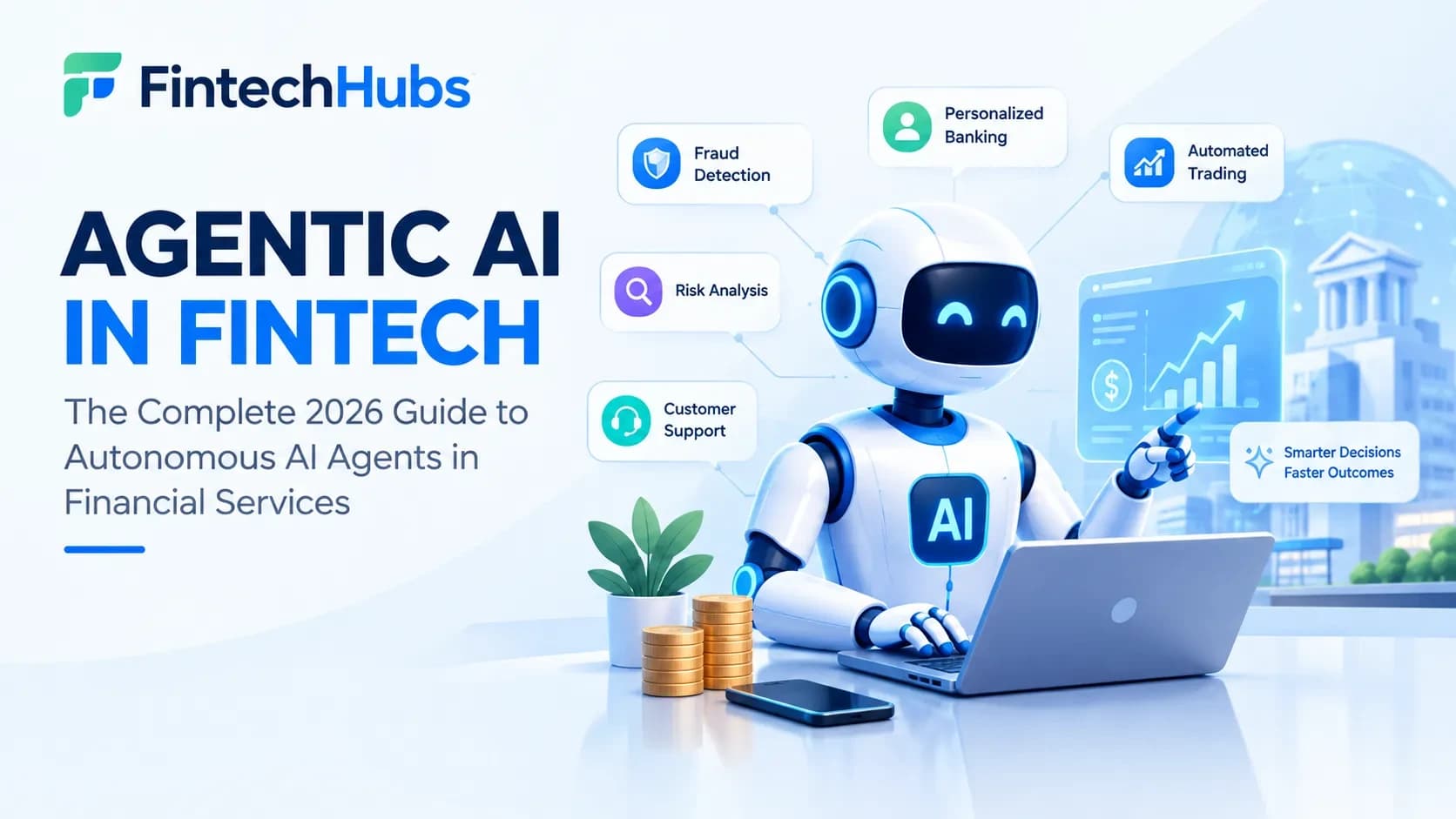
AGENTIC AI IN FINTECH: The Complete 2026 Guide to Autonomous AI Agents in Financial Services
Financial services has spent the last decade automating tasks. In 2026, it is automating judgment. That shift is what people mean when they talk about agentic AI in fintech, a move from software that follows fixed rules to software that pursues a goal, decides how to get there, and acts.
This guide explains what agentic AI actually is, how it is being used across banking and fintech today, the real risks it introduces, and how regulators and institutions are responding.
What Is Agentic AI?
Agentic AI refers to AI systems that can pursue a goal through a sequence of independent actions rather than simply responding to a single prompt. Instead of answering a question or classifying a document, an agentic system can interpret a goal, break it into smaller tasks, call outside tools and data sources, keep track of what it has done across multiple steps, and adjust its plan as new information arrives.
In a fintech context, that might look like an AI system that takes in a loan application, checks the applicant's identity, evaluates risk, confirms the application meets internal policy, and moves it forward for approval, largely without a person touching each step.
How Agentic AI Differs from RPA and Generic Chatbots
It helps to place agentic AI next to two things it is often confused with. RPA is precise but brittle. Chatbots are conversational but passive. Agentic AI is designed to actually complete a multi-step piece of work and only bring in a human when something falls outside its guardrails.
Dimension | RPA | Agentic AI |
|---|---|---|
Logic | Fixed, rule-based scripts | Goal-driven, adapts its own plan |
Data it can use | Structured data only | Structured and unstructured (PDFs, emails, contracts) |
Adapts over time | No breaks when a process changes | Learns from outcomes and adjusts |
Typical fintech job | Data entry, scheduled reports | Underwriting, fraud triage, compliance monitoring, payment execution |
Why Fintech Is Adopting Agentic AI Now
Three forces are converging to make 2026 the year agentic AI moved from pilot to production in financial services:
Volume outpacing headcount: Transaction volumes, KYC checks, and support tickets are growing faster than compliance and operations teams can scale by hiring.
Millisecond decision windows: Fraud and payment decisions increasingly need to happen faster than any human review process allows.
Maturing underlying models: Large language models have become reliable enough at reasoning and tool use that institutions are willing to let them execute, not just recommend, within tightly defined limits.
A regulatory survey from the Cambridge Centre for Alternative Finance found that 52 percent of financial services respondents were actively adopting agentic AI systems that execute multi-step workflows autonomously as of its April 2026 survey, making it the fastest-growing AI category in the sector.
Core Use Cases of Agentic AI in Fintech
1. Fraud Detection and Real-Time Transaction Monitoring
Rather than flagging transactions against static thresholds, agents continuously evaluate behavior, cross-reference risk signals, and can block or approve a transaction in real time as patterns emerge.
2. Credit Underwriting and Lending
Agents pull alternative data sources, run risk models, generate a narrative credit memo highlighting the key risk factors, and route the file for approval. Institutions using this approach have reported straight-through processing of the large majority of credit applications, cutting onboarding from days to minutes.
3. KYC, AML, and Compliance Monitoring
Agents review customer documentation, screen against watchlists, monitor customer service calls for regulatory adherence, and flag conduct issues replacing sporadic manual spot-checks with continuous coverage.
4. Agentic Payments
This is one of the newest and fastest-moving categories: AI that does not just monitor a payment but can initiate and complete a multi-step transaction on a user's behalf, within defined limits. Treasury management and corporate payment routing are the earliest production deployments, with e-commerce checkout agents expected to follow.
5. Portfolio Management and Investment Research
Agents can act as an autonomous layer of a portfolio manager's workflow tracking positions, flagging rebalancing opportunities, and systematizing research knowledge that traditionally lived only with senior analysts.
6. Financial Operations and Reconciliation
Agents handle document-heavy administrative work: reconciling accounts, extracting figures from invoices, compiling financial statements, and drafting routine compliance reports, the kind of work that previously consumed significant analyst time.
7. Customer Service and Support
Unlike scripted chatbots, service agents can look up account history, resolve multi-step requests, and escalate only genuinely ambiguous cases to a human.
8. Cross-Border Tax and Regulatory Screening
Agents pre-screen cross-border transactions for risks like withholding tax exposure or VAT mismatches, gather supporting evidence, and generate explainability notes before escalating flagged cases to human specialists.
Real-World Deployments
Agentic AI in fintech is no longer theoretical. A few documented examples illustrate the scale involved:
Standard Chartered used a unified agentic platform to manage roughly a million digital customer engagements, cutting response times to under ten minutes.
At least one bank has processed more than 80 percent of its credit applications straight through an agentic system, reducing onboarding to minutes.
Major institutions including JPMorgan Chase, Visa, and Mastercard are deploying multi-agent systems for wealth management and agent-initiated commerce.
India's fintech sector, which processes more than 13 billion UPI transactions monthly, is shifting from pilot-stage generative AI toward enterprise-wide agentic deployment for underwriting, compliance, and support.
The Business Case: What Institutions Are Seeing
Institutions that have moved past the pilot stage report benefits along a few consistent lines:
Lower operating cost per transaction, as agents absorb document-heavy and repetitive review work.
Faster cycle times for underwriting, onboarding, and dispute resolution often from days to minutes.
Scaling service without scaling headcount, letting smaller institutions like credit unions meet the same compliance bar as much larger competitors.
Earlier risk detection, since continuous agent monitoring replaces periodic manual spot-checks.
Boards are increasingly asking for these gains in concrete financial terms: cash unlocked, revenue leakage prevented rather than abstract productivity metrics, which is pushing fintechs to tie agentic deployments directly to measurable ledger impact.
Risks and Challenges
Agentic AI's autonomy is exactly what makes it valuable and exactly what makes it risky in a regulated industry. The main challenges institutions are grappling with:
Explainability
When an agent denies a loan application after weighing hundreds of factors, institutions must still be able to explain the decision to the customer and to a regulator. Black-box reasoning is a genuine liability in lending and investment advice.
Accountability and Liability
When an autonomous agent makes a costly error or when multiple agents interact and produce an unexpected outcome it is often unclear whether responsibility sits with the institution, the software vendor, or the model provider. Existing liability frameworks were built around human decision-makers.
Data Privacy and Security
Agentic systems need broad access to sensitive financial data to function, which concentrates risk. A compromised agent, or one with poorly scoped permissions, can expose far more than a single record.
Regulatory Lag
Financial regulation was largely written with human decision-makers in mind. Regulators are actively working on frameworks for autonomous systems, but comprehensive rules specific to agentic AI remain limited in most jurisdictions, leaving institutions to build internal governance ahead of formal requirements.
Unauthorized or Unintended Actions
International regulators have specifically flagged the risk of agentic systems in finance taking unauthorized actions or contributing to system disruptions that could unfold faster than human oversight can respond.
Cultural and Organizational Readiness
Even among banks that see AI adoption as a priority, only a minority currently have the culture, governance structures, and cross-functional skills to deploy agentic systems responsibly at scale.
Regulatory Landscape
Regulators globally are treating agentic AI in finance as a priority watch area rather than a settled issue. Financial-sector supervisors, including bodies like FINRA in the US, have issued guidance on AI use generally, but few jurisdictions yet have rules written specifically for autonomous, multi-step financial agents. International regulatory bodies have called for tighter controls, citing the speed at which an agent's unauthorized action or a technical failure could cascade through a system before a human notices.
A useful way to think about the emerging regulatory posture: the verifiability of an agent's decision matters more than its accuracy alone. In regulated finance, an agent's action needs to be reconstructable and defensible after the fact, not just statistically correct.
How Institutions Are Approaching Implementation
Institutions moving from pilot to production tend to follow a similar pattern:
Start with bounded, reversible tasks: Document review and reconciliation carry lower risk than autonomous trade execution or credit denial, and are common starting points.
Keep a human in the loop at defined checkpoints. Most production deployments retain human review for edge cases, high-value decisions, or anything outside a pre-set confidence threshold.
Build explainability from the start: Systems that generate a narrative rationale alongside a decision are far easier to defend to both customers and regulators than ones that produce a bare output.
Invest in governance before scaling: Clear ownership of agent behavior, audit trails, and rollback plans matter as much as the underlying model.
Treat agent traffic as its own security category: Institutions are building monitoring specifically to distinguish legitimate agent activity from malicious or malfunctioning agent behavior, including from other institutions' agents interacting with theirs.
The Outlook
Venture funding into agentic applications grew sharply through 2025 and into 2026, and the trajectory across banking, lending, and payments points toward agents taking on more end-to-end responsibility, not less. The likely near-term path is agents handling entire transactions from initiation to completion within narrow, well-governed parameters, while human oversight consolidates around exceptions, high-stakes decisions, and system design rather than routine execution.
The institutions gaining the most ground are the ones treating agentic AI as an execution architecture that requires new governance, not just a faster version of the automation they already had.
Frequently Asked Questions
What is agentic AI in fintech, in simple terms?
It is AI that can carry out a multi-step financial task on its own like reviewing a loan application, checking compliance, and moving it to approval rather than just answering a question or following a fixed script.
How is agentic AI different from a chatbot?
A chatbot responds to what you type. An agentic system pursues a goal: it can plan steps, use outside tools and data, remember what it has already done, and adjust its approach as it goes, often without needing a person to prompt each step.
Is agentic AI the same as RPA (robotic process automation)?
No. RPA follows fixed rules and breaks when a process changes. Agentic AI reasons about a goal and adapts, and can work with unstructured data like PDFs and emails, not just structured fields.
What are the biggest use cases right now?
Fraud monitoring, credit underwriting, KYC and compliance review, agentic payments, portfolio and investment research support, and financial operations like reconciliation are the areas with the most production deployments today.
Is agentic AI safe to use for decisions like loan approvals?
It is being used for this, but carefully. Most institutions keep human review for high-stakes or ambiguous cases and build in explainability so a decision can be justified to a customer or regulator after the fact.
Who is liable if an autonomous agent makes a costly mistake?
This is still unsettled in most jurisdictions. Current liability frameworks assume a human decision-maker, and regulators and institutions are actively working out how responsibility should be assigned when an agent, or several interacting agents, causes harm.
Are regulators comfortable with agentic AI in finance?
Not fully yet. Regulators have issued general AI guidance, and some have specifically called for tighter controls on agentic systems, but comprehensive rules built specifically for autonomous financial agents are still developing in most countries.
What ROI are institutions actually seeing?
Reported gains include faster processing (credit onboarding cut from days to minutes in some deployments), lower cost per transaction, and the ability to scale compliance and service capacity without proportional headcount growth.
Do small fintechs and credit unions use agentic AI, or is it just for large banks?
Both. Smaller institutions, including credit unions, are often the ones under the most pressure to adopt it, since they face similar regulatory demands as large banks but with far smaller teams.
What should a company evaluate before deploying agentic AI?
Start with lower-risk, reversible tasks; define where a human must stay in the loop; build in explainability from day one; and invest in governance and monitoring before scaling to higher-stakes decisions like credit or trading.
Share this article
Related Articles
Fintech Regulation and Compliance
Understand fintech regulation and compliance in 2026 licensing, AML, consumer protection, crypto rules, and how oversight shapes financial technology.

Financial Cybersecurity and Fraud Prevention
Learn how financial cybersecurity and fraud prevention work in 2026 — fraud detection, identity verification, scam protection, and key industry trends.
Personal Finance Management
Learn how personal finance management works in 2026, including budgeting, saving, investing, digital banking, fintech apps, and smarter ways to manage your money.