
Wealthtech & Robo-Advisors: Complete Guide 2026 | Fintech
Explore wealthtech and robo-advisors in 2026 — how automated investing works, its key branches, benefits, risks, and where financial technology is headed.
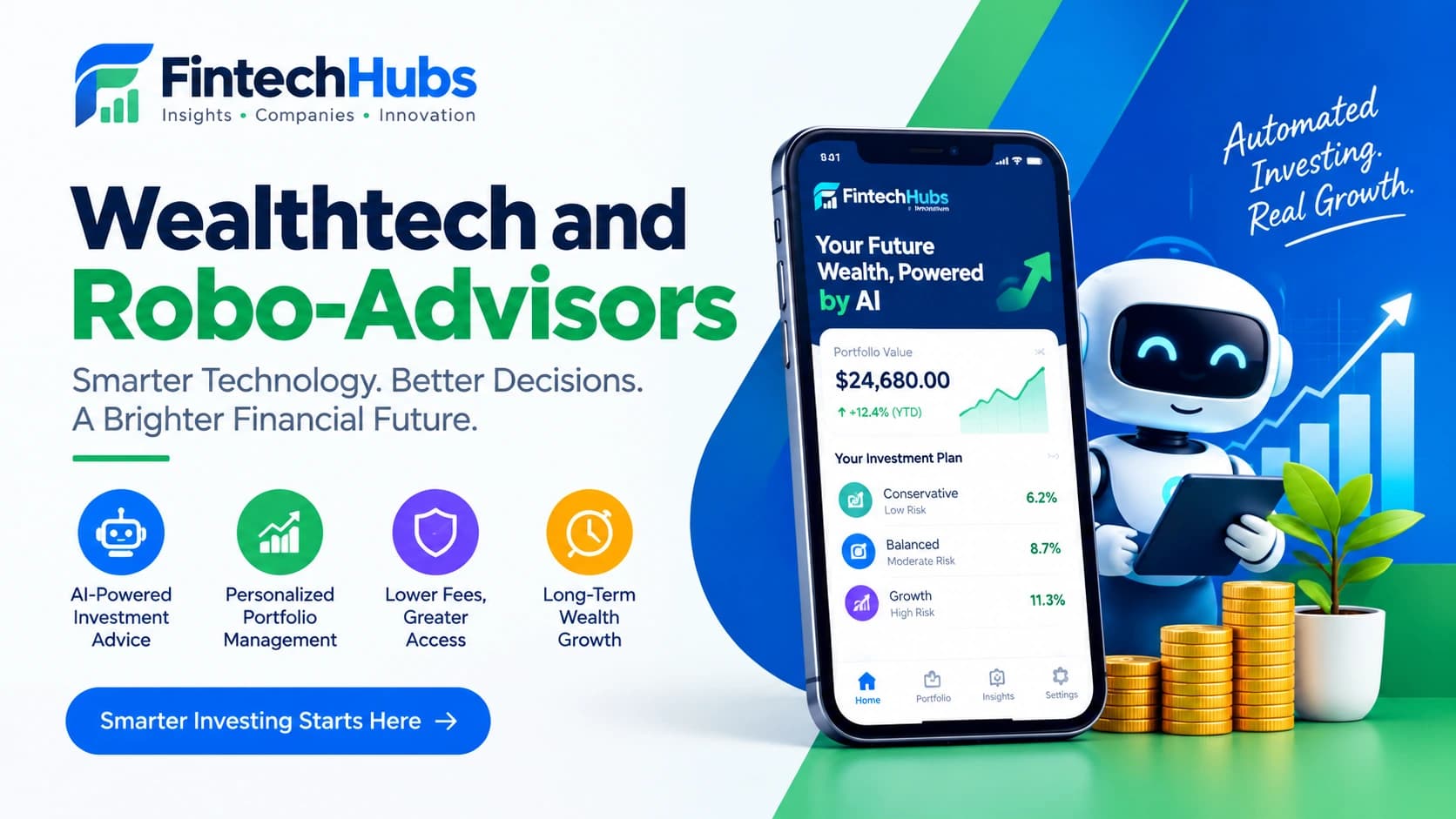
Wealthtech and Robo-Advisors: A Complete Guide to Financial Technology in 2026
Introduction
Money management used to mean one thing: a human advisor, a paneled office, and a fee structure that only made sense once your portfolio crossed six figures. That world hasn't disappeared, but it now sits alongside a much larger, much faster-moving one wealthtech. Wealthtech is the umbrella term for the software, algorithms, and digital platforms that automate, simplify, and democratize investing, financial planning, and wealth management. Robo-advisors are its most visible product: apps and platforms that build and manage investment portfolios using algorithms instead of (or alongside) human judgment.
By 2026, wealthtech is no longer a niche experiment run by scrappy startups. It is core infrastructure for banks, brokerages, insurers, and independent advisors alike. This guide walks through what wealthtech actually is, how robo-advisors work under the hood, the major branches of the industry, why the shift matters for ordinary investors and for the financial system as a whole, and where the space is heading next.
1. What Is Wealthtech, Exactly?
Wealthtech (short for "wealth management technology") refers to any technology built to improve how people save, invest, plan, and manage financial assets. It sits inside the broader fintech universe but focuses specifically on wealth-building and wealth-preserving activities rather than payments, lending, or banking infrastructure.
Wealthtech includes:
Automated investing platforms (robo-advisors)
Financial planning and budgeting software
Portfolio management and rebalancing tools for advisors
Alternative investment marketplaces (real estate, private credit, art, collectibles)
Tax optimization engines
Retirement and goal-planning calculators
Client relationship management (CRM) systems built for advisors
Robo-retirement and workplace savings tools
AI-driven research and market analysis tools
The common thread is that software not paperwork or manual spreadsheets — does the heavy lifting of analysis, execution, and ongoing management.
2. How Robo-Advisors Actually Work
A robo-advisor is, at its core, a rules-based (and increasingly AI-enhanced) system that builds and maintains an investment portfolio on a client's behalf. The typical process looks like this:
Step 1: Onboarding and Risk Profiling
New users answer a questionnaire covering their age, income, investment goals, time horizon, and risk tolerance. Some platforms now use behavioral data and machine learning to refine this profile over time rather than relying on a single static questionnaire.
Step 2: Portfolio Construction
Based on the risk profile, the platform allocates funds across asset classes — typically low-cost exchange-traded funds (ETFs) covering stocks, bonds, and sometimes real estate or commodities. Most robo-advisors rely on some variation of Modern Portfolio Theory, aiming to maximize expected return for a given level of risk.
Step 3: Automated Rebalancing
As markets move, a portfolio's allocation drifts from its target. Robo-advisors monitor this continuously and automatically buy or sell assets to bring the portfolio back into balance — something a human advisor would typically only do quarterly or annually.
Step 4: Tax Optimization
Many platforms offer tax-loss harvesting: automatically selling losing positions to offset capital gains elsewhere in the portfolio, then reinvesting in a similar (but not identical) asset to maintain market exposure. This is a feature that used to be reserved for high-net-worth clients with dedicated tax advisors.
Step 5: Ongoing Monitoring and Reporting
Dashboards give users real-time visibility into performance, fees, and progress toward goals, replacing the annual (or less frequent) statements of traditional wealth management.
3. The Branches of Wealthtech
Wealthtech isn't one product category it's an ecosystem. Here are its major branches:
A. Pure Robo-Advisors (B2C)
Direct-to-consumer platforms that let individuals open an account, answer a risk questionnaire, and get an automatically managed portfolio with minimal human interaction. These typically charge a small percentage of assets under management (AUM) annually, often well below traditional advisory fees.
B. Hybrid Advisory Platforms
A blend of algorithmic portfolio management and access to human financial planners, usually via chat, video call, or scheduled sessions. Hybrid models have become dominant because many investors want automation for the routine work but still want a person to call during a market downturn or a major life event.
C. B2B Wealthtech (Advisor-Facing Tools)
Software sold to financial advisors and wealth management firms rather than directly to consumers. This includes portfolio rebalancing engines, client reporting dashboards, compliance and audit tools, and CRM systems tailored to the advisory business. This branch has grown enormously as traditional advisory firms race to modernize rather than be displaced.
D. Embedded Wealth Management
Banks, neobanks, and even non-financial apps increasingly embed investing features directly into their existing products think "round-up" micro-investing inside a banking app, or a retirement savings feature built into a payroll platform. This branch blurs the line between "wealthtech company" and "everyone else."
E. Alternative and Private Market Access Platforms
Technology that opens up asset classes historically reserved for institutions and the ultra-wealthy private equity, venture capital, real estate syndications, private credit, and fine art or collectibles to a broader base of accredited and sometimes non-accredited investors, often through fractional ownership structures.
F. Retirement and Workplace Wealthtech
Platforms focused specifically on 401(k)/pension-style retirement accounts, offering automated allocation, target-date-style glidepaths, and increasingly personalized advice at the workplace-benefits level.
G. AI-Driven Research and Advisory Copilots
A newer branch layering generative AI and large language models on top of traditional robo-advisory infrastructure tools that can explain portfolio decisions in plain language, answer complex planning questions conversationally, and assist human advisors in drafting client communications and financial plans.
H. Digital Estate and Tax Planning Tools
Software addressing the less glamorous but critical parts of wealth management: estate planning, beneficiary management, and multi-account tax-efficient withdrawal strategies, particularly for people approaching or in retirement.
4. Why Wealthtech and Robo-Advisors Matter
Lower Costs, Wider Access
Traditional human financial advisors commonly charge around 1% of assets under management annually, often with account minimums in the tens or hundreds of thousands of dollars. Robo-advisors typically charge a fraction of that, with minimums as low as a few dollars. This has opened investing to people who were previously priced out of professional portfolio management entirely younger investors, first-time savers, and those with modest but growing balances.
Consistency and Discipline
Emotional decision-making — panic-selling during a downturn, chasing returns during a rally — is one of the biggest drags on individual investor performance. Automated systems don't panic. By enforcing rules-based rebalancing and long-term allocation strategies, robo-advisors help remove behavioral biases from the equation.
Efficiency for Advisors, Not Just Replacement
A common misconception is that wealthtech is purely about replacing human advisors. In practice, the bigger story is augmentation: advisor-facing tools let a single financial planner manage far more clients effectively by automating portfolio construction, rebalancing, and reporting, freeing up time for higher-value work like tax strategy, estate planning, and client relationships.
Financial Inclusion
By lowering minimums and fees, wealthtech extends professional-grade investment management to demographics younger workers, gig-economy earners, people in emerging markets who were historically excluded from wealth management entirely.
Data-Driven Personalization
Modern platforms increasingly tailor recommendations not just to a static risk questionnaire but to real spending patterns, life events, and even goals expressed in natural language, making financial advice feel less like a one-size-fits-all product.
Pressure on Incumbents
The rise of wealthtech has forced traditional banks and brokerages to modernize or risk losing a generation of clients who expect app-based, transparent, low-cost financial services. This competitive pressure has, on balance, benefited consumers through lower fees industry-wide.
5. Challenges and Criticisms
Wealthtech isn't without its downsides and open questions:
Limited handling of complex situations: Algorithms are well-suited to straightforward, long-term index investing but can struggle with complex tax situations, business ownership, or multi-generational estate planning where human judgment still matters.
Trust during market stress: Some investors want a human voice to talk to during a crash, not just a dashboard — a gap hybrid models try to close.
Algorithmic sameness: Because many robo-advisors rely on similar portfolio theory and similar ETF providers, portfolios across platforms can end up more similar than marketing suggests.
Data privacy and security: These platforms hold sensitive financial data, making them attractive targets for cyberattacks and raising ongoing questions about how personal financial data is used to train AI models.
Regulatory complexity: Robo-advisors are still subject to fiduciary and suitability rules in most jurisdictions, and regulators continue to refine how automated advice should be disclosed, audited, and held accountable — particularly as generative AI plays a larger role in generating recommendations.
Over-reliance on passive strategies: Heavy use of low-cost ETFs is generally good for long-term investors, but it also means most robo-advised portfolios offer limited downside protection during systemic market events.
6. The Competitive Landscape
The wealthtech space today includes several overlapping categories of players:
Pure-play robo-advisors: that built their business from the ground up around automated investing
Traditional brokerages and banks: that have added robo-advisory tiers alongside their legacy human-advisor businesses
Neobanks and fintech"super apps": embedding investing features into broader financial products
Enterprise wealthtech vendors: selling the infrastructure and software that advisory firms and banks use behind the scenes
Specialized alternative-asset platforms: focused on private markets, real estate, or collectibles
Consolidation has been a defining trend: larger financial institutions have increasingly acquired or partnered with wealthtech startups rather than build competing technology from scratch, while independent platforms have differentiated through niches like sustainable investing, retirement-specific tools, or generational wealth transfer planning.
7. Where Wealthtech Is Headed
Several trends are shaping the next phase of the industry:
Generative AI as a planning copilot: Rather than just executing trades, AI systems are increasingly capable of holding natural-language conversations about financial goals, explaining trade-offs in plain terms, and drafting personalized financial plans — narrowing the experience gap between automated and human advice.
Hyper-personalization:Portfolios are moving beyond a handful of standard risk buckets toward highly individualized allocations that account for a person's full financial picture, values (such as ESG preferences), and even real-time life events.
Direct indexing at scale: Instead of buying a broad ETF, technology increasingly allows investors to own the underlying individual stocks directly, enabling more granular tax-loss harvesting and values-based customization — a feature once reserved for the wealthiest clients.
Broader access to private markets:Fractional ownership technology continues to lower the barriers to private equity, venture capital, and real estate investing for a wider range of investors.
Deeper embedding into everyday financial life:Investing features are increasingly built directly into payroll systems, banking apps, and even shopping platforms, rather than requiring a separate, dedicated app.
Stronger regulatory frameworks: As AI plays a larger role in generating financial advice, regulators worldwide are expected to sharpen disclosure, explainability, and accountability requirements specific to algorithmic and AI-driven financial recommendations.
Conclusion
Wealthtech and robo-advisors represent one of the more consequential shifts in personal finance in the last two decades — not because they eliminate the value of human financial expertise, but because they make disciplined, low-cost, professionally structured investing accessible to far more people than ever before. The branches of the industry, from pure-play robo-advisors to advisor-facing enterprise tools to alternative-asset marketplaces, all point toward the same underlying trend: financial management is becoming more automated, more data-driven, and more accessible, while the role of human advisors shifts from manual execution toward strategy, empathy, and the complex judgment calls that algorithms still can't fully replicate. As AI capabilities continue to mature, the line between "automated" and "personalized" advice will likely keep narrowing, making the coming years a pivotal period for how the world manages its money.
Share this article
Related Articles

Lending and Alternative Credit: A Complete Guide to Financial Technology in 2026
A complete 2026 guide to lending and alternative credit, covering BNPL, embedded lending, AI underwriting, revenue-based financing, risks, and regulation.

Digital Payments Guide: Complete Overview for 2026
Everything you need to know about digital payments in 2026: how they work, every major type, key risks, and the trends reshaping how money moves.
What Is Fintech? A Complete Guide to Financial Technology in 2026
A complete 2026 guide to fintech, covering digital payments, banking, lending, blockchain, embedded finance, and the AI trends reshaping money.