
Personal Finance Management
Explore personal finance management tools in 2026 — budgeting apps, savings automation, AI assistants, and how PFM tech helps you take control of money.
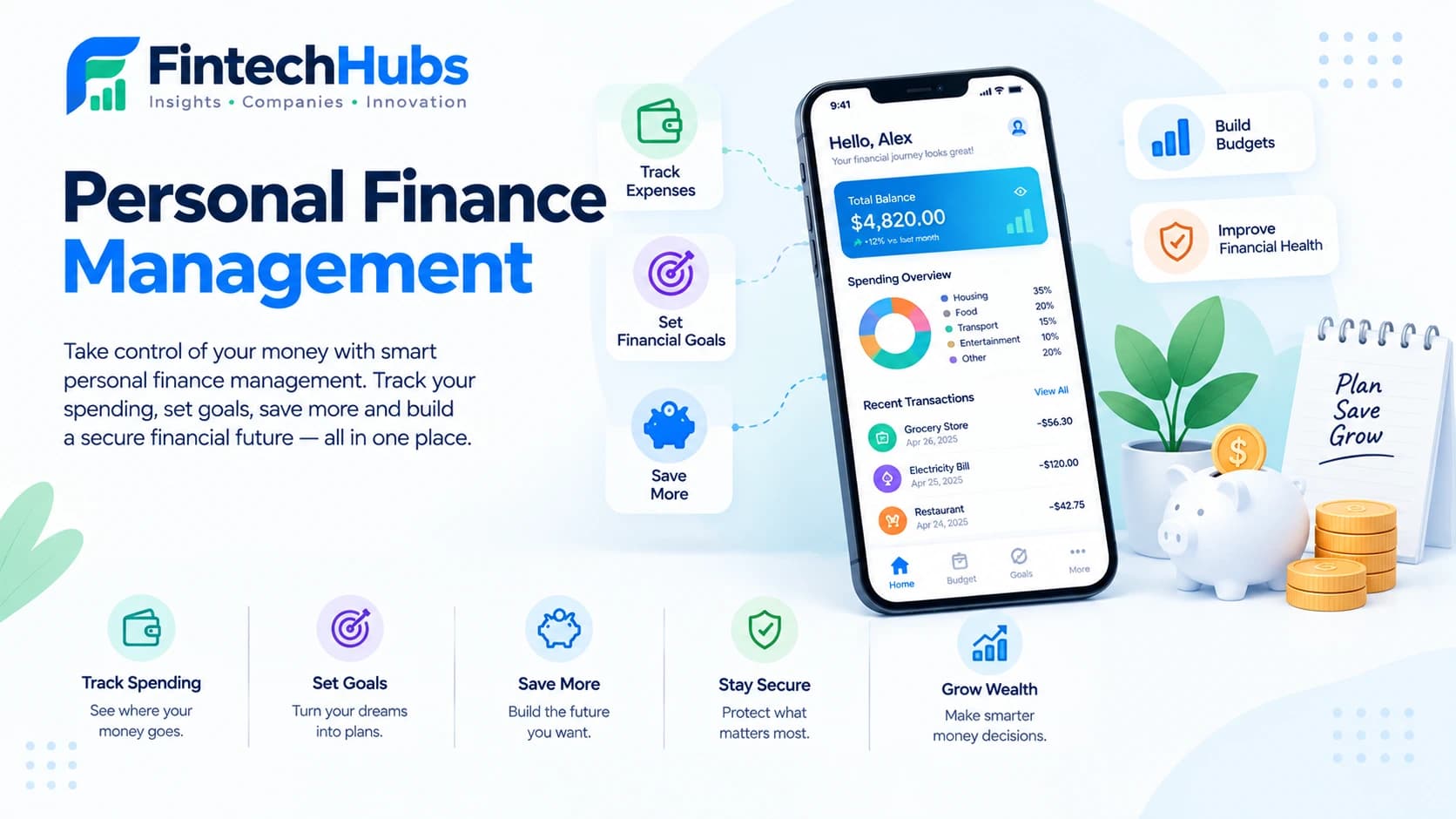
Personal Finance Management: A Complete Guide to Financial Technology in 2026
Not long ago, managing personal finances meant a checkbook register, a folder of paper statements, and maybe a once-a-year sit-down with a calculator to figure out where the money actually went. Personal Finance Management technology often shortened to PFM has replaced that manual, backward-looking process with real-time, automated, and increasingly intelligent tools that help people track spending, build budgets, save toward goals, and understand their full financial picture at a glance.
PFM sits at the consumer-facing edge of fintech. It's the layer most people interact with daily, whether that's a standalone budgeting app, a spending-insights feature built into their banking app, or an AI assistant that flags an unusual charge before they even notice it themselves. By 2026, PFM tools have moved well beyond simple expense tracking into proactive, predictive financial guidance powered by open banking data and artificial intelligence.
This guide covers what personal finance management technology is, how it works, its major branches, why it matters, and where it's headed next
1. What Is Personal Finance Management, Exactly?
Personal Finance Management refers to software and digital tools that help individuals track, organize, understand, and improve their personal finances. At its core, PFM technology aims to answer a few fundamental questions automatically and continuously: How much am I earning and spending? Where is my money going? Am I on track toward my goals? What should I do differently?
Modern PFM tools typically pull data directly from bank accounts, credit cards, loans, and investment accounts often via open banking connections rather than requiring users to manually enter every transaction. This shift from manual tracking to automated aggregation is what transformed PFM from a niche hobby for the highly organized into a mainstream tool used by millions of people who would never have kept a spreadsheet.
2. How Personal Finance Management Tools Actually Work
Step 1: Account Aggregation
Users connect their bank accounts, credit cards, loans, and investment accounts to the PFM platform, typically through secure open banking APIs. This gives the tool a unified view of the user's entire financial life in one place.
Step 2: Transaction Categorization
Incoming transaction data is automatically sorted into categories groceries, rent, entertainment, subscriptions, transportation using rules-based logic and increasingly machine learning models trained to recognize merchants and spending patterns accurately.
Step 3: Budgeting and Goal Tracking
Users set budgets for different categories or savings goals for specific purposes (an emergency fund, a vacation, a down payment), and the platform tracks progress automatically, updating in real time as new transactions come in.
Step 4: Insights and Alerts
The platform surfaces patterns and anomalies an unusually large charge, a subscription the user forgot about, a category where spending is trending upward often via push notifications rather than requiring the user to go looking for the information.
Step 5: Recommendations and Action
More advanced platforms go a step further, suggesting specific actions: moving money to a higher-yield savings account, adjusting a budget category, or flagging a bill that could be negotiated down, sometimes using AI to generate personalized, plain-language guidance.
3. The Branches of Personal Finance Management
PFM is a broad category covering several distinct but overlapping tools and use cases.
A. Budgeting Apps
Tools focused specifically on helping users plan and track spending against a budget, often using methodologies like zero-based budgeting (assigning every dollar a job) or simple category-based limits.
B. Expense Tracking and Spend Analytics
Platforms centered on automatically categorizing and visualizing where money goes, helping users understand spending patterns over time without necessarily enforcing a strict budget.
C. Net Worth and Account Aggregation Tools
Dashboards that pull together checking, savings, credit cards, loans, and investment accounts into a single view of total net worth, giving users a big-picture snapshot rather than a category-by-category breakdown.
D. Savings Automation Tools
Apps that use rules-based or AI-driven logic to automatically move small amounts of money into savings round-up savings on purchases, "pay yourself first" automatic transfers, or algorithm-driven savings based on analyzing cash flow patterns to find safe amounts to set aside.
E. Debt Payoff Planning Tools
Platforms specifically designed to help users plan and track paying down debt, often using strategies like the "avalanche" method (paying off highest-interest debt first) or the "snowball" method (paying off smallest balances first for psychological momentum), with visual progress tracking.
F. Bill Management and Subscription Tracking
Tools that identify recurring bills and subscriptions across a user's accounts, flag price increases or forgotten subscriptions, and sometimes offer to negotiate bills or cancel unused services on the user's behalf.
G. Financial Goal Planning
Broader planning tools that help users map out and track progress toward specific life goals buying a home, retirement, paying for education often combining budgeting, saving, and light investment guidance into a single roadmap.
H. Credit Score Monitoring and Improvement Tools
Platforms that track a user's credit score over time, explain the factors affecting it, and offer specific, personalized guidance on how to improve it.
I. AI-Powered Financial Assistants
A rapidly growing branch layering conversational AI on top of aggregated financial data, allowing users to ask natural-language questions about their finances ("Can I afford this?" "Where did I overspend this month?") and receive personalized, plain-language answers rather than navigating charts and dashboards themselves.
J. Embedded PFM Features
Rather than standalone apps, many PFM capabilities are increasingly built directly into banking apps themselves spending insights, budgeting tools, and savings features offered natively by the bank a customer already uses, rather than requiring a separate app and a separate account connection.
4. Why Personal Finance Management Matters
Financial Awareness and Literacy
Many people don't have a clear, real-time picture of their own spending and saving habits. PFM tools close that gap automatically, building financial awareness without requiring users to become spreadsheet experts.
Better Financial Decision-Making
When people can see clearly where their money goes and how close they are to their goals, they tend to make more informed decisions cutting back in specific categories, catching wasteful subscriptions, or adjusting savings rates before a shortfall becomes a crisis.
Reduced Financial Stress
Uncertainty about money is a significant source of stress for many people. Clear, automated visibility into one's financial situation even when the news isn't great tends to reduce anxiety compared to avoidance and uncertainty.
Behavioral Nudges That Actually Work
Automated savings tools and real-time alerts take advantage of behavioral finance principles making the "right" financial behavior the path of least resistance rather than requiring constant willpower and manual effort.
Accessibility for Everyone
Unlike traditional financial planning, which often required paying a human advisor, PFM tools are frequently free or low-cost, making structured financial guidance available to people at every income level, not just those with substantial assets.
Early Warning System
Automated tracking and alerts can catch problems early fraudulent charges, bills that are about to be missed, spending that's trending unsustainably before they become larger financial problems.
Foundation for Bigger Financial Decisions
A clear picture of income, spending, and savings is the foundation for every bigger financial decision whether someone can afford a major purchase, how much they can invest, or whether they're ready to apply for a mortgage. PFM tools make that foundation available continuously rather than only when someone manually pulls it together.
5. Challenges and Criticisms
Data accuracy and categorization errors: Automated categorization isn't perfect transactions are sometimes mis-categorized, which can distort budgets and insights if users don't periodically review and correct them.
Privacy concerns: PFM tools require access to detailed, sensitive financial data, raising ongoing questions about how that data is stored, used, and potentially monetized by the platforms offering these "free" tools.
Overwhelm and abandonment: Some users find budgeting apps require more ongoing engagement than they're willing to sustain, leading to high abandonment rates after an initial burst of enthusiasm.
One-size-fits-all limitations: Generic budgeting categories and methodologies don't fit everyone's financial situation equally well, particularly for irregular incomes, complex family finances, or small business owners mixing personal and business spending.
False sense of security: Automated tools can create a false sense that "the app has it handled," potentially reducing the deeper financial engagement and planning that more complex situations actually require.
Fragmentation across tools: Users sometimes end up with multiple overlapping PFM tools (one from their bank, one standalone app, one from their investment platform), creating a fragmented rather than unified view of their finances.
6. The Competitive Landscape
The PFM ecosystem includes several types of players:
Standalone budgeting and PFM apps: Built specifically around personal finance tracking and goal planning
Banks and Neobanks:
NeoBanks Offering native PFM features embedded directly into their primary banking appCredit score and credit-monitoring platforms: That have expanded into broader PFM feature sets
Investment and brokerage platforms: Adding PFM-style budgeting and net-worth tracking alongside their core investing products
AI-native financial assistants: Built specifically around conversational, natural-language interaction with personal financial data
Open banking infrastructure providers: That power the underlying data aggregation many PFM tools rely on, even when the provider itself isn't consumer-facing
7. Where Personal Finance Management Is Headed
Proactive, predictive guidance: Rather than simply reporting what already happened, PFM tools are increasingly using AI to predict upcoming cash flow issues, forecast whether a savings goal is realistically achievable, and suggest adjustments before problems occur rather than after.
Conversational AI as the primary interface: Natural-language financial assistants are expected to become a more common way people interact with their finances, replacing some of the manual dashboard-browsing that defined earlier generations of PFM apps.
Deeper personalization: As tools gather more context about a user's actual life circumstances (family situation, career stage, regional cost of living), recommendations are expected to move further away from generic advice and closer to genuinely individualized guidance.
Tighter integration with the full financial picture: PFM is increasingly converging with adjacent categories automated investing, retirement planning, tax optimization moving toward a single unified view of a person's entire financial life rather than separate tools for separate purposes.
Embedded PFM becoming the default: As banks continue investing in native PFM features, standalone budgeting apps may increasingly need to differentiate through more sophisticated AI guidance or specialized use cases rather than basic tracking, which banks themselves increasingly offer for free.
Greater emphasis on financial wellness, not just tracking: The framing of PFM tools is shifting from pure number-tracking toward broader "financial wellness" incorporating behavioral coaching, stress reduction, and long-term financial confidence alongside the raw data.
Conclusion
Personal Finance Management technology has quietly transformed one of the most universal but historically under-served needs understanding and controlling one's own money from a manual, occasional chore into a continuous, largely automated process. Its branches, spanning budgeting, expense tracking, savings automation, debt payoff planning, and increasingly AI-powered financial assistants, all serve the same underlying purpose: giving people clear, real-time visibility into their finances so they can make better decisions with less effort. As PFM tools continue to integrate more deeply with open banking data and AI, they're positioned to keep closing the gap between having access to financial data and actually understanding and acting on it making financial confidence more achievable for far more people than traditional financial planning ever reached.
Share this article
Related Articles
Open Banking: Complete Guide to Open Banking in 2026
Learn what open banking is, how it works, its benefits, security, APIs, and how fintech companies are transforming financial services in 2026.
Embedded Finance and Banking-as-a-Service
Learn how embedded finance and Banking-as-a-Service work in 2026 — key branches, real-world use cases, benefits, risks, and where the industry is headed.

Stablecoins and Digital Currencies
A complete 2026 guide to stablecoins and digital currencies, covering types, the GENIUS Act, bank-issued coins, CBDCs, real use cases, and key risks.