
Embedded Finance and Banking-as-a-Service
Learn how embedded finance and Banking-as-a-Service work in 2026 — key branches, real-world use cases, benefits, risks, and where the industry is headed.
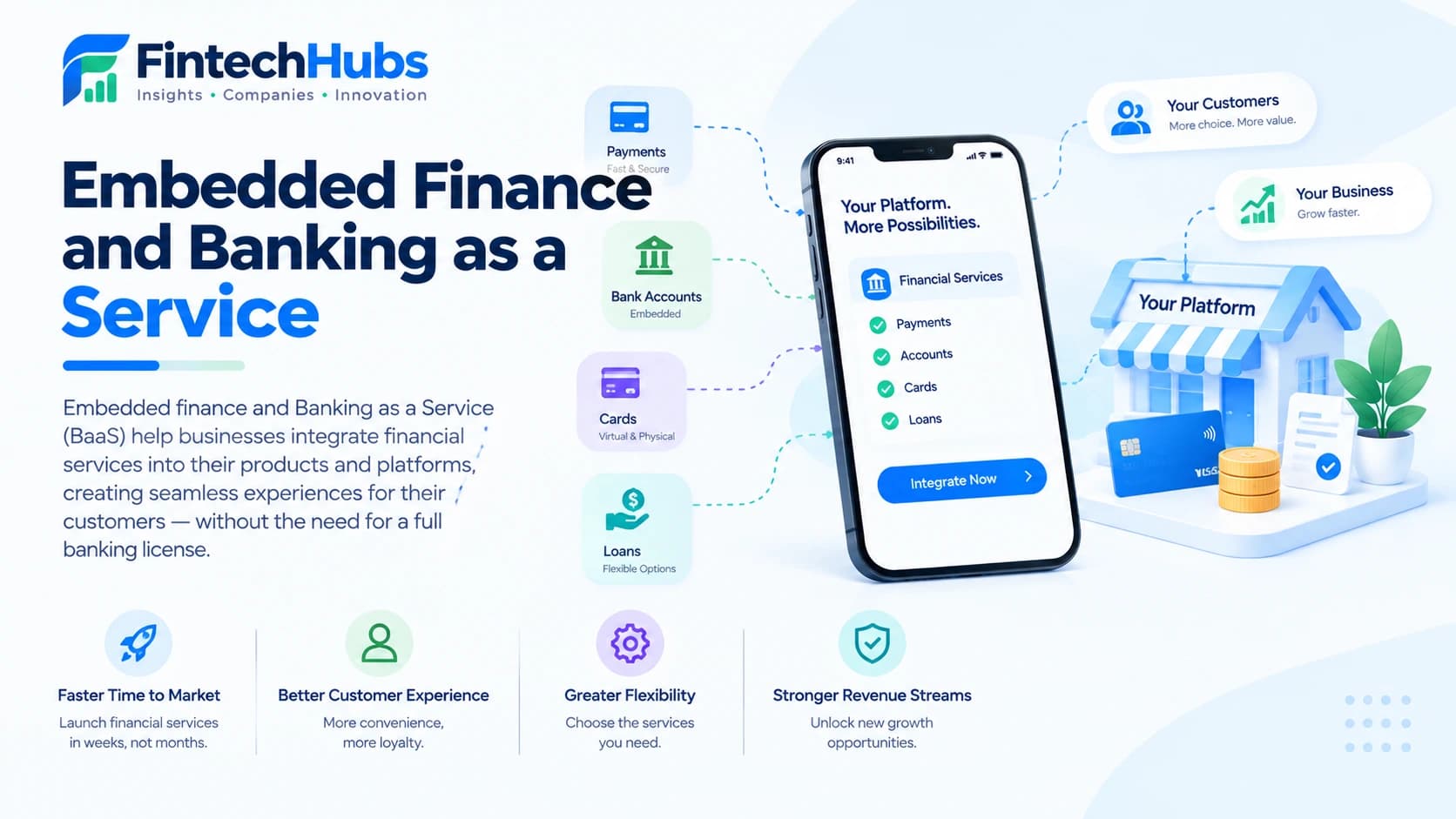
Embedded Finance and Banking-as-a-Service: A Complete Guide to Financial Technology in 2026
Introduction
Not long ago, if you wanted a bank account, a loan, or an insurance policy, you went to a bank or an insurer directly. Today, you might get a business loan from your accounting software, a savings account from your favorite retail app, or insurance coverage at checkout on an e-commerce site all without ever visiting a traditional financial institution's website. This shift is powered by two closely related concepts: embedded finance and Banking-as-a-Service (BaaS).
Embedded finance is the practice of integrating financial products payments, lending, insurance, banking directly into non-financial platforms, so users can access financial services in the exact moment and context they need them. Banking-as-a-Service is the infrastructure layer that makes this possible: licensed banks and regulated infrastructure providers exposing their banking capabilities through APIs so that other companies can build financial products on top of them, without becoming a bank themselves.
By 2026, these two forces together have become one of the most transformative trends in financial technology, quietly rewiring how and where people access money, credit, and financial tools. This guide explains what embedded finance and BaaS are, how they work, their major branches, why they matter, and where they're headed.
1. What Is Embedded Finance, Exactly?
Embedded finance means financial services are built directly into the products and platforms people already use, rather than requiring them to visit a separate bank or financial app. Instead of a "financial services" destination, the financial product becomes a feature inside something else entirely a ride-share app, an online marketplace, a payroll platform, or a point-of-sale system.
The key idea is contextual relevance: financial services are most useful exactly when and where a need arises. A small business owner using accounting software doesn't want to leave that software, apply for a loan at a separate bank website, and come back embedded finance lets the loan offer appear inside the accounting software itself, informed by the business's actual financial data.
2. What Is Banking-as-a-Service, Exactly?
Banking-as-a-Service is the infrastructure that makes embedded finance possible at scale. Licensed banks and specialized BaaS providers expose core banking functions account creation, card issuing, payments, compliance checks through APIs that other companies (often called "brands" or "non-bank companies") can build on top of.
In this model:
The licensed bank holds the regulatory license, manages compliance, and holds customer deposits (where applicable)
The BaaS provider (sometimes the bank itself, sometimes a specialized middleware company) offers the technical infrastructure and APIs
The non-bank company (a retailer, a software platform, a gig-economy app) builds the customer-facing product and owns the brand experience
This layered structure allows non-bank companies to offer real financial products — bank accounts, debit cards, lending — without becoming a licensed bank themselves, a process that would otherwise take years and enormous regulatory investment.
3. How Embedded Finance and BaaS Actually Work
Step 1: Partnership and Licensing
A non-bank company partners with a licensed bank, either directly or through a BaaS middleware provider that already has banking partnerships in place.
Step 2: API Integration
The non-bank company integrates the bank's APIs into its own product — for example, adding a "get paid instantly" feature to a gig-work app, or a "buy now, pay later" option at checkout.
Step 3: Compliance and Risk Management
Behind the scenes, the licensed bank (and often the BaaS provider) handles the regulatory obligations: KYC/AML checks, deposit insurance where applicable, and ongoing compliance monitoring, even though the customer never interacts with the bank directly.
Step 4: Branded Customer Experience
The end customer experiences the financial product as a native feature of the platform they're already using often without ever knowing which bank is operating behind the scenes.
Step 5: Revenue Sharing
The non-bank company, the BaaS provider, and the licensed bank typically share revenue generated from the financial product — interchange fees from card transactions, interest income, or subscription fees — based on their partnership agreement.
4. The Branches of Embedded Finance and BaaS
A. Embedded Payments
The most mature and widespread branch enabling businesses to accept and send payments directly within their own platform, rather than redirecting users to a separate payment processor. This includes checkout payments, marketplace payouts to sellers, and in-app peer-to-peer transfers.
B. Embedded Banking (Accounts and Cards)
Non-bank companies offering branded bank accounts and debit/prepaid cards to their users — for example, a gig-economy platform offering workers an instant-pay debit card, or a software platform offering business checking accounts to its small-business customers.
C. Embedded Lending
Credit and financing offered at the point of need, informed by real-time data the platform already has about the customer. This includes point-of-sale installment loans (buy now, pay later), embedded small-business lending inside accounting or e-commerce platforms, and revenue-based financing offered to sellers on a marketplace.
D. Embedded Insurance
Insurance products offered at the moment of purchase or relevant life event — travel insurance at flight booking, device protection at electronics checkout, or usage-based auto insurance embedded into a car-sharing app.
E. Embedded Investing and Wealth Tools
Investment and savings features built into non-financial apps round-up micro-investing inside a banking or shopping app, or retirement savings tools embedded into payroll and HR platforms.
F. Card Issuing-as-a-Service
Infrastructure that lets companies issue their own branded physical or virtual cards often used for expense management platforms, corporate spend cards, and consumer rewards cards without managing the card-issuing infrastructure themselves.
G. Compliance-as-a-Service
A supporting branch where BaaS providers bundle in the regulatory and compliance infrastructure (identity verification, transaction monitoring, sanctions screening) needed to operate embedded financial products safely, letting non-bank companies launch faster without building compliance capabilities from scratch.
H. Vertical-Specific BaaS
BaaS infrastructure tailored to a specific industry's needs — for example, banking infrastructure built specifically for healthcare payments, real estate transactions, or freelancer/gig-economy payouts, with compliance and features suited to that vertical's particular regulatory requirements.
5. Why Embedded Finance and BaaS Matter
Convenience and Context
Financial services delivered at the exact moment of need — a loan offer when a business needs working capital, insurance at the point of purchase — remove friction that used to require a separate application process at a separate institution.
New Revenue Streams for Non-Financial Companies
Platforms that embed financial products can generate meaningful new revenue (interchange fees, interest income, subscription fees) from an audience they already have, often at a fraction of the customer acquisition cost a standalone bank or lender would face.
Faster Market Entry for Fintech Innovation
BaaS dramatically lowers the barrier to launching a financial product. A company no longer needs a banking license, years of regulatory approval, and core banking infrastructure — they can partner with a BaaS provider and launch in months rather than years.
Better Data-Driven Financial Products
Because embedded finance is delivered inside a platform that already has rich data about the customer (purchase history, business revenue, payroll data), the financial products offered can be more accurately underwritten and personalized than a traditional bank could achieve with limited external data.
Financial Inclusion
Embedded finance often reaches people and small businesses that traditional banks have historically underserved gig workers without conventional pay stubs, small merchants without extensive credit history because the embedding platform already has the data needed to assess and serve them responsibly.
Efficiency for Banks
For licensed banks, BaaS partnerships open up new distribution channels and customer bases without the cost of building and marketing consumer-facing products themselves, turning banking infrastructure into a wholesale product.
6. Challenges and Criticisms
Regulatory accountability gaps. When a customer interacts with a non-bank brand but the underlying product is provided by a licensed bank, questions can arise about which party is ultimately accountable for consumer protection, particularly when something goes wrong.
Compliance and risk concentration. BaaS providers and their partner banks must manage compliance across many different non-bank partners simultaneously, and weak oversight of any single partner can create outsized regulatory or reputational risk for the underlying bank.
Customer confusion. Because the branding often hides the licensed bank behind the scenes, customers may not always understand who actually holds their deposits or is responsible for resolving disputes.
Concentration risk for non-bank companies. A company that relies entirely on a single BaaS provider or bank partner for its financial product faces significant business risk if that partnership ends or the partner faces regulatory action.
Uneven regulatory scrutiny. As embedded finance has grown rapidly, regulators in various markets have increased scrutiny of BaaS arrangements, sometimes resulting in enforcement actions against banks with inadequate oversight of their fintech partners.
Data privacy considerations. Embedded finance relies on platforms sharing customer data with financial partners, raising ongoing questions about consent, data security, and appropriate use of that information.
7. The Competitive Landscape
The embedded finance and BaaS ecosystem includes several distinct types of players:
Licensed banks: That offer BaaS partnerships directly, exposing their banking license and infrastructure through APIs
BaaS middleware providers: That sit between banks and non-bank companies, simplifying integration and often working with multiple bank partners
Card issuing and payments infrastructure providers: Specializing specifically in card programs and payment rails
Vertical BaaS providers: Focused on a specific industry's embedded finance needs
Non-bank brands: Retailers, software platforms, marketplaces, gig-economy apps — that are the end consumer-facing users of this infrastructure
This is a layered, partnership-driven market rather than a single type of company, and successful players often specialize in one layer of the stack rather than trying to do everything.
8. Where Embedded Finance and BaaS Are Headed
Deeper regulatory oversight of the BaaS model: As embedded finance scales, regulators are expected to sharpen expectations around how banks oversee their fintech partners, likely leading to more rigorous due diligence and compliance requirements across the industry.
Consolidation among BaaS providers: As the market matures, expect fewer but stronger BaaS infrastructure providers, as smaller players struggle to meet rising compliance and capital requirements.
AI-enhanced embedded underwriting: Embedded lending and insurance products are expected to become more sophisticated as AI models improve the ability to underwrite risk in real time using the rich contextual data available inside the host platform.
Expansion into new verticals: Embedded finance is expected to continue expanding into industries that haven't traditionally offered financial products — healthcare, real estate, education, and logistics are all seeing growing embedded finance activity.
Greater transparency requirements: Expect increasing pressure — both regulatory and competitive — for platforms to be clearer about which licensed institution is actually providing an embedded financial product, improving consumer trust and accountability.
Global expansion with local complexity: As embedded finance spreads to new markets, companies will need to navigate significantly different banking regulations, licensing requirements, and consumer protection standards from one country to the next, making local BaaS partnerships increasingly important.
Conclusion
Embedded finance and Banking-as-a-Service together represent a fundamental shift in how financial services reach customers not as a destination people have to seek out, but as a feature woven directly into the platforms and moments where a financial need naturally arises. The branches of this ecosystem, from embedded payments and lending to embedded insurance and vertical-specific banking infrastructure, all point toward the same underlying transformation: financial services are becoming more contextual, more accessible, and more deeply integrated into everyday digital life. As regulatory frameworks mature alongside the technology, and as AI continues to improve the underwriting and personalization possible within embedded products, this space is positioned to remain one of the most significant forces reshaping financial technology in the years ahead.
Share this article
Related Articles
Personal Finance Management
Learn how personal finance management works in 2026, including budgeting, saving, investing, digital banking, fintech apps, and smarter ways to manage your money.
Open Banking: Complete Guide to Open Banking in 2026
Learn what open banking is, how it works, its benefits, security, APIs, and how fintech companies are transforming financial services in 2026.
Stablecoins and Digital Currencies
A complete 2026 guide to stablecoins and digital currencies, covering types, the GENIUS Act, bank-issued coins, CBDCs, real use cases, and key risks.