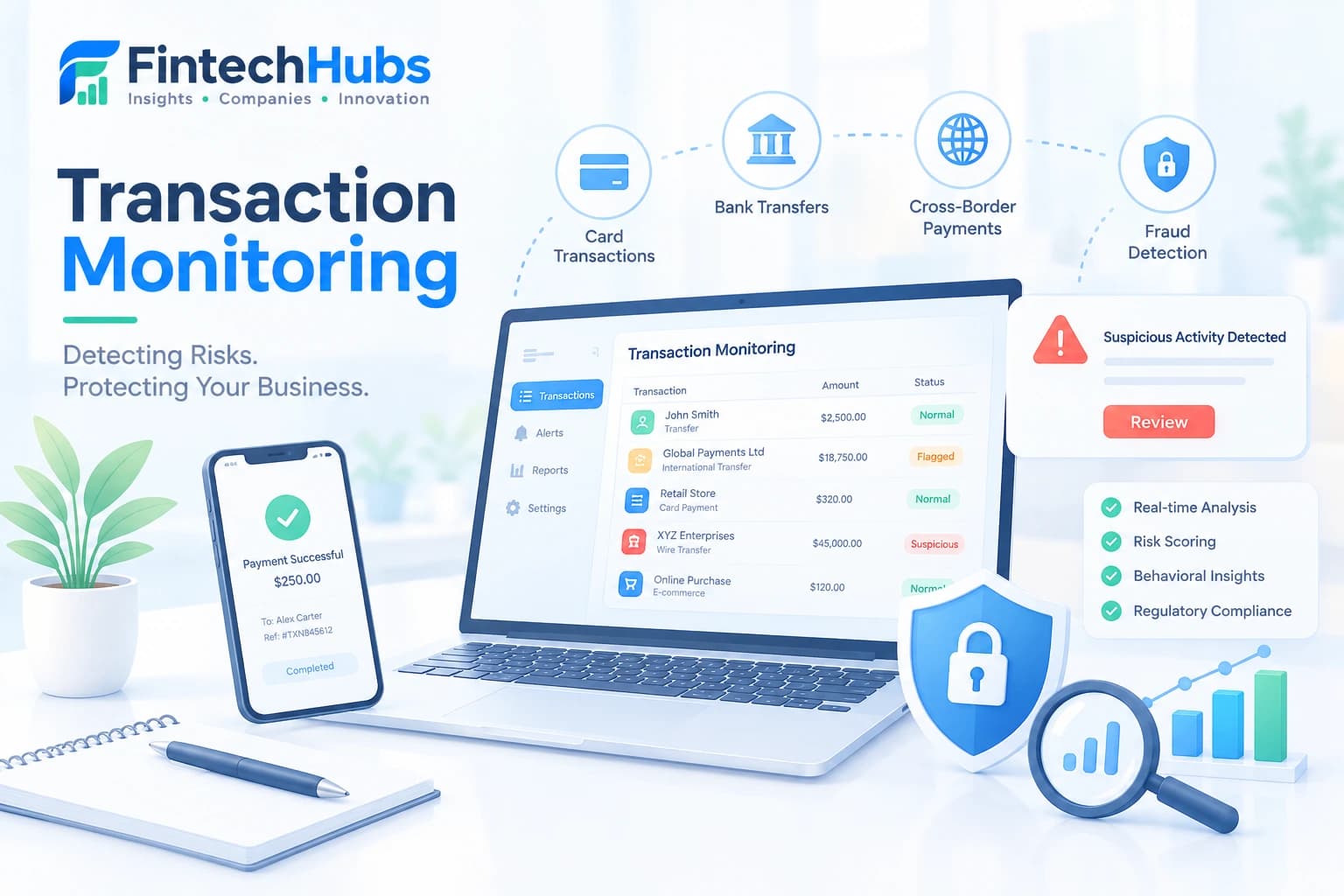
Transaction Monitoring: A Complete Guide to Financial Security
A complete guide to transaction monitoring, covering how it works, AML compliance, AI detection, best practices, common challenges, and 10 key FAQs.
Transaction Monitoring: A Complete Guide to Financial Security
Every second, financial institutions around the world process an overwhelming volume of transactions, transfers, deposits, withdrawals, card payments, and cryptocurrency transfers, moving trillions of dollars across the global economy. Hidden within that enormous volume of legitimate activity, criminals attempt to move money tied to fraud, drug trafficking, corruption, and terrorist financing. Finding those transactions without a systematic, technology driven approach would be practically impossible.
Transaction monitoring is the discipline built specifically to solve that problem. It sits at the center of nearly every modern anti-money laundering and fraud prevention program, and in 2026, it has become significantly more sophisticated, and significantly more necessary, as both financial crime and the technology used to fight it have advanced rapidly. This guide explains what transaction monitoring actually is, why it matters so much, and covers every major aspect of how it works, from the underlying technology and regulatory requirements to the practical challenges compliance teams face and where the discipline is heading next.
What Is Transaction Monitoring
Transaction monitoring is the process of reviewing customer transactions, including transfers, deposits, withdrawals, and payments, to identify unusual or suspicious activity that may indicate money laundering, fraud, terrorist financing, or other financial crime. It typically operates through automated systems that apply rules, statistical models, and increasingly, machine learning to score and evaluate transactions, either as they happen or shortly afterward, flagging anything that deviates meaningfully from expected or normal behavior for further human review.
Transaction monitoring works closely alongside two other core components of a financial crime prevention program. Know your customer processes build an initial profile of a customer when they open an account, verifying their identity and understanding the nature of their expected activity. Customer due diligence extends that understanding, particularly for higher risk customers. Transaction monitoring then continuously screens that customer's actual, ongoing activity against the profile established during onboarding, watching for signs that behavior has changed in a way that warrants closer attention.
Why Transaction Monitoring Matters
Transaction monitoring is not simply a regulatory checkbox. It serves several distinct and genuinely important purposes.
It protects the integrity of the financial system. Money laundering allows the proceeds of serious crime, including drug trafficking, human trafficking, and corruption, to enter the legitimate economy disguised as normal financial activity. Effective transaction monitoring makes that disguise far harder to maintain, helping cut off the financial incentive behind much of that underlying criminal activity.
It satisfies a core legal obligation. Financial institutions and many other regulated businesses are legally required to monitor customer transactions and report suspicious activity to the relevant authorities. Failing to do so can result in severe financial penalties and serious reputational damage, regardless of how well the rest of a business operates.
It catches fraud before it causes lasting harm. Beyond money laundering, transaction monitoring systems are equally effective at catching account takeover, card fraud, and other forms of financial crime that directly harm individual customers, often stopping a fraudulent transaction before the money is gone for good.
It protects a business's own reputation and relationships. A financial institution known for weak controls can lose access to correspondent banking relationships, face restrictions from regulators, and lose the trust of customers and partners, consequences that often carry a far higher long term cost than the expense of running an effective monitoring program.
It genuinely works when implemented well. Organizations running effective, well tuned transaction monitoring systems consistently detect fraud significantly faster and experience meaningfully lower total fraud losses compared to those relying on outdated or purely manual methods, making a strong monitoring program a genuine competitive and financial advantage, not just a compliance cost.
How Transaction Monitoring Works
At a practical level, transaction monitoring follows a consistent process, regardless of the specific technology or industry involved.
Data collection. The system continuously ingests transaction data, including the amount, timing, origin, destination, and method of each transaction, along with relevant customer profile information established during onboarding.
Rule and model application. Each transaction is evaluated against a combination of predefined rules and statistical or machine learning models, which assign a risk score or determine whether the transaction matches a known suspicious pattern.
Alert generation. Transactions that exceed a defined risk threshold, or that trigger a specific rule, generate an alert for human review, rather than being automatically blocked outright in most cases.
Investigation and case management. A compliance or fraud analyst reviews the alert, examining the transaction in context alongside the customer's broader history and profile, to determine whether the activity is genuinely suspicious or a false positive.
Escalation and reporting. If an investigation confirms genuinely suspicious activity, the institution typically files a formal report with the relevant financial intelligence authority, such as a suspicious activity report, and may take further action on the account itself, including restricting access or closing the relationship entirely.
Continuous tuning. Effective transaction monitoring programs treat this entire process as an ongoing cycle, regularly reviewing and adjusting rules and models based on investigation outcomes, emerging typologies, and changing regulatory expectations, rather than treating the initial system setup as a finished, permanent configuration.
Types of Transaction Monitoring Systems
Transaction monitoring systems generally fall into a few core categories, and most mature programs use a combination of approaches rather than relying on just one.
Rule Based Monitoring
Rule based systems apply clearly defined conditions to transaction data, such as flagging any transfer above a specific amount, or generating an alert when a customer's sanctions status changes. These rules are straightforward to configure, easy to audit for regulatory purposes, and remain a foundational element of most monitoring programs, since they reliably catch clearly defined categories of risk. Their main limitation is that they can only catch patterns someone has already anticipated and explicitly programmed into the system.
Behavioral and Statistical Monitoring
Behavioral and statistical monitoring analyzes patterns in a customer's activity over time, building a dynamic sense of what normal behavior looks like for that specific individual or business, and flagging meaningful deviations from that established pattern. This approach can catch suspicious activity that would never trigger a simple, fixed rule, since it is based on relative change rather than a single fixed threshold.
Machine Learning and AI Driven Monitoring
Machine learning models analyze much larger and more complex sets of data than a human analyst or a fixed rule ever could, identifying subtle, non-obvious patterns of suspicious activity and continuously improving as the system processes more confirmed outcomes over time. These models are increasingly central to modern transaction monitoring, particularly for detecting sophisticated laundering typologies that deliberately try to avoid triggering simple, predictable rules.
Real Time Versus Batch Processing
Real time monitoring evaluates a transaction as it happens, allowing a system to flag or even block suspicious activity before money actually moves, which has become increasingly important as instant payment systems remove the multi day delay that once gave institutions extra time to catch fraud after the fact. Batch processing evaluates transactions in scheduled groups after the fact, which allows for deeper, more resource intensive analysis across larger volumes of historical data, but cannot stop a fraudulent transaction from completing before it is reviewed. Most mature programs use both approaches together, applying real time screening for the most urgent risks while using batch analysis for deeper, pattern based investigation.
What Transaction Monitoring Detects
Transaction monitoring systems are designed to identify a range of distinct suspicious patterns and financial crime typologies.
Structuring involves deliberately breaking up a large transaction into several smaller ones, specifically to stay under a reporting threshold that would otherwise trigger automatic regulatory reporting.
Layering involves moving money through a complex series of transactions, often across multiple accounts, institutions, or countries, specifically to obscure its original, illegitimate source.
Unusual transaction velocity refers to a sudden, significant increase in the frequency or volume of a customer's transactions compared to their established historical pattern, which can indicate either fraud or laundering activity.
High risk geographic activity flags transactions involving countries or regions known for weaker financial crime controls, or that appear on relevant sanctions or watch lists.
Account takeover and fraud patterns include signs that an account is being accessed and used by someone other than its legitimate owner, such as an unusual login location combined with an immediate, unusually large withdrawal.
Sanctions evasion involves attempts to conduct transactions that would violate international sanctions, often disguised through altered names, intermediary accounts, or complex ownership structures designed to hide the true parties involved.
Transaction Monitoring Across Different Sectors
While the core principles remain consistent, transaction monitoring looks somewhat different depending on the type of business applying it.
Traditional banks typically operate large scale, heavily regulated monitoring programs covering enormous volumes of transactions across retail and commercial banking, often supported by dedicated compliance teams and long established relationships with regulators.
Fintechs and digital payment providers frequently need highly automated, scalable monitoring systems capable of handling rapid growth and high transaction volumes, often combining fraud detection and anti-money laundering monitoring within a single unified platform rather than treating them as separate systems.
Cryptocurrency exchanges and digital asset platforms face unique monitoring challenges, since blockchain based transactions can move across borders instantly and, in some cases, involve wallets not directly tied to a verified identity, requiring specialized tools capable of analyzing blockchain data alongside traditional transaction monitoring techniques.
Money service businesses, including remittance providers, often deal disproportionately with cross border transactions and cash based activity, both of which carry elevated money laundering risk and typically require more intensive monitoring relative to their overall transaction volume.
Insurance companies apply transaction monitoring principles to premium payments and claims activity, watching for patterns that might indicate insurance fraud or attempts to use an insurance policy as a vehicle for laundering money.
Key Components of a Transaction Monitoring Program
A complete, effective transaction monitoring program typically includes several integrated components working together.
A rules and risk scoring engine applies the actual logic used to evaluate each transaction, whether through fixed rules, statistical models, or machine learning.
Sanctions and watchlist screening checks transaction parties against relevant government and international sanctions lists, flagging any potential match for immediate review.
Case management tools give investigators a structured way to review alerts, document their findings, and track an investigation from the initial flag through to its final resolution.
Regulatory reporting workflows support the preparation and timely filing of required reports, such as a suspicious activity report, once an investigation confirms genuinely suspicious activity.
Model governance and validation ensures that the underlying rules and machine learning models remain accurate, fair, and properly documented, an increasingly important requirement as regulators pay closer attention to how automated systems make decisions that affect real customers.
Regulatory Requirements and Compliance Frameworks
Transaction monitoring obligations are shaped by a combination of international standards and national law. The Financial Action Task Force, an international body focused on combating money laundering and terrorist financing, sets widely adopted global standards that most countries incorporate into their own national regulations. In the United States, the Bank Secrecy Act and related regulations require financial institutions to maintain effective transaction monitoring programs and file suspicious activity reports when warranted. In the European Union, a series of anti-money laundering directives set out similar requirements across member states, with a new, more centralized regulatory framework and dedicated enforcement authority continuing to strengthen and standardize these obligations across the region.
Regulatory expectations continue to evolve, with regulators increasingly focused not just on whether an institution has a monitoring system in place, but on whether that system is genuinely effective, properly tuned, and regularly reviewed, rather than simply installed once and left unchanged for years.
Technology Powering Modern Transaction Monitoring
Several underlying technologies and approaches define how modern transaction monitoring systems actually function.
Graph based analytics map relationships between accounts, transactions, and entities, making it possible to uncover complex laundering networks and hidden connections that traditional, transaction by transaction analysis would likely miss entirely.
Entity level analytics evaluate risk at the level of a customer relationship as a whole, rather than looking at each transaction in complete isolation, giving investigators a fuller, more accurate picture of overall risk.
Application programming interfaces allow transaction monitoring systems to integrate directly with core banking platforms, payment processors, and other compliance tools, such as identity verification and sanctions screening, forming a connected compliance ecosystem rather than a collection of separate, disconnected tools.
Cloud based infrastructure allows monitoring systems to scale quickly alongside growing transaction volumes, an especially important capability for fast growing fintech companies that might otherwise outgrow an on premises system within a short period of time.
Common Challenges in Transaction Monitoring
Even well resourced transaction monitoring programs face genuine, persistent challenges.
Alert fatigue remains one of the most significant and costly problems in the field. A system that generates an overwhelming number of alerts, the large majority of which turn out to be false positives, consumes enormous analyst time and can actually delay genuine investigations, since important alerts can get lost within a flood of low value noise.
Data quality issues can seriously undermine even a sophisticated monitoring system, since inaccurate, incomplete, or poorly integrated customer and transaction data will inevitably produce unreliable results, regardless of how advanced the underlying analytics are.
Evolving criminal typologies mean that monitoring systems must be continuously updated, since criminals actively adapt their methods specifically to avoid triggering known detection patterns once those patterns become widely used across the industry.
Cross border complexity creates genuine difficulty for institutions operating across multiple countries, each with its own specific regulatory requirements, reporting formats, and risk factors that must all be accounted for within a single, coherent monitoring program.
Balancing detection and customer experience requires care, since overly aggressive monitoring can unnecessarily delay or block legitimate transactions, frustrating customers, while overly lenient monitoring risks missing genuinely suspicious activity.
Best Practices for Effective Transaction Monitoring
Organizations that run genuinely effective transaction monitoring programs tend to follow a consistent set of practices.
Take a risk based approach. Apply more intensive monitoring to higher risk customers, products, and geographies, rather than treating every customer relationship identically regardless of their actual risk profile.
Combine rule based and AI driven detection. Use clear, auditable rules to reliably catch known risk patterns, while layering in machine learning to catch more subtle, evolving typologies that fixed rules would likely miss.
Prioritize alert quality over alert volume. A system that generates fewer, more accurate alerts is considerably more valuable than one that generates a large volume of alerts most of which turn out to be noise, since alert quality directly determines how effectively a compliance team can actually use its limited investigative time.
Follow a structured, phased implementation. A well planned rollout typically moves through a clear risk assessment, careful integration and rule configuration, thorough testing and validation, and a monitored go live period with continuous optimization afterward, rather than attempting to launch a fully tuned system all at once.
Invest in ongoing governance and tuning. Treat the monitoring system as a living program that requires regular review and adjustment, rather than a one time technical project that is considered finished once it is initially deployed.
Train investigators continuously. Ensure the human analysts reviewing alerts understand both the underlying technology generating those alerts and the evolving financial crime typologies they are meant to catch, since even the best technology still depends heavily on skilled human judgment during the actual investigation process.
Measuring the Success of a Transaction Monitoring Program
Effective transaction monitoring programs track a specific set of metrics to understand whether the system is genuinely working, rather than assuming success simply because alerts are being generated.
False positive rate measures what share of generated alerts turn out, upon investigation, to represent legitimate rather than suspicious activity, with a lower rate generally indicating a better tuned system.
Detection speed measures how quickly the system identifies genuinely suspicious activity after it occurs, which directly affects how much potential harm can be prevented or limited.
Suspicious activity report conversion rate measures what share of investigated alerts ultimately result in a filed regulatory report, offering insight into how well the initial alert generation process is calibrated.
Case resolution time measures how long it takes investigators to fully resolve an alert once it has been generated, reflecting both system design and team capacity.
The Future of Transaction Monitoring in 2026 and Beyond
Several clear themes are shaping the next phase of transaction monitoring. Artificial intelligence continues to move from a supplementary tool toward the primary engine behind detection, as financial institutions seek to keep pace with increasingly sophisticated, AI assisted financial crime. Real time monitoring is becoming the clear industry standard rather than an advanced option, driven directly by the continued global expansion of instant payment systems that leave little to no time for after the fact review. Cross institution and cross border collaboration is deepening, as criminal typologies increasingly span multiple institutions and countries simultaneously, making isolated, single institution monitoring less effective on its own. And graph based, relationship focused analytics continue to gain ground over purely transaction by transaction analysis, reflecting a broader industry recognition that financial crime is fundamentally a network problem, not simply a series of isolated, individual transactions.
At the same time, the fundamentals have not changed. Effective transaction monitoring still depends on accurate data, well designed rules and models, skilled human judgment, and a genuine commitment to continuous improvement, rather than any single piece of technology alone.
Frequently Asked Questions
What is transaction monitoring? Transaction monitoring is the process of reviewing customer transactions using automated systems to identify unusual or suspicious activity that may indicate money laundering, fraud, or other financial crime, allowing a business to investigate and report genuinely suspicious behavior.
Who is required to perform transaction monitoring? Banks, credit unions, payment processors, money service businesses, cryptocurrency exchanges, and many other regulated financial businesses are generally required by law to monitor customer transactions and report suspicious activity, with the exact requirements varying by country and type of institution.
What is the difference between transaction monitoring and fraud detection? Transaction monitoring traditionally focuses on identifying money laundering and other financial crime for regulatory compliance purposes, while fraud detection focuses specifically on protecting individual customers and the business from direct financial loss. In practice, many modern systems combine both functions within a single platform, since the underlying analytical techniques overlap significantly.
How does transaction monitoring relate to know your customer processes? Know your customer processes establish an initial understanding of a customer's identity and expected activity when an account is opened, while transaction monitoring continuously checks that customer's actual, ongoing activity against that established profile, flagging meaningful deviations for further review.
What causes a transaction to be flagged for review? A transaction can be flagged for a wide range of reasons, including an unusually large amount, an unexpected destination or geography, a pattern that resembles a known laundering typology, or a significant deviation from a customer's normal, established behavior.
What happens after a transaction is flagged? A compliance or fraud analyst investigates the flagged transaction in the context of the customer's broader history and profile, determining whether the activity is genuinely suspicious or a false positive, and escalating the case for formal regulatory reporting if warranted.
What is a false positive in transaction monitoring, and why does it matter? A false positive occurs when a system flags a transaction as suspicious even though it turns out to be entirely legitimate. A high false positive rate wastes significant investigative time and can delay genuinely important investigations, making false positive reduction a major ongoing priority for most compliance teams.
Can artificial intelligence fully replace rule based transaction monitoring? Not entirely. Most effective programs combine both approaches, using clear, auditable rules to reliably catch well understood risks while layering in machine learning to detect more subtle, evolving patterns that fixed rules alone would likely miss.
How often should a transaction monitoring system be reviewed or updated? A transaction monitoring system should be reviewed on a regular, ongoing basis, since financial crime typologies continue to evolve and a system that is not periodically tuned will gradually become less effective, even if it worked well when it was first implemented.
Does transaction monitoring apply to cryptocurrency transactions? Yes. Cryptocurrency exchanges and other digital asset businesses are increasingly required to apply transaction monitoring to blockchain based transactions, often using specialized tools designed specifically to analyze blockchain data alongside traditional transaction information.
Conclusion
Transaction monitoring has grown from a narrow regulatory obligation into one of the most important disciplines protecting the integrity of the global financial system. Understanding how it actually works, from the underlying rules and machine learning models to the regulatory frameworks and practical challenges compliance teams face every day, helps organizations build programs that genuinely catch financial crime rather than simply generating alerts for their own sake. The institutions succeeding at transaction monitoring in 2026 are the ones treating it as a continuously evolving discipline built on quality data, well tuned technology, and skilled human judgment working together, rather than a fixed system installed once and left unchanged.
Share this article
Related Articles
Regulatory Reporting Automation: Simplifying Financial Compliance
Discover how regulatory reporting automation simplifies financial compliance — key benefits, technologies, challenges, best practices, and 10 FAQs.
Financial Cybersecurity & Fraud Prevention: Full Guide
A complete guide to financial cybersecurity and fraud prevention, types of fraud, key technologies, best practices, trends, and 10 essential FAQs.
RegTech: Solutions, Benefits & Trends Guide 2026
Discover regulatory technology (RegTech) in 2026, top solutions, key benefits, and emerging trends transforming compliance for banks and fintechs.