RegTech: Solutions, Benefits & Trends Guide 2026
Discover regulatory technology (RegTech) in 2026 — top solutions, key benefits, and emerging trends transforming compliance for banks and fintechs.
RegTech: A Complete Guide to Financial Technology in 2026
Introduction
Every financial institution, no matter how small, operates inside a dense web of rules: anti-money laundering requirements, data privacy laws, consumer protection standards, capital adequacy rules, tax reporting obligations, and sanctions lists that change without warning. For decades, staying compliant with all of this meant armies of compliance officers, mountains of paperwork, and reporting processes measured in weeks rather than minutes. RegTech short for "regulatory technology" is the branch of fintech built to fix that.
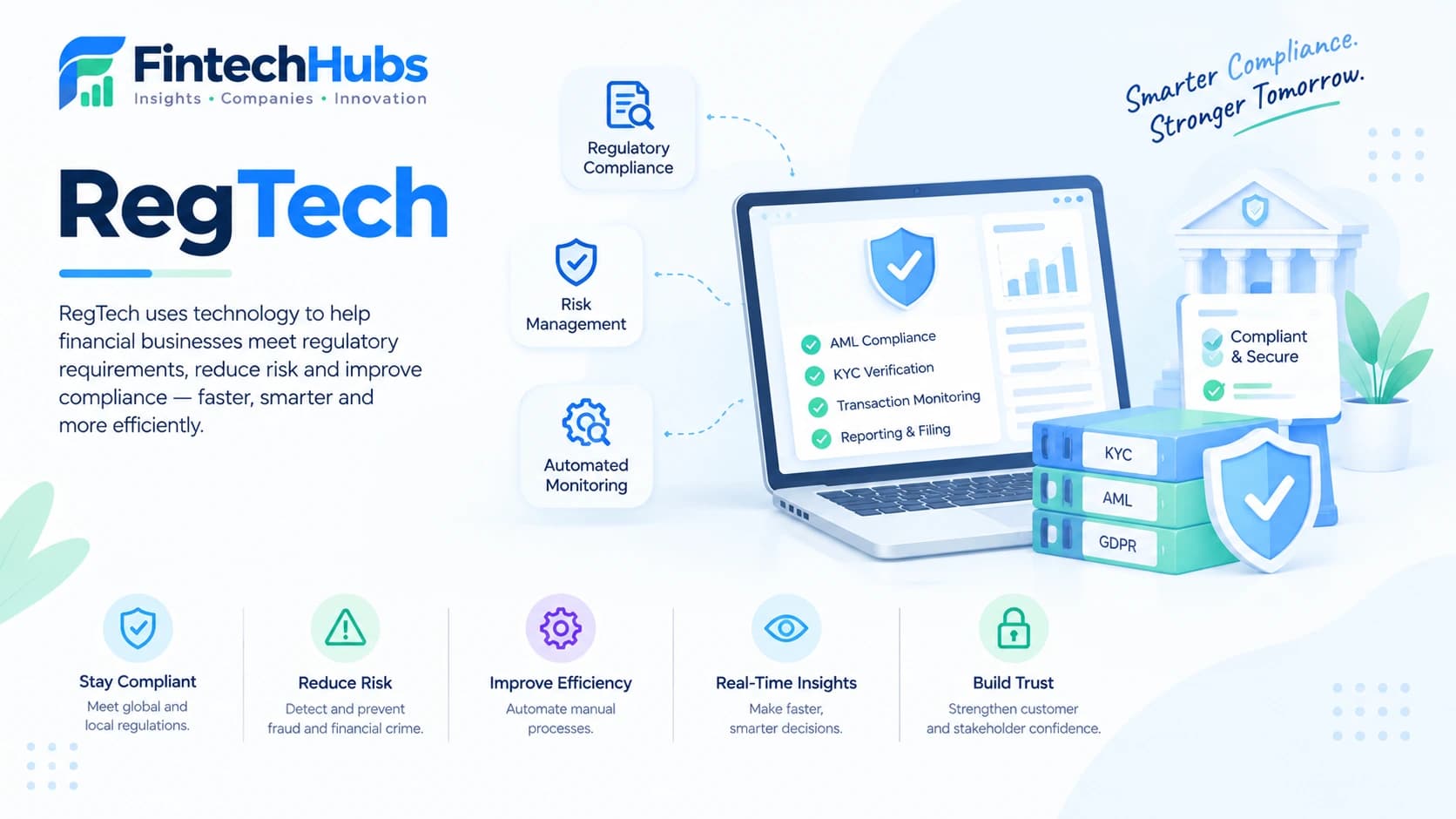
RegTech uses software, automation, and increasingly artificial intelligence to help financial institutions and other regulated businesses meet compliance obligations faster, more accurately, and at a fraction of the cost of manual processes. By 2026, it has grown from a back-office cost-saving tool into a strategic necessity, as regulatory complexity continues to rise across nearly every market in the world.
This guide covers what RegTech is, how it works, its major branches, why it matters, and where the space is heading next.
1. What Is RegTech, Exactly?
RegTech refers to technology specifically designed to help organizations primarily in financial services, but increasingly in other regulated industries manage regulatory compliance, risk, and reporting more efficiently. Rather than compliance teams manually reviewing transactions, cross-checking sanctions lists, or compiling reports by hand, RegTech platforms automate these processes using rules engines, data analytics, and machine learning.
RegTech sits at the intersection of three pressures:
Regulatory complexity is increasing: Financial regulation has grown more detailed and more frequently updated across nearly every jurisdiction.
Manual compliance doesn't scale: As transaction volumes and customer bases grow, manual review processes become slower, more expensive, and more error-prone.
The cost of non-compliance is severe: Regulatory fines, reputational damage, and loss of banking licenses make robust, reliable compliance a business necessity rather than a nice-to-have.
2. How RegTech Actually Works
Step 1: Data Ingestion
RegTech platforms pull in data from multiple sources customer records, transaction histories, communications, market data, and external watchlists often in real time.
Step 2: Automated Monitoring and Screening
Using rules-based logic and machine learning models, the system continuously screens this data against relevant regulatory requirements: checking transactions for suspicious patterns, screening customers against sanctions and politically-exposed-persons (PEP) lists, and flagging unusual behavior that might indicate fraud or money laundering.
Step 3: Risk Scoring and Prioritization
Rather than treating every flagged item equally, modern RegTech systems assign risk scores, helping compliance teams focus their limited attention on the cases most likely to represent genuine risk rather than drowning in false positives.
Step 4: Case Management and Investigation
When something is flagged, RegTech platforms typically provide investigation workflows pulling together relevant data, prior history, and context so a compliance analyst can make a decision quickly and document it properly.
Step 5: Reporting and Audit Trail
Finally, the system generates the reports required by regulators suspicious activity reports, regulatory filings, audit trails and maintains a documented history that demonstrates compliance during examinations or audits.
3. The Branches of RegTech
RegTech is a broad field covering many distinct compliance functions. Here are its major branches:
A. Anti-Money Laundering (AML) and Know Your Customer (KYC)
Tools that verify customer identity at onboarding, monitor transactions for money laundering patterns, and screen against global sanctions and watchlists. This is one of the largest and most mature branches of RegTech, given how central AML/KYC compliance is to nearly every regulated financial business.
B. Fraud Detection and Prevention
Systems that use behavioral analytics and machine learning to detect unusual account activity, payment fraud, account takeover attempts, and synthetic identity fraud in real time often distinguished from AML tools by their focus on protecting the institution and customer from direct financial loss rather than purely regulatory reporting.
C. Regulatory Reporting Automation
Platforms that automatically compile and submit the reports financial institutions are required to file with regulators covering everything from capital requirements to transaction reporting reducing manual effort and minimizing filing errors.
D. Transaction Monitoring
Real-time or near-real-time systems that scan payment and trading activity for patterns indicative of fraud, market manipulation, or other prohibited behavior, generating alerts for human review.
E. Risk Management and Stress Testing
Software that helps institutions model financial risk, run regulatory stress tests, and maintain the capital and liquidity buffers regulators require, replacing what used to be largely spreadsheet-driven processes.
F. Identity Verification
Digital identity tools that confirm a person is who they claim to be during onboarding, often using document verification, biometric checks, and liveness detection, reducing both fraud and friction compared to manual document review.
G. Regulatory Change Management
Tools that track regulatory updates across jurisdictions and automatically map how a new or changed rule affects an institution's existing policies and controls, helping compliance teams stay current without manually monitoring dozens of regulatory bodies.
H. Communications Surveillance
Systems used primarily by trading firms and investment banks to monitor employee communications (email, chat, voice) for signs of market abuse, insider trading, or other misconduct, often using natural language processing to flag risky language at scale.
I. ESG and Sustainability Reporting
An emerging branch helping institutions track, verify, and report on environmental, social, and governance metrics as sustainability-related disclosure requirements expand across more markets.
4. Why RegTech Matters
Cost Reduction
Manual compliance processes are labor-intensive and expensive. Automating routine monitoring, screening, and reporting significantly reduces the operational cost of staying compliant, particularly as transaction volumes grow.
Speed and Scalability
RegTech allows institutions to screen customers and monitor transactions in real time rather than in periodic batches, and to scale compliance operations alongside business growth without a proportional increase in headcount.
Accuracy and Reduced Human Error
Automated systems are far more consistent than manual review at catching patterns across large volumes of data, reducing the risk of a missed red flag that later becomes a regulatory or reputational problem.
Faster, Safer Customer Onboarding
Automated identity verification and KYC checks mean legitimate customers can open accounts in minutes rather than days, improving the customer experience while still meeting regulatory obligations.
Reduced Regulatory Risk
Regulatory fines for compliance failures can run into the hundreds of millions of dollars for large institutions, and reputational damage can be even more costly. RegTech reduces the likelihood of the gaps and oversights that lead to enforcement action.
Enabling Innovation Elsewhere
By automating compliance overhead, RegTech frees up financial institutions to move faster on new products and services, since compliance no longer has to be a slow, manual bottleneck for every new initiative.
Supporting Financial Inclusion
Faster, cheaper, more accurate identity verification and risk assessment tools make it more economically viable for institutions to serve lower-margin customer segments that manual compliance processes would make too costly to onboard.
5. Challenges and Criticisms
False positives: Even sophisticated systems can generate large volumes of false alerts, creating "alert fatigue" for compliance teams and potentially causing genuine risks to be overlooked amid the noise.
Data quality and integration: RegTech systems are only as good as the data feeding them; fragmented or inconsistent data across an institution's systems can undermine even well-designed tools.
Explainability of AI-driven decisions: As machine learning plays a larger role in flagging risk, regulators increasingly expect institutions to be able to explain why a system made a particular decision — a challenge for complex models that can behave like "black boxes."
Cross-border regulatory fragmentation: Institutions operating across multiple jurisdictions must often reconcile inconsistent or even conflicting regulatory requirements, complicating the design of a single unified compliance system.
Over-reliance on automation:Regulators and institutions alike caution against treating RegTech as a complete replacement for human judgment, particularly for complex or ambiguous cases that require contextual understanding.
Vendor and implementation risk: Integrating a new RegTech platform into legacy banking infrastructure can be technically complex and costly, and poor implementation can undermine the very compliance goals the tool was meant to serve.
6. The Competitive Landscape
The RegTech ecosystem includes several categories of players:
Specialized RegTech vendors: Focused on a single compliance function, such as sanctions screening or transaction monitoring
Full-suite compliance platforms:Offering integrated AML, KYC, fraud, and reporting capabilities in one system
Large enterprise software providers: That have added RegTech modules to broader financial infrastructure offerings
Identity verification specialists: Focused specifically on digital onboarding and biometric verification
Consulting and managed-service providers: That combine RegTech software with human expertise for institutions that want a more hands-off compliance function
Banks, payment companies, crypto exchanges, insurers, and increasingly non-financial businesses handling regulated data (such as healthcare and real estate) all represent active buyers in this market.
7. Where RegTech Is Headed
AI-driven compliance copilots: Generative AI is increasingly being used to help compliance analysts draft investigation summaries, interpret complex regulatory text, and explain flagged transactions in plain language, reducing the manual workload of case review.
Real-time, continuous compliance: The shift from periodic, batch-based compliance checks toward continuous, real-time monitoring is expected to accelerate, particularly as instant payments and real-time settlement become more widespread.
Greater regulatory collaboration: Regulators themselves are increasingly building "suptech" (supervisory technology) tools and working more closely with RegTech vendors to standardize reporting formats and reduce duplicate compliance effort across the industry.
Expansion beyond traditional finance: As data privacy, ESG disclosure, and AI governance regulations expand, RegTech principles and tools are increasingly being adapted for use in healthcare, real estate, and other heavily regulated industries beyond financial services.
Stronger focus on explainable AI: As regulators sharpen expectations around the transparency of automated decision-making, RegTech vendors are investing heavily in making their AI models more interpretable and auditable.
Consolidation of point solutions: Institutions increasingly prefer integrated platforms over managing dozens of separate compliance tools, driving consolidation among vendors and the growth of comprehensive, all-in-one RegTech suites.
Conclusion
RegTech has quietly become one of the most consequential branches of financial technology, transforming compliance from a slow, manual cost center into a fast, automated, and increasingly intelligent function. Its branches spanning AML and KYC, fraud detection, regulatory reporting, risk management, identity verification, and emerging areas like ESG reporting all serve the same underlying purpose: helping regulated institutions keep pace with an increasingly complex rulebook without sacrificing speed, accuracy, or customer experience. As AI capabilities mature and regulatory expectations around transparency grow, RegTech is set to keep expanding its role, not just as a cost-saving tool but as a strategic enabler of safer, faster, and more inclusive financial services.
Share this article