
OSINT Framework: Open Source Intelligence Guide
Explore the OSINT Framework to discover open source intelligence tools, data sources, investigation methods, and resources for effective online research.
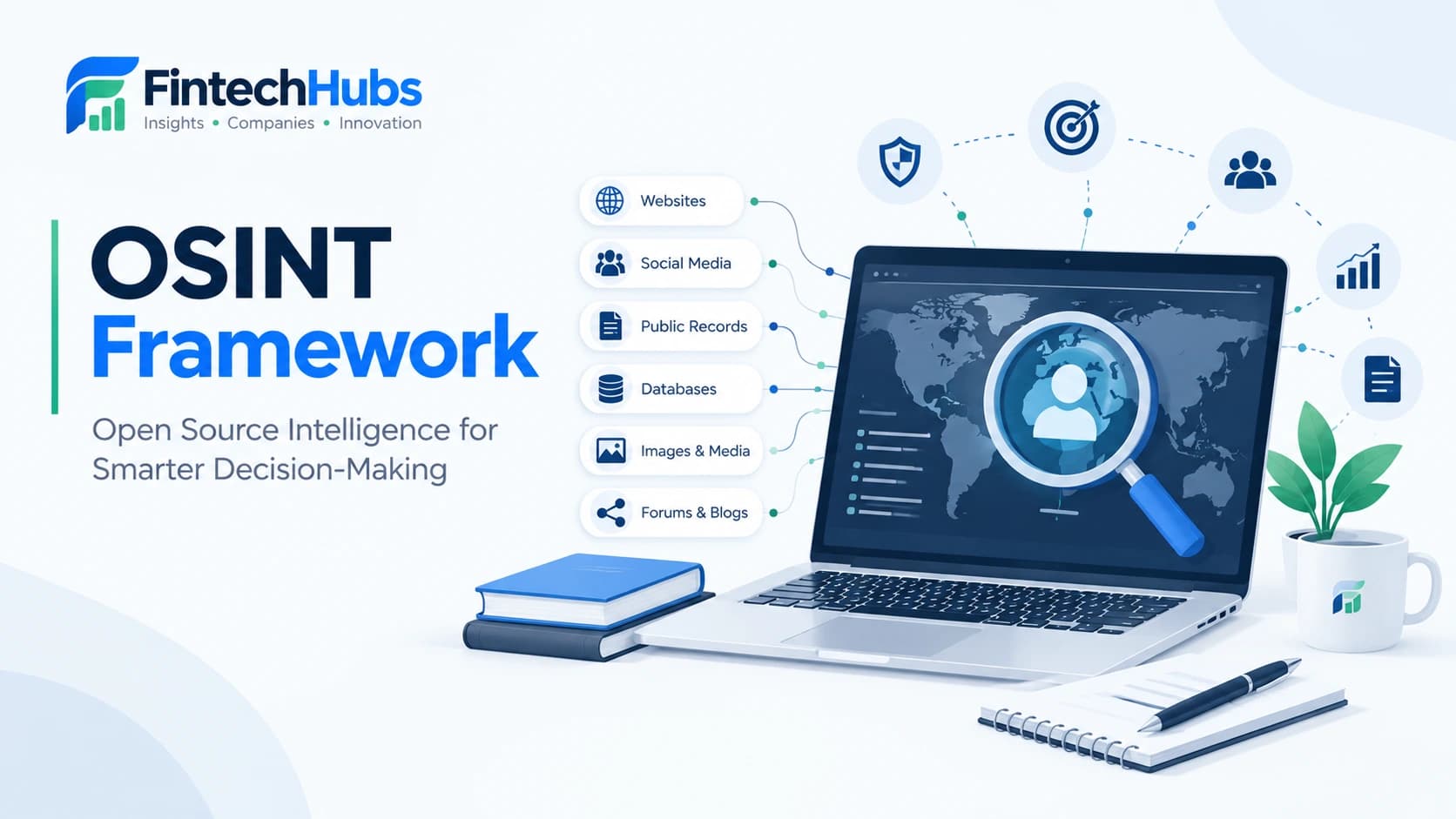
OSINT Framework: Tools, Techniques & Best Practices
Most of the information an investigator needs is already public. It sits in company registries, news archives, satellite imagery, social platforms, domain records, court filings, and the metadata of files people post online. The challenge is no longer access. It is knowing where to look, how to collect information efficiently, how to verify it, and how to do all of this lawfully and ethically.
Open-source intelligence (OSINT) is the discipline that addresses this challenge. This guide covers the OSINT framework: what it is, how the intelligence cycle applies, the main tools and techniques, how to verify findings, how to protect yourself, and how to stay within legal and ethical limits.
What Is OSINT?
Open-source intelligence is the collection, analysis, and use of publicly available information to answer a specific question or support a decision. The key word is intelligence. Raw information becomes intelligence only after it has been collected with purpose, evaluated for reliability, and analyzed in context.
OSINT is not hacking, and it does not involve breaking into systems, bypassing authentication, or deceiving people into disclosing private data. It relies on information that is lawfully accessible to the public, although "publicly accessible" does not always mean "free to use for any purpose" (see Section 11).
OSINT vs. other intelligence disciplines
Discipline | Source | Example |
|---|---|---|
OSINT | Publicly available information | News, social media, registries, satellite imagery |
HUMINT | Human sources | Interviews, informants |
SIGINT | Signals and communications | Intercepted communications |
IMINT / GEOINT | Imagery and geospatial data | Aerial and satellite analysis |
TECHINT | Technical systems | Equipment and technology analysis |
In practice these disciplines complement each other, and OSINT is often the starting point that directs further work.
What Is an "OSINT Framework"?
The term is used in two related ways, and it helps to separate them.
The OSINT Framework directory: A well-known, free web-based directory that organizes links to OSINT tools and resources by category, such as usernames, email addresses, domains, social networks, and geolocation. It works like a map of where tools live, not a tool itself.
An OSINT framework as a methodology: A structured, repeatable approach covering planning, collection, processing, analysis, verification, and reporting, along with the legal, ethical, and security guardrails around it.
This article focuses mainly on the second meaning, because tools change constantly but a sound methodology lasts. A good framework keeps investigators from collecting data aimlessly and helps ensure that results are defensible.
Why OSINT Matters
Speed and cost: Open sources can answer many questions in hours that would otherwise take weeks.
Early warning: Public signals often appear before formal reports or official action.
Scale. Digital life generates a large volume of searchable information.
Corroboration: OSINT can confirm or challenge information from other sources.
Transparency: Findings built on public sources can be reproduced and checked by others.
Accessibility: Journalists, researchers, and small organizations can do work once limited to large agencies.
Who Uses OSINT?
User group | Typical applications |
|---|---|
Cybersecurity teams | Attack surface mapping, threat intelligence, phishing and brand-abuse monitoring, exposure assessment |
Compliance and due diligence teams | Customer and third-party checks, adverse media, beneficial ownership research |
Fraud and financial crime investigators | Tracing entities, identifying scam infrastructure, linking networks |
Journalists and fact-checkers | Verifying images, videos, and claims; investigative reporting |
Human rights and conflict researchers | Documenting events through open evidence |
Law enforcement and government | Investigations, situational awareness, public safety |
Corporate security and risk teams | Executive protection, event risk, supply chain monitoring |
Penetration testers and red teams | Authorized reconnaissance within agreed scope |
Academics and independent researchers | Studies using public data |
Recruiters and HR | Limited, lawful background checks where permitted |
The OSINT Intelligence Cycle
A structured workflow keeps work focused and defensible. The widely used intelligence cycle can be adapted to OSINT as follows.
Stage 1: Planning and direction
Define the question before opening a single tool. A clear objective, scope, deadline, and set of constraints prevents wasted effort. Ask:
What exactly do we need to know, and why?
What decision will this support?
What is in scope and out of scope?
What legal or ethical limits apply?
Stage 2: Collection
Gather relevant information from identified sources, using a mix of passive and active methods (see Section 6). Record the source, the date and time of access, and the method for every item.
Stage 3: Processing
Convert raw material into a usable form: translate foreign-language content, extract text from images, remove duplicates, normalize names and dates, and organize files.
Stage 4: Analysis
Turn data into insight by identifying patterns, connections, timelines, and gaps. Test competing hypotheses, assess confidence, and separate fact from inference.
Stage 5: Verification and validation
Check reliability before drawing conclusions (see Section 9). This is the stage that most separates professional work from casual searching.
Stage 6: Reporting and dissemination
Present findings clearly to the intended audience, with sources, confidence levels, and limitations stated.
Stage 7: Feedback and review
Assess whether the product answered the question and refine the approach. Retain only what is needed and dispose of the rest in line with policy.
Collection Methods: Passive vs. Active
Approach | Description | Considerations |
|---|---|---|
Passive | Gathering information without interacting with the target or leaving a trace on target-controlled systems (reading articles, searching archives, viewing public records) | Lower risk of detection and lower legal risk |
Semi-passive | Light interaction that looks like normal traffic (visiting a public website, running standard queries) | Generally low risk, but may appear in server logs |
Active | Direct interaction with the target or its systems (scanning, sending requests, engaging with accounts) | Higher risk of detection and potentially legal issues. In security work, requires explicit authorization |
A sound rule is to use the least intrusive method that answers the question.
Core OSINT Sources
Search engines and the open web
General and specialized search engines remain the foundation. Skilled use of operators (quotation marks, site restrictions, file-type filters, date ranges, and exclusions) greatly improves precision. Use several engines, since each indexes and ranks differently.
Social media and online communities
Platforms, forums, and messaging communities reveal affiliations, activity patterns, locations, and public statements. Platform rules, privacy settings, and terms of service vary and change often.
News and media archives
Local, regional, and trade outlets often report events that never reach international media. Archives show how a story developed and what was later changed or removed.
Public records and registries
Company registries and filings
Court and litigation records (where public)
Property and land records
Licensing and regulatory registers
Trademark and patent databases
Procurement and tender notices
Sanctions and enforcement publications
Domain, network, and internet infrastructure data
WHOIS and domain registration records
DNS records and passive DNS history
TLS/SSL certificate transparency logs
Internet-wide device and service search engines
IP and autonomous system information
Imagery, video, and geospatial data
Satellite and aerial imagery, street-level imagery, maps, and user-generated photos and videos support location and event verification.
Documents and metadata
Files such as PDFs, spreadsheets, and images can carry metadata, including author names, software versions, timestamps, and sometimes location data. Many platforms strip this on upload, but not all do.
Academic, scientific, and technical literature
Papers, conference proceedings, and technical reports are valuable for subject-matter research and for understanding specialized domains.
Transport and movement data
Public flight, vessel, and rail tracking data can support logistics and event research.
Leaked and breached data
Publicly circulating breach data raises serious legal and ethical questions. Many organizations restrict or prohibit its use, and legal rules vary by jurisdiction. Seek legal advice and follow internal policy before using it.
Key OSINT Techniques
Advanced search operators ("dorking")
Using search operators to narrow results to specific sites, file types, phrases, or time periods. This is a basic skill and also a reason organizations should check what their own staff and systems expose.
Username and identity correlation
People often reuse usernames, avatars, or biographical details across platforms. Careful correlation can link accounts, but it is also a common source of false matches. Confirm with multiple independent signals.
Email and phone intelligence
Checking whether an address or number is associated with public profiles or services. Handle with care for privacy, and avoid contacting or alerting the subject unless that is part of an authorized process.
Image analysis and reverse image search
Searching for earlier appearances of an image helps detect recycled, staged, or misattributed visuals. Analysts also examine shadows, signage, architecture, vegetation, vehicles, and landmarks for contextual clues.
Geolocation and chronolocation
Determining where and when an image or video was captured by comparing visible features with maps, satellite imagery, and street-level imagery, and by analyzing sun angle, weather, and other temporal clues.
Metadata analysis
Examining file properties for information about origin, authorship, device, and edit history.
Social network and relationship analysis
Mapping connections among people, organizations, and events to identify clusters, intermediaries, and unexpected links.
Corporate and ownership research
Tracing directors, shareholders, registered addresses, and related entities. Layered structures and offshore arrangements often require combining several sources.
Infrastructure and attack surface mapping
Identifying an organization's domains, subdomains, exposed services, and technology stack from public data, typically as part of authorized security assessments.
Archive and historical research
Using web archives and cached pages to recover deleted or edited content and to establish what was published and when.
Timeline construction
Ordering events chronologically to expose inconsistencies, gaps, and causal relationships.
Language and translation techniques
Searching in native languages and scripts, handling transliteration variants, and recognizing local naming conventions. This often reveals material that English-only searches miss.
Verification: Separating Signal from Noise
The open web contains errors, rumors, manipulated media, and deliberate disinformation. Verification is not optional.
Evaluate the source
Who published it, and what is their track record?
Is this the original source or a repost?
What is their possible motive or bias?
Can the claim be corroborated elsewhere?
Evaluate the information
Is it consistent with other evidence?
Is it specific and checkable, or vague?
Does the date, location, and context hold up?
Use a structured grading scheme
Many professional teams grade source reliability and information credibility separately, using a scale such as the NATO/Admiralty system (reliability rated A to F and credibility rated 1 to 6). This prevents a trusted source from lending unearned credibility to a weak claim, and the reverse.
Corroborate with independent sources
Several articles that all trace back to a single original report are one source, not many. Look for genuinely independent confirmation.
Guard against manipulation
Recycled content: old images presented as new.
Edited or synthetic media: altered or AI-generated images, audio, and video.
Fake personas and coordinated accounts: networks designed to look organic.
Planted or seeded information: content created to mislead investigators.
Acknowledge uncertainty
State confidence honestly. Phrases such as "assessed with moderate confidence" are more credible than overstatement.
OSINT Tools by Category
Tools change quickly, and availability, pricing, and terms vary. Verify current features and licensing before relying on any of them. The list below is illustrative, not an endorsement.
Category | Purpose | Examples |
|---|---|---|
Tool directories and learning hubs | Discover tools and methods | OSINT Framework directory, Bellingcat's online investigation toolkit |
Search and archive | Advanced search, historical content | Major search engines, Internet Archive's Wayback Machine, archive.today |
Domain and network intelligence | DNS, WHOIS, certificates, infrastructure | WHOIS lookups, DNS history services, certificate transparency search, Shodan, Censys |
Reconnaissance frameworks | Automating collection from many sources | theHarvester, Recon-ng, SpiderFoot, Amass |
Link and relationship analysis | Visualizing connections | Maltego, open-source graph tools |
Image and video verification | Reverse search, forensics | Google Lens, TinEye, Yandex image search, InVID-WeVerify |
Geolocation and mapping | Place and time verification | Google Earth, Sentinel Hub, OpenStreetMap, SunCalc |
Metadata extraction | File and image properties | ExifTool |
Username and account research | Cross-platform presence | Sherlock, WhatsMyName |
Corporate and public records | Ownership, filings | National company registries, OpenCorporates, OCCRP Aleph |
Transport tracking | Flights, vessels | Public flight and vessel tracking platforms |
Case management and capture | Evidence preservation, notes | Hunchly, Obsidian, structured note tools |
Social media monitoring | Alerts and listening | Platform-native search, commercial monitoring suites |
Open-source vs. commercial tools
Open-source / free | Commercial | |
|---|---|---|
Cost | Low or none | Subscription or license fees |
Flexibility | High, customizable | Often more limited |
Support | Community | Vendor support and SLAs |
Data coverage | Varies | Often broader, curated, multilingual |
Audit trail | May need manual setup | Usually built in |
Best for | Individuals, research, small teams | Enterprise, regulated, high-volume work |
Most mature teams use a mix, and they should always be able to explain how a tool produced a result.
Legal and Ethical Considerations
OSINT is lawful in principle, but how it is practiced can cross legal and ethical lines. Obligations differ by country and context, so consult qualified legal counsel.
Legal considerations
Data protection and privacy law. Regimes such as the GDPR regulate the collection and use of personal data, even if it is publicly available. Lawful basis, purpose limitation, minimization, retention limits, and individual rights may apply.
Computer misuse laws. Accessing systems without authorization, even through weak security, may be unlawful. Active scanning and probing should only be done with explicit permission.
Terms of service: Scraping or automated collection can breach platform rules and, in some places, create legal exposure.
Intellectual property: Public availability does not equal permission to republish.
Defamation and accuracy: Publishing unverified claims about real people can cause harm and liability.
Evidence handling: If findings may be used in legal or regulatory proceedings, collection and preservation methods matter.
Sector rules: Employment, credit, and consumer reporting rules may restrict how certain information can be used in decisions.
Ethical principles
Proportionality: Collect only what the objective requires.
Purpose: Use information only for its stated, legitimate purpose.
Minimize harm: Consider the effect on individuals, including third parties who appear incidentally.
No deception where unlawful or inappropriate: Be cautious about impersonation or manipulating people.
Respect for vulnerable people: Take extra care with minors and people at risk.
Accuracy and fairness: Do not present speculation as fact.
Transparency within the organization: Keep records and be able to justify decisions.
Responsible disclosure: If you find exposed sensitive data or vulnerabilities, report them through proper channels instead of exploiting or publicizing them.
Useful reference points include professional codes of conduct in journalism, investigations, and security, and the Berkeley Protocol on Digital Open Source Investigations for work that may support legal accountability.
Operational Security (OPSEC) for Investigators
Investigators can expose themselves, their organization, or their investigation. Sensible precautions include:
Separate research environments: Use dedicated browsers, profiles, or virtual machines, kept apart from personal and work accounts.
Control your digital footprint: Be aware of what your IP address, browser fingerprint, and account activity reveal. Avoid logging into personal accounts during investigations.
Use network privacy tools appropriately: VPNs and similar tools can reduce exposure but do not provide anonymity, and some platforms restrict them.
Consider notification risks: Some platforms show viewers to account owners. Understand what the target can see.
Handle accounts and personas carefully: Where an organization permits research accounts, they must comply with platform rules, legal advice, and internal policy, and must not be used to deceive in harmful or unlawful ways.
Be wary of malicious content: Links, files, and websites may be traps. Open untrusted material in isolated environments.
Secure your findings: Encrypt storage, restrict access, and log who handles sensitive material.
Protect personal safety: Investigators working on sensitive subjects should consider threats such as harassment and doxxing.
Documentation and Evidence Preservation
Good documentation makes findings reproducible and credible.
Record URL, date, time (with time zone), tool used, and search terms for every item.
Capture full-page screenshots and archived copies, since content can disappear.
Keep original files and hashes where integrity matters.
Maintain a chain of custody log if the material may be used formally.
Separate facts, assessments, and assumptions in notes.
Use a consistent naming and folder structure.
Store sources so that another analyst can retrace your steps.
Best Practices
Start with a clear question: Objectives drive efficient collection.
Plan before you search: Define scope, constraints, and success criteria.
Use the least intrusive method: Prefer passive collection.
Work from multiple, independent sources: Avoid single-source conclusions.
Verify before you conclude: Treat everything as unconfirmed until checked.
Document as you go: Do not rely on memory or on content staying online.
Search in multiple languages and regions: Local sources are often richer.
Challenge your own assumptions: Actively look for evidence that contradicts your hypothesis.
Watch for bias: Confirmation bias and anchoring distort analysis.
Handle personal data responsibly: Minimize, secure, and delete in line with policy.
Stay within authorization and law: Scope and permission matter, especially for active techniques.
Communicate confidence and limits: Be explicit about what is known and unknown.
Keep skills current: Platforms, tools, and manipulation techniques evolve rapidly.
Peer review important findings: A second analyst catches errors.
Build repeatable workflows: Checklists and templates improve consistency.
Common Mistakes to Avoid
Mistake | Consequence | Fix |
|---|---|---|
Collecting without a defined objective | Wasted time, irrelevant data | Write the question first |
Trusting the first result | Errors and manipulation | Corroborate independently |
Misidentifying people | Harm to innocent individuals | Require multiple matching identifiers |
Treating absence of evidence as evidence of absence | False reassurance | State search limits |
Poor note-taking | Unreproducible findings | Document continuously |
Ignoring metadata and context loss | Misread material | Check the original source |
Neglecting OPSEC | Exposure of investigator or case | Use isolated environments |
Overreliance on one tool | Blind spots | Cross-check across tools |
Confusing correlation with causation | Wrong conclusions | Test alternative explanations |
Crossing legal lines | Legal and reputational risk | Get legal guidance and authorization |
Illustrative Scenario
This is a hypothetical example for illustration only.
A security team is asked to assess how exposed a mid-sized company is to phishing and impersonation. Using passive OSINT, the analyst:
Plans: Confirms written authorization and scope with the client.
Maps domains: Reviews registration records and certificate transparency logs to list the company's official domains and spot look-alike registrations.
Checks public footprints: Reviews staff roles visible on professional networks and published documents, noting what information could help an attacker craft convincing messages.
Examines documents: Finds a public PDF whose metadata reveals internal usernames and software versions.
Reviews exposure: Identifies a forgotten subdomain that still resolves publicly.
Verifies and grades: Confirms each finding through at least two methods and rates confidence.
Reports: Delivers prioritized findings with evidence, risk ratings, and recommendations, such as removing metadata, retiring the subdomain, registering defensive domains, and training staff.
The work stayed passive, authorized, documented, and focused on reducing risk.
Building an OSINT Capability in an Organization
Define use cases and risk tolerance: Decide where OSINT creates value and where it should not be used.
Set policy and governance: Cover legal basis, data handling, retention, personas, and approval paths.
Select tools and data sources: Combine free and commercial options based on need.
Standardize workflows: Create templates for requests, collection logs, reports, and review.
Train analysts: Cover methodology, verification, OPSEC, law, and ethics.
Create secure infrastructure: Provide isolated environments and secure storage.
Implement quality control: Use peer review and source-grading standards.
Measure results: Track turnaround time, accuracy, and decisions supported.
Review and improve: Update processes as tools and threats change.
Challenges in Modern OSINT
Information overload: Vast volume makes triage essential.
Platform restrictions: Reduced API access and tighter controls limit collection.
Ephemeral and private content: Disappearing posts and closed groups reduce visibility.
Synthetic media and disinformation: AI-generated content complicates verification.
Privacy regulation: Stricter data protection rules affect what can be collected and retained.
Attribution difficulty: Anonymity tools and fake personas hinder identification.
Skills and training gaps: A good OSINT needs both technical and analytical ability.
Bias and over-interpretation: Online data is not a representative picture of reality.
Future Trends
AI-assisted analysis for translation, summarization, entity extraction, and image analysis, with human validation.
Stronger synthetic media detection and provenance standards for authentic content.
Automation and continuous monitoring replacing one-off searches.
Greater emphasis on ethics, governance, and legal defensibility.
Integration of OSINT with threat intelligence, compliance, and risk platforms.
Growth in geospatial and commercial satellite data accessibility.
Increased professionalization through training, standards, and certification.
Frequently Asked Questions (FAQs)
1. What does OSINT stand for?
Open-source intelligence. It means collecting and analyzing publicly available information to answer specific questions or support decisions.
2. What is the OSINT Framework?
The term can mean the free online directory that organizes links to OSINT tools by category, or a structured methodology for planning, collecting, verifying, analyzing, and reporting open-source information. This article covers both, with emphasis on methodology.
3. Is OSINT legal?
Using genuinely public sources is generally lawful, but legality depends on jurisdiction, method, and purpose. Data protection law, computer misuse law, platform terms, and intellectual property rules can all apply. Get legal advice for your situation.
4. Is OSINT the same as hacking?
No. OSINT uses information that is publicly accessible and does not involve breaking into systems or bypassing access controls. Active probing of systems without permission can be illegal.
5. What are the main stages of an OSINT investigation?
Planning, collection, processing, analysis, verification, reporting, and review. Starting with a clear question and ending with documented, verified findings is what separates structured OSINT from casual searching.
6. What are the best OSINT tools for beginners?
Start with advanced search operators, the Internet Archive, reverse image search, public company registries, mapping tools, and the OSINT Framework directory. Learn the method first, then add specialized tools as needs arise.
7. How do I verify information found through OSINT?
Check the original source, assess its reliability, corroborate with independent sources, examine date, location, and context, and use a structured grading approach. Be especially careful with images, video, and social media accounts.
8. Can OSINT be used for cybersecurity?
Yes. Security teams use it for attack surface mapping, threat intelligence, brand protection, and exposure assessment. Active techniques must only be used with explicit authorization.
9. How can I protect myself while conducting OSINT?
Use separate research environments, limit your digital footprint, keep personal and investigative accounts apart, treat untrusted files and links with caution, and store findings securely. Follow your organization's policy.
10. What skills do OSINT analysts need?
Critical thinking, structured research methods, source evaluation, attention to detail, language and cultural awareness, technical understanding, clear writing, and a strong grasp of legal and ethical limits. Tool knowledge matters less than analytical discipline.
Conclusion
OSINT's value lies not in the number of tools an investigator knows but in the quality of the process behind the work. A good framework begins with a clear question, relies on lawful and proportionate collection, verifies rigorously, protects both the investigator and the people being researched, and communicates findings honestly, including their limits.
As data volumes grow, platforms change, and synthetic media becomes more convincing, the need for disciplined methodology will only increase. Practitioners and organizations that combine strong technique with sound ethics and good documentation will produce intelligence that is not only fast and insightful but also reliable and defensible.
Disclaimer: This article is provided for general informational purposes only and does not constitute legal, security, or professional advice. Laws, platform terms, and tool features vary and change over time. Always confirm legal requirements and obtain proper authorization before conducting investigations.
OSINT Framework: Tools, Techniques & Best Practices
Share this article
Related Articles
Top 20 RegTech Companies in the USA in 2026
Explore the top 20 RegTech companies in the USA in 2026, featuring leading firms in compliance, risk management, fraud prevention, and regulatory technology.

Top 20 Fintech Companies in the USA in 2026
Discover the top 20 fintech companies in the USA in 2026, including leading innovators in payments, digital banking, lending, wealthtech, and financial technology.
Sanctions Screening: Compliance & Risk Management Guide
Learn how sanctions screening helps businesses detect restricted entities, reduce financial crime risks, and maintain regulatory compliance.