
Sanctions Screening: Compliance & Risk Management Guide
Learn how sanctions screening helps businesses detect restricted entities, reduce financial crime risks, and maintain regulatory compliance.
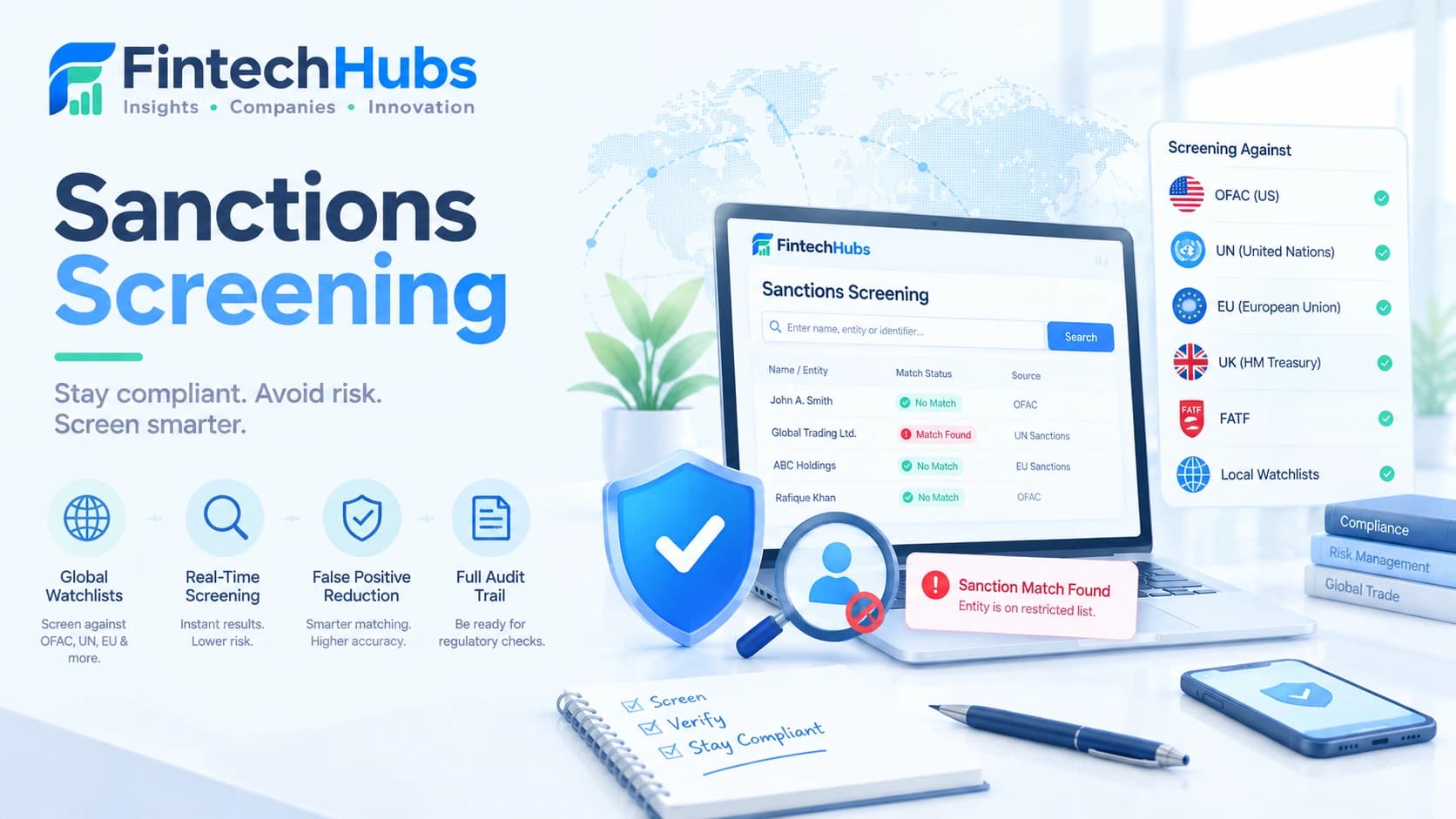
Sanctions Screening: Benefits, Challenges, and Best Practices
A single overlooked name on a payment instruction can expose a financial institution to regulatory penalties running into the hundreds of millions of dollars, alongside lasting reputational damage that can take years to repair. Sanctions screening exists specifically to prevent that outcome, acting as the checkpoint that stops a business from knowingly or unknowingly transacting with individuals, organizations, or countries that governments have specifically prohibited from accessing the financial system.
In 2026, sanctions screening has entered what many compliance professionals describe as a decisive phase, shaped by rising geopolitical volatility, rapidly expanding watchlists, and a clear regulatory shift away from simply proving a screening process exists toward demonstrating that it is genuinely effective. This guide explains what sanctions screening actually involves, the real benefits it delivers, the persistent challenges compliance teams face in practice, and the best practices that separate a genuinely effective program from one that exists only on paper.
What Is Sanctions Screening
Sanctions screening is the process of checking customers, counterparties, and transactions against official government and international sanctions lists to identify any match with a sanctioned individual, entity, vessel, or country. These lists are maintained by bodies such as the United States Office of Foreign Assets Control, the United Nations, the European Union, and national authorities in countries around the world, each identifying parties that are legally prohibited, or subject to significant restrictions, from engaging in financial transactions.
Sanctions screening typically operates alongside broader financial crime compliance functions, including know your customer processes and anti-money laundering transaction monitoring, though it serves a distinct and specific purpose. While anti-money laundering monitoring looks for patterns suggestive of disguising illegally obtained money, sanctions screening looks specifically for any connection, however indirect, to a party that has been formally designated as prohibited by a relevant government authority. A single confirmed sanctions match carries immediate legal significance in a way that a suspicious transaction pattern alone does not, since knowingly or negligently transacting with a sanctioned party can itself constitute a direct legal violation.
Why Sanctions Screening Matters: Key Benefits
Sanctions screening delivers value that extends well beyond simply satisfying a regulatory checkbox.
It prevents severe legal and financial penalties: Regulators have consistently demonstrated a willingness to impose extremely large fines on institutions found to have facilitated transactions involving sanctioned parties, making an effective screening program one of the most direct forms of financial risk protection a regulated business can maintain.
It protects institutional reputation: Being publicly associated with sanctions violations can cause lasting damage to a business's relationships with customers, correspondent banks, and investors, often creating consequences that extend well beyond the direct financial penalty itself.
It supports the broader goals of international sanctions regimes: Sanctions are typically imposed to apply economic pressure in response to serious concerns such as human rights abuses, weapons proliferation, or acts of aggression. Effective screening by financial institutions and businesses around the world is what gives these government imposed sanctions their practical, real world effect.
It enables safer cross border business: A business with a strong, demonstrable sanctions screening program can engage more confidently in international trade and finance, since it has meaningfully reduced the risk of inadvertently becoming entangled with a prohibited party operating across a different jurisdiction.
It builds trust with correspondent banks and business partners: Financial institutions and businesses increasingly evaluate their counterparties based partly on the strength of their compliance programs, and a credible sanctions screening function can directly support broader business relationships rather than functioning purely as an internal cost center.
It is increasingly recognized as a genuine driver of operational efficiency when modernized properly: Organizations that have adopted more sophisticated, AI assisted screening approaches report meaningfully faster investigation times and a reduced burden from false positives compared to those still relying entirely on older, more rigid screening methods, showing that an effective program can reduce cost and friction rather than only adding to it.
Types of Sanctions Lists and Designations
Sanctions screening programs typically need to account for several distinct categories of lists and designations, each maintained by a different authority.
The United States Office of Foreign Assets Control: Maintains several key lists, most notably the Specially Designated Nationals list, which identifies individuals and entities whose assets are blocked and with whom United States persons are generally prohibited from dealing, alongside sectoral sanctions lists that impose narrower restrictions on specific types of transactions with certain Russian and other designated entities.
United Nations sanctions: Are adopted through Security Council resolutions and apply across all member states, typically targeting specific individuals and entities connected to concerns such as terrorism, weapons proliferation, or particular conflict situations.
European Union sanctions: Apply across member states and include both individual and entity designations as well as broader sectoral and country specific restrictions, often closely coordinated with, but not always identical to, equivalent measures adopted elsewhere.
c: Including bodies such as the United Kingdom's Office of Financial Sanctions Implementation, maintain their own country specific lists and requirements, which may overlap substantially with international lists while still containing meaningful differences in scope and specific designations.
Politically exposed persons lists: While technically distinct from formal sanctions lists, are frequently screened alongside sanctions data given the elevated money laundering and corruption risk associated with current and former government officials, their family members, and close associates.
Adverse media screening: Checks for negative news coverage connecting a customer or counterparty to financial crime, corruption, or other serious concerns, complementing formal list based adverse media screening with a broader view of reputational and legal risk.
Types of Sanctions Screening
Sanctions screening is applied at several distinct points within a business relationship, each serving a specific purpose.
Customer and Onboarding Screening
Customer screening checks a new customer's identity against relevant sanctions and watchlists before an account or relationship is established, serving as the first and most fundamental checkpoint in preventing a sanctioned party from gaining access to a financial institution's services in the first place.
Ongoing and Continuous Screening
Ongoing screening re-checks existing customers against sanctions lists on a regular basis, or in increasingly common real time or near real time configurations, since a customer who was not sanctioned at the time of onboarding can become newly designated at any later point as governments update their lists in response to changing circumstances.
Transaction and Payment Screening
Transaction screening checks the specific parties involved in a payment or transaction, including senders, recipients, and any intermediary parties, against sanctions lists at the moment the transaction is processed, serving as a critical real time control given how quickly funds can move once a payment is initiated.
Trade Document Screening
Trade finance transactions involve checking a wide range of supporting documentation, including bills of lading, invoices, and vessel information, against sanctions lists, since international trade transactions often involve multiple parties and jurisdictions where sanctions exposure can be embedded in less obvious places than a simple payment instruction.
Beneficial Ownership Screening
Beneficial ownership screening looks beyond the immediately visible parties to a transaction to identify the actual individuals who ultimately own or control a business entity, addressing a particularly difficult and increasingly significant challenge, since sanctioned parties frequently attempt to obscure their involvement behind layers of corporate ownership structures specifically to evade straightforward name based screening.
How Sanctions Screening Works
A typical sanctions screening process follows a consistent sequence of steps, regardless of the specific point in the customer relationship at which it is applied.
Data collection: Gathers the relevant names and identifying details of the customer, counterparty, or transaction parties that need to be screened.
List matching: Compares the collected data against current sanctions, watchlist, and politically exposed persons data, using name matching algorithms designed to catch not just exact matches but also close variations, transliterations, and deliberate misspellings.
Fuzzy matching and scoring: Applies more sophisticated matching logic capable of identifying a potential match even when names are spelled differently, written in a different alphabet, or only partially similar to a designated name, assigning a confidence score to each potential match.
Alert generation: Flags any match that exceeds a defined confidence threshold for human review, rather than automatically blocking a transaction or relationship outright based on a preliminary system generated match alone.
Investigation and disposition: Involves a compliance analyst reviewing the flagged match in detail, considering additional identifying information to determine whether it represents a genuine match to a sanctioned party or a false positive involving an unrelated individual who happens to share a similar name.
Escalation and reporting: Ensures that any confirmed sanctions match is handled according to legal requirements, which may include blocking the transaction, freezing relevant assets, and filing a required report with the appropriate government authority.
Core Challenges in Sanctions Screening
Sanctions screening has become significantly more demanding in recent years, and compliance teams consistently point to several specific, persistent challenges.
False positives remain the single biggest operational burden: A large share of compliance professionals report that managing a high volume of false positive alerts, where a legitimate customer is incorrectly flagged due to a name similarity with a sanctioned party, continues to drive backlogs, consume significant analyst time, and contribute directly to compliance team burnout.
Beneficial ownership complexity continues to grow: Identifying the true individuals who ultimately control a complex corporate structure, particularly one deliberately designed to obscure ownership, remains one of the most persistently difficult aspects of effective sanctions screening.
Cross regime compliance creates significant difficulty: A large majority of compliance professionals describe aligning screening practices across multiple, sometimes inconsistent sanctions regimes, such as reconciling United States, European Union, and United Kingdom requirements simultaneously, as a meaningfully or very challenging part of their work.
Sanctions lists change constantly and without warning: Geopolitical events can trigger new designations with little or no advance notice, requiring screening systems and processes capable of incorporating list updates quickly to avoid a dangerous gap between a new designation and an institution's own screening data.
Data quality issues undermine even sophisticated screening technology: Incomplete, inconsistent, or poorly structured customer and transaction data will inevitably reduce the effectiveness of even the most advanced name matching technology, regardless of how well that technology performs in ideal conditions.
Evasion tactics continue to grow more sophisticated: Sanctioned parties increasingly use deliberate name variations, intermediary entities, and complex ownership structures specifically designed to avoid detection by standard screening approaches, requiring compliance programs to continuously adapt in response.
Budgets remain flat even as expectations continue to rise: Many compliance teams report being expected to improve screening quality and speed without a corresponding increase in resources, forcing a much stronger emphasis on smarter optimization of existing programs rather than simply expanding headcount or spending.
Crypto and digital asset exposure introduces newer, less mature screening challenges: The pseudonymous and cross border nature of blockchain based transactions creates distinct sanctions screening difficulties that traditional, name based screening approaches were not originally designed to address.
Technology Powering Modern Sanctions Screening
Several key technologies are directly reshaping how sanctions screening is conducted.
Fuzzy name matching algorithms: Represent one of the most important recent improvements in the field, using sophisticated linguistic and statistical techniques to identify potential matches despite spelling variations, transliteration differences, and deliberate attempts to disguise a designated name.
Artificial intelligence and machine learning: Are being adopted rapidly across the industry, with a significant and growing share of compliance teams already using these tools directly within their screening programs, and a substantial additional share planning to adopt them within the near future, specifically to improve match accuracy and reduce false positive volume.
Network and beneficial ownership analysis: Uses advanced data analysis to map relationships between entities and individuals, helping uncover sanctions exposure hidden behind layered corporate ownership structures that simple, surface level name screening would likely miss entirely.
Agentic and explainable AI: Represents an emerging and increasingly significant shift in the field, moving screening from static, isolated name matching toward a more intelligence led investigative approach, while maintaining clear human oversight and documented reasoning behind each decision, directly addressing growing regulatory expectations for demonstrable, explainable program effectiveness rather than simple technical compliance.
Real time screening infrastructure: Allows institutions to screen transactions and payments at the moment they occur, rather than relying solely on slower batch processes that could allow a prohibited transaction to complete before being identified.
Regulatory Expectations and Enforcement
Regulatory expectations for sanctions screening continue to intensify and, increasingly, converge across different jurisdictions. Authorities such as the United States Office of Foreign Assets Control and the United Kingdom's Financial Conduct Authority increasingly emphasize a consistent set of core expectations, including clear senior management accountability for the sanctions program, genuinely risk based controls tailored to an institution's specific exposure, effective and well documented screening and alert investigation processes, regular testing and independent assurance, comprehensive staff training, and thorough, defensible governance documentation. Regulators have moved decisively away from accepting a program's mere existence as sufficient, instead expecting institutions to demonstrate, often through detailed documentation and testing records, that their screening program is genuinely effective at identifying real sanctions risk rather than simply generating activity that looks compliant on the surface.
Best Practices for Effective Sanctions Screening
Organizations that run genuinely effective sanctions screening programs tend to follow a consistent set of practices.
Adopt a risk based approach: Apply more intensive screening scrutiny to higher risk customers, transactions, and geographies, rather than treating every relationship with identical screening intensity regardless of its actual underlying risk profile.
Combine fuzzy matching with careful threshold tuning: Use sophisticated matching technology to catch genuine variations and disguised names, while carefully calibrating match thresholds to avoid generating an unmanageable volume of false positives that ultimately undermine investigator effectiveness.
Invest in data quality as a foundation: Recognize that even the most advanced screening technology will underperform if built on incomplete, inconsistent, or poorly maintained underlying customer and transaction data.
Build genuine beneficial ownership capability: Invest specifically in the tools and expertise needed to identify true ownership and control behind complex corporate structures, given how central this challenge has become to effective sanctions compliance.
Maintain human oversight alongside automation: Ensure that AI and automated matching tools operate within a framework of clear human accountability and documented decision making, rather than allowing automated systems to make final determinations without meaningful human review.
Keep screening data current without delay: Establish processes capable of incorporating new sanctions designations as quickly as possible after they are issued, minimizing the dangerous window between a new designation and an institution's own screening coverage.
Document program effectiveness thoroughly: Maintain clear, detailed records demonstrating not just that screening activity occurred, but that the program is genuinely calibrated, tested, and effective, directly addressing the specific type of evidence regulators increasingly expect to see during an examination.
Develop a clear cross regime alignment strategy: For institutions operating across multiple jurisdictions, establish a deliberate, documented approach to reconciling differences between sanctions regimes, rather than attempting to manage each jurisdiction's requirements in an ad hoc, disconnected manner.
Train staff continuously: Ensure that compliance analysts and relevant business staff understand both the underlying technology generating alerts and the evolving sanctions landscape itself, since skilled human judgment remains essential even within a highly automated screening program.
Industries That Rely on Sanctions Screening
While banks and other traditional financial institutions maintain some of the most extensive sanctions screening programs, the obligation extends well beyond traditional banking.
Fintech companies and digital payment providers must screen transactions at significant scale, often across many countries simultaneously.
Cryptocurrency exchanges and digital asset platforms face a rapidly maturing but still developing set of sanctions screening expectations specifically adapted to blockchain based transactions.
Trade finance institutions must screen complex multi party transactions involving goods, vessels, and documentation spanning multiple jurisdictions.
Insurance companies screen policyholders and beneficiaries to avoid providing coverage to sanctioned parties.
Exporters and businesses engaged in international trade must screen counterparties directly, given that sanctions obligations frequently extend well beyond the financial sector into any business engaged in cross border commerce.
Real estate and high value goods dealers face growing sanctions screening expectations given the historical use of high value, illiquid assets as a vehicle for evading financial sanctions.
The Future of Sanctions Screening in 2026 and Beyond
Several clear themes are shaping the next phase of sanctions screening. Artificial intelligence adoption continues to accelerate rapidly, with a large and growing share of compliance programs now using these tools directly, driven specifically by the need to reduce false positive volume while simultaneously improving genuine detection accuracy. The field is shifting decisively from a focus on coverage, simply proving that screening occurred, toward a focus on demonstrable quality and effectiveness, reflecting a clear and consistent regulatory expectation shift. Agentic and explainable AI approaches are beginning to move screening from static, isolated name matching toward a more dynamic, intelligence led investigative model, while preserving the human accountability regulators continue to expect. And sanctions exposure in historically less mature areas, particularly cryptocurrency and other digital assets, continues to mature rapidly as both the technology and the regulatory expectations surrounding it develop further.
At the same time, the fundamentals have not changed. Effective sanctions screening still depends on accurate data, well calibrated matching technology, skilled human judgment, and genuine organizational commitment, rather than any single tool or technology serving as a complete solution on its own.
Frequently Asked Questions
What is sanctions screening?
Sanctions screening is the process of checking customers, counterparties, and transactions against official government and international sanctions lists to identify any connection to a sanctioned individual, entity, vessel, or country before a relationship or transaction proceeds.
Who is required to perform sanctions screening?
Banks, fintech companies, payment processors, cryptocurrency exchanges, insurance companies, trade finance institutions, and many businesses engaged in international trade are generally required to screen customers and monitor transactions against relevant sanctions lists, with specific requirements varying by jurisdiction and industry.
What is the difference between sanctions screening and anti-money laundering monitoring?
Sanctions screening specifically checks for a connection to a party formally designated as prohibited by a government authority, while anti-money laundering monitoring looks more broadly for transaction patterns suggestive of disguising illegally obtained money. The two functions frequently operate together within a broader financial crime compliance program.
What causes a sanctions screening false positive?
A false positive typically occurs when a legitimate customer or counterparty shares a name, or a close variation of a name, with an individual or entity on a sanctions list, triggering a system generated alert that a human investigator must then review and ultimately clear as unrelated to the actual designated party.
Why are false positives such a significant challenge in sanctions screening?
A high volume of false positive alerts consumes significant investigator time and resources, can create backlogs that delay legitimate transactions, and contributes to compliance team burnout, making false positive reduction a major ongoing priority for most sanctions screening programs.
How does fuzzy matching improve sanctions screening?
Fuzzy matching uses sophisticated linguistic and statistical techniques to identify potential matches despite spelling variations, transliteration differences, or deliberate attempts to disguise a sanctioned individual's name, catching matches that a simple exact name comparison would miss entirely.
How often are sanctions lists updated?
Sanctions lists can be updated at any time, often without advance notice, particularly in response to significant geopolitical events, which is why effective screening programs need processes capable of incorporating new designations as quickly as possible after they are issued.
What is beneficial ownership screening, and why is it important?
Beneficial ownership screening identifies the actual individuals who ultimately own or control a business entity, addressing situations where a sanctioned party attempts to obscure their involvement behind layers of corporate structure specifically to evade straightforward name based screening.
What role does artificial intelligence play in modern sanctions screening?
Artificial intelligence increasingly supports more accurate name matching, intelligent alert prioritization, network and beneficial ownership analysis, and evasion pattern detection, helping compliance teams improve both screening accuracy and investigation speed while managing high alert volumes more efficiently.
What happens if a sanctions screening program fails to catch a genuine match?
An institution that fails to identify and act on a genuine sanctions match can face significant legal and financial penalties, regulatory enforcement action, and serious reputational damage, which is why regulators increasingly expect institutions to demonstrate not just that a screening program exists, but that it is genuinely effective in practice.
Conclusion
Sanctions screening has evolved from a relatively narrow compliance checkpoint into one of the most consequential and closely scrutinized disciplines within financial crime prevention, shaped directly by rising geopolitical volatility, rapidly expanding watchlists, and a clear regulatory shift toward demanding demonstrable program effectiveness rather than simple technical compliance. Understanding the real benefits an effective program delivers, the persistent challenges compliance teams genuinely face, and the best practices that separate a strong program from a merely adequate one helps organizations build sanctions screening capability that protects both their legal standing and their broader business relationships. The institutions succeeding at sanctions screening in 2026 are the ones treating it as a continuously evolving, well governed discipline, rather than a fixed system installed once and left unchanged while the underlying risk landscape continues to shift around it.
Share this article
Related Articles

Adverse Media Screening: A Guide to Smarter Risk Management
Learn how adverse media screening works, why it matters, key challenges, best practices, and how AI improves AML and due diligence risk management.

Biometric Authentication: Secure, Password Free Identity
A complete look at biometric verification for secure identity authentication: how it works, key technologies, and why it's replacing passwords.

Liveness Detection: A Complete Guide
Understand liveness detection how it stops spoofing and deepfakes, active vs passive methods, key technologies, industries, best practices, and 10 FAQs.