
Perpetual KYC (pKYC): Guide to Continuous Due Diligence
Learn what perpetual KYC (pKYC) is, how continuous customer due diligence works, its benefits, challenges, and how to implement it for AML compliance.
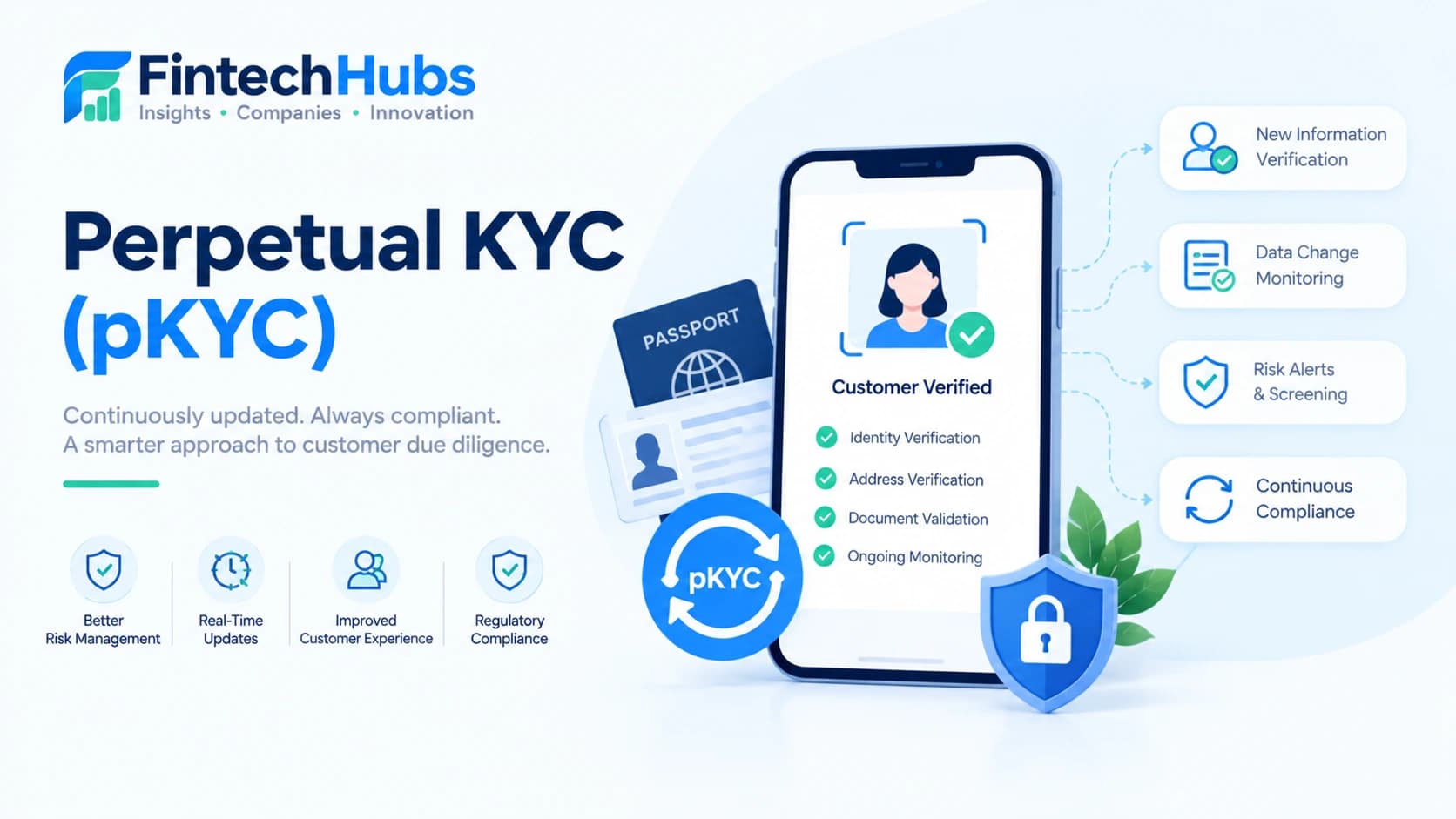
Perpetual KYC (pKYC): A Complete Guide to Continuous Customer Due Diligence
An original, royalty-free article for compliance professionals, financial institutions, fintechs, and regulated businesses.
Executive Summary
Know Your Customer (KYC) has long been treated as a point-in-time exercise: verify a customer at onboarding, then revisit the file every one, three, or five years depending on risk. This model is increasingly out of step with reality. Customers change jobs, move countries, change ownership structures, and appear on sanctions lists between scheduled reviews, and criminals exploit the gaps.
Perpetual KYC (pKYC) replaces the calendar with the event. Instead of refreshing customer files on a fixed cycle, an institution continuously monitors customer data and external signals, and triggers a review only when something meaningful changes. The result is customer information that is current, risk ratings that reflect actual behaviour, and compliance teams that spend their time on genuine risk rather than routine paperwork.
This guide explains what pKYC is, how it works, the regulatory context, the technology behind it, a practical implementation roadmap, common pitfalls, and answers to the ten questions practitioners ask most often.
What Is Perpetual KYC?
Perpetual KYC is an approach to customer due diligence in which customer information and risk profiles are kept up to date on an ongoing basis, using data-driven triggers rather than fixed review schedules. It is sometimes called continuous KYC, dynamic KYC, or event-driven KYC.
The defining features are:
Continuous data ingestion: Internal data (transactions, product usage, contact changes) and external data (sanctions, adverse media, corporate registries, politically exposed person lists) are monitored on an ongoing basis.
Event-driven reviews: A review is opened when a trigger fires, not simply because a date has arrived.
Dynamic risk scoring: A customer’s risk rating is recalculated as new information arrives.
Automation first, human judgement where it matters: Routine refreshes are automated, and analysts focus on exceptions and high-risk cases.
Perpetual KYC does not eliminate periodic review. Many institutions retain a long-stop backstop (for example, a maximum interval after which a file is refreshed regardless of triggers), but the backstop becomes a safety net rather than the primary control.
Why Periodic KYC Falls Short
Traditional periodic review has several structural weaknesses.
Stale information between reviews: A customer file may be accurate on the day of review and wrong a month later. Risk accumulates silently in the gap.
Misallocated effort: Low-risk customers receive the same refresh effort as high-risk customers whose circumstances have materially changed.
Customer friction: Large remediation waves generate document requests that customers find repetitive and intrusive, and many do not respond.
Backlogs and cost: Review cycles create peaks of workload, driving temporary staffing, overtime, and quality problems.
Reactive detection: Sanctions designations, adverse media, or ownership changes may be discovered only at the next scheduled review, or after a screening hit raises questions.
Poor audit narrative: Regulators increasingly ask whether controls are risk-based and effective, not merely whether reviews were completed on time.
How Perpetual KYC Works
A pKYC programme can be understood as a loop with five stages.
3.1 Data collection and consolidation
The institution builds a single, reliable view of each customer. This includes identity attributes, beneficial ownership, product holdings, expected activity, geographic exposure and historical risk decisions. Fragmented customer data across systems is the most common obstacle, so consolidation is usually the first technical task.
3.2 Trigger monitoring
The programme defines events that should prompt reassessment. Typical triggers include:
Customer-driven changes: New address, new country of residence, new nationality, change of name, change of occupation or employer, new beneficial owner, change of directors, change of business activity.
Behavioural changes: Transaction volumes or values inconsistent with the customer profile, new high-risk counterparties, unusual geographic flows, sudden dormancy followed by activity, use of new products or channels.
External events: A sanctions or watchlist match, a customer becoming a politically exposed person, adverse media, insolvency or litigation news, change in a corporate registry record, or a change in the risk rating of a country of operation.
Document events: An identity document or licence approaching expiry, or a failed re-verification.
Internal alerts: A suspicious activity referral, a transaction monitoring escalation, or a complaint.
3.3 Risk re-scoring
When a trigger fires, the customer’s risk score is recalculated using the institution’s methodology. Well-designed models weigh the nature of the change, the customer’s existing profile, and the cumulative effect of several small changes.
3.4 Triage and review
The outcome of re-scoring determines the response:
No material change: The event is logged, and no action is required.
Low-impact change: The file is updated automatically, using verified data sources where possible.
Moderate change: A targeted refresh is initiated, for example, requesting a single document or confirmation from the customer.
High-impact change: The case is escalated to an analyst for enhanced due diligence, senior approval, or relationship exit.
3.5 Audit and feedback
Every trigger, decision, and update is recorded. Outcomes feed back into the model: triggers that generate many false positives are tuned, and gaps revealed by missed events lead to new rules.
Key Benefits
Better risk detection: Changes are identified close to when they occur, narrowing the window in which illicit activity can go unnoticed.
Improved customer experience: Customers are contacted only when something has changed, and automated updates reduce repeated document requests.
Operational efficiency: Resources shift from mass refreshes to targeted reviews. Many institutions report significant reductions in manual review volumes once mature, though results vary by starting point and implementation quality.
Stronger regulatory posture: Continuous, evidence-based monitoring demonstrates a genuinely risk-based approach.
Data quality: Customer records are consistently current, which also benefits sanctions screening, transaction monitoring, credit risk, and marketing compliance.
Scalability: Growth in customer numbers does not create proportional growth in periodic review workloads.
Regulatory Context
Perpetual KYC is an operating model rather than a regulatory requirement, but it aligns closely with the principle found across major frameworks that customer due diligence must be ongoing and risk-based.
FATF Recommendations: Recommendation 10 on customer due diligence expects ongoing due diligence on the business relationship, including scrutiny of transactions and keeping documents, data and information up to date and relevant, particularly for higher-risk customers.
European Union: The EU anti-money laundering framework, including the AML Regulation adopted in 2024 and the new EU Anti-Money Laundering Authority (AMLA), sets expectations for keeping customer information current and defines minimum update frequencies in certain circumstances. Institutions should check the current text and applicable dates for their jurisdiction.
United States: The FinCEN customer due diligence requirements for covered financial institutions include ongoing monitoring to identify and report suspicious transactions and, on a risk basis, to maintain and update customer information.
United Kingdom, Singapore, Hong Kong, UAE and others: Regulators and supervisory bodies generally expect risk-based, ongoing monitoring and have been receptive to technology-enabled approaches, provided governance, explainability and record-keeping are sound.
Important: regulatory requirements differ by jurisdiction and change over time. This article is general information, not legal advice. Institutions should consult their regulator’s current guidance and engage legal and compliance counsel before changing their KYC policy. Many regulators expect to be informed of, or to approve, material changes to the customer due diligence framework.
The Technology Stack Behind pKYC
Capability | Role in pKYC |
|---|---|
Customer data platform/master data management | Creates a single, trusted customer view across products and systems |
Entity resolution | Matches records that refer to the same person or company despite spelling variations |
Data and screening providers | Supply sanctions, PEP, adverse media, corporate registry, and identity data feeds |
Rules and event engine | Detects triggers and routes them to the appropriate workflow |
Risk scoring engine | Calculates and updates customer risk ratings dynamically |
Workflow and case management | Assigns, tracks, and documents reviews and escalations |
Customer communication tools | Digital channels for requesting and verifying updated information securely |
Machine learning and AI | Detects behavioural anomalies, prioritises alerts, extracts data from documents and summarises adverse media |
Audit and reporting layer | Preserves an immutable record of triggers, decisions and rationale |
Artificial intelligence can add value, but it must be explainable and governed. Regulators expect institutions to understand and justify how decisions are made, to test models for bias and drift, and to keep humans accountable for significant outcomes.
Implementation Roadmap
Phase 1: Assess and define
Document the current KYC lifecycle, review frequencies and pain points.
Establish objectives: risk reduction, cost, customer experience, or all three.
Secure executive sponsorship and involve compliance, operations, technology, legal, data, and business teams.
Confirm regulatory expectations with the relevant supervisor.
Phase 2: Build the data foundation
Inventory customer data sources and assess quality, completeness, and ownership.
Resolve duplicates and establish a golden record.
Identify the external data providers needed and assess their coverage and reliability.
Phase 3: Design triggers and risk logic
Define a trigger library, categorised by customer, behavioural, external and document events.
Set response rules: automatic update, targeted request, analyst review or escalation.
Revise the risk scoring methodology so it can be recalculated dynamically.
Decide what backstop review interval, if any, remains.
Phase 4: Pilot
Start with a defined segment, such as low-risk retail customers or a single business line.
Run pKYC in parallel with periodic review to compare outcomes.
Measure trigger volumes, false positive rates, review times and customer response rates.
Phase 5: Scale
Extend by segment in waves, moving to higher-risk populations only after controls are proven.
Retire periodic review tasks progressively, as approved by governance.
Train staff and update policies, procedures and risk assessments.
Phase 6: Monitor and improve
Track key indicators and report regularly to senior management and the board.
Test the programme through quality assurance and independent audit.
Retune triggers and models as typologies, products and regulations change.
Governance and Key Performance Indicators
Good governance is what makes pKYC defensible. Core elements include a clear policy, defined ownership, model risk management, change control for rules and thresholds, documented rationale for design choices, and regular independent testing.
Useful indicators include:
Percentage of customer files with up-to-date, verified information
Time from trigger event to completed review
Trigger volumes and false positive rate by trigger type
Share of updates completed automatically versus manually
Customer response rate and time to respond to information requests
Number of material risks identified earlier than under periodic review
Backlog of overdue reviews
Cost per review and total cost of KYC operations
Audit and regulatory findings related to customer due diligence
Challenges and Risks
Poor data quality: Triggers built on inaccurate or fragmented data produce noise or miss events entirely.
Alert fatigue: Overly sensitive triggers can overwhelm analysts and recreate the backlog problem in another form.
Under-triggering: Insufficient coverage creates false comfort, with real risk events never detected.
Legacy systems: Older platforms may not support real-time events or integration with modern data sources.
Regulatory uncertainty: Supervisors may differ in how they view the retirement of periodic reviews.
Privacy and data protection: Continuous monitoring must comply with lawful basis, purpose limitation, proportionality, and retention rules, such as those under GDPR and similar laws.
Model governance: Machine learning models need validation, explainability and bias testing.
Third-party dependency: Reliance on data vendors requires due diligence, contingency planning, and quality checks.
Change management: Staff accustomed to calendar-based workflows need training and clear new procedures.
Customer communication: Poorly designed outreach can cause confusion or be mistaken for fraud, so channels must be secure and recognisable.
Best Practices
Start small and prove value: With a limited segment before scaling.
Treat data as the foundation: Investing in quality and integration before automation.
Take a risk-based approach to triggers: Using more sensitive monitoring for higher-risk customers.
Keep a backstop: For long-interval review until the programme has earned supervisory confidence.
Engage the regulator early: And share the design rationale and test results.
Automate evidence capture: So every decision is traceable.
Design for the customer: Minimising repeated requests and using digital self-service.
Combine rules and analytics: Rules offer transparency, analytics offer detection power; together they perform better.
Maintain human oversight: For high-risk decisions and exits.
Review continuously: Tuning triggers, thresholds, and models with real outcomes.
Periodic KYC vs Perpetual KYC at a Glance
Dimension | Periodic KYC | Perpetual KYC |
|---|---|---|
Review timing | Fixed calendar (1, 3 or 5 years) | Event-driven, with optional backstop |
Data freshness | Current only at review date | Continuously refreshed |
Effort allocation | Uniform within risk tier | Concentrated where change or risk occurs |
Customer contact | Large, periodic waves | Targeted, only when needed |
Risk detection | Delayed | Near real time |
Workload pattern | Peaks and backlogs | Smooth and scalable |
Automation level | Typically low | High |
Technology demand | Moderate | Significant |
The Future of Continuous Due Diligence
Several developments are likely to shape pKYC over the coming years:
Digital identity and verifiable credentials: Allowing customers to share verified attributes securely and update them once for many institutions.
Better public data: Including more accessible beneficial ownership and corporate registries.
Greater use of AI: From document understanding to adverse media summarisation, under tighter model governance expectations.
Data sharing and utilities: Enabling institutions to share KYC utility data where law permits, reducing duplication.
Regulatory convergence: As supervisors publish clearer guidance on event-driven approaches.
Integration of KYC, fraud and transaction monitoring: Into a unified view of customer risk.
Frequently Asked Questions (FAQs)
1. What does pKYC stand for, and how is it different from regular KYC?
pKYC stands for Perpetual Know Your Customer. Regular KYC establishes customer identity at onboarding and refreshes it on a fixed schedule. pKYC keeps customer information and risk ratings current continuously, triggering reviews when relevant events occur rather than when a date arrives.
2. Is perpetual KYC a regulatory requirement?
No regulator mandates pKYC by name. However, regulations require ongoing, risk-based due diligence and up-to-date customer information. pKYC is one way, increasingly favoured, to meet those obligations. Specific expectations vary by jurisdiction, so check current local rules.
3. Does pKYC replace periodic reviews completely?
Not necessarily. Many institutions keep a long-interval backstop review, particularly in the early stages, so that no customer file goes unreviewed regardless of triggers. Over time, and with supervisory comfort, the backstop may be lengthened or applied only to selected segments.
4. What events typically trigger a pKYC review?
Common triggers include changes in address, ownership, occupation or business activity; unusual transaction behaviour; sanctions, PEP or adverse media hits; document expiry; and escalations from transaction monitoring or fraud teams.
5. Which institutions benefit most from pKYC?
Banks, payment providers, fintechs, crypto-asset service providers, insurers, broker-dealers and other regulated businesses with large or fast-changing customer bases benefit most. Institutions with high periodic review costs or significant remediation backlogs often see the clearest returns.
6. What technology is needed to implement pKYC?
At minimum: a consolidated customer data foundation, access to external data feeds, an event and rules engine, a dynamic risk scoring capability, workflow and case management, and an audit trail. AI and machine learning can improve detection and efficiency but are not strictly required to begin.
7. How does pKYC affect the customer experience?
Customers are generally contacted less often, and only when something relevant has changed. Digital, automated updates reduce repetitive paperwork. Clear and secure communication is essential so that legitimate requests are not mistaken for scams.
8. What are the main risks of adopting pKYC?
The main risks are poor data quality, alert overload, missed events due to weak trigger design, privacy and data protection non-compliance, weak model governance, and regulatory misalignment. These can be mitigated through phased rollout, strong governance, and early supervisory engagement.
9. Does continuous monitoring raise data privacy concerns?
It can. Institutions must ensure there is a lawful basis for processing, that monitoring is proportionate and purpose-limited, that data is retained only as long as necessary, and that customers are informed through appropriate notices. Data protection officers should be involved from the design stage.
10. How long does it take to implement pKYC, and how do we start?
Timelines vary widely, from several months for a focused pilot to a few years for full enterprise rollout. A practical start is to assess current processes and data quality, define a trigger framework, pilot on a lower-risk segment in parallel with periodic review, measure results, and scale in controlled phases.
Conclusion
Perpetual KYC is a shift in philosophy as much as in technology: from asking “is it time to review this customer?” to asking “has anything changed that matters?” Done well, it improves risk detection, reduces cost, and treats customers with greater respect for their time. Done poorly, it can produce noise, gaps, and regulatory exposure. The difference lies in data quality, thoughtful trigger design, strong governance, and early engagement with supervisors. Institutions that approach pKYC as a phased, evidence-based transformation are best placed to turn continuous due diligence into a lasting advantage.
Disclaimer: This article is provided for general informational purposes only and does not constitute legal, regulatory, or compliance advice. Regulatory requirements differ by jurisdiction and change over time. Readers should consult qualified advisers and current official guidance before making decisions. This original work may be freely used, adapted and republished.
Share this article
Related Articles
Soft vs Hard Declines: Advanced Payment Recovery Guide
Soft vs hard declines explained: Visa and Mastercard retry rules, smart retries, network tokens, 3-D Secure, dunning, recovery metrics, and 10 FAQs.
Interlinking Instant Payment Systems Across Countries
How countries link instant payment systems: bilateral links, Nexus, UPI-PayNow, risks, compliance, operations, a rollout roadmap, and 10 FAQs.
PCI DSS 4.0.1: Technical Requirements for Modern Payments
PCI DSS 4.0.1 explained: 12 requirements, MFA, payment page scripts, cloud and API compliance, scope reduction, a rollout roadmap, and 10 FAQs.