Payment Switching vs. Payment Processing: Key Differences
Understand the difference between payment switching and payment processing, how each works, and how they relate to gateways, acquirers, and orchestration.
Payment Switching vs. Payment Processing: Key Differences Explained
"Payment switch" and "payment processor" are terms often used interchangeably, yet they describe different roles in the movement of money. Confusing them can lead to poor vendor choices, unclear contracts, and misunderstandings about who is responsible for what when a payment fails.
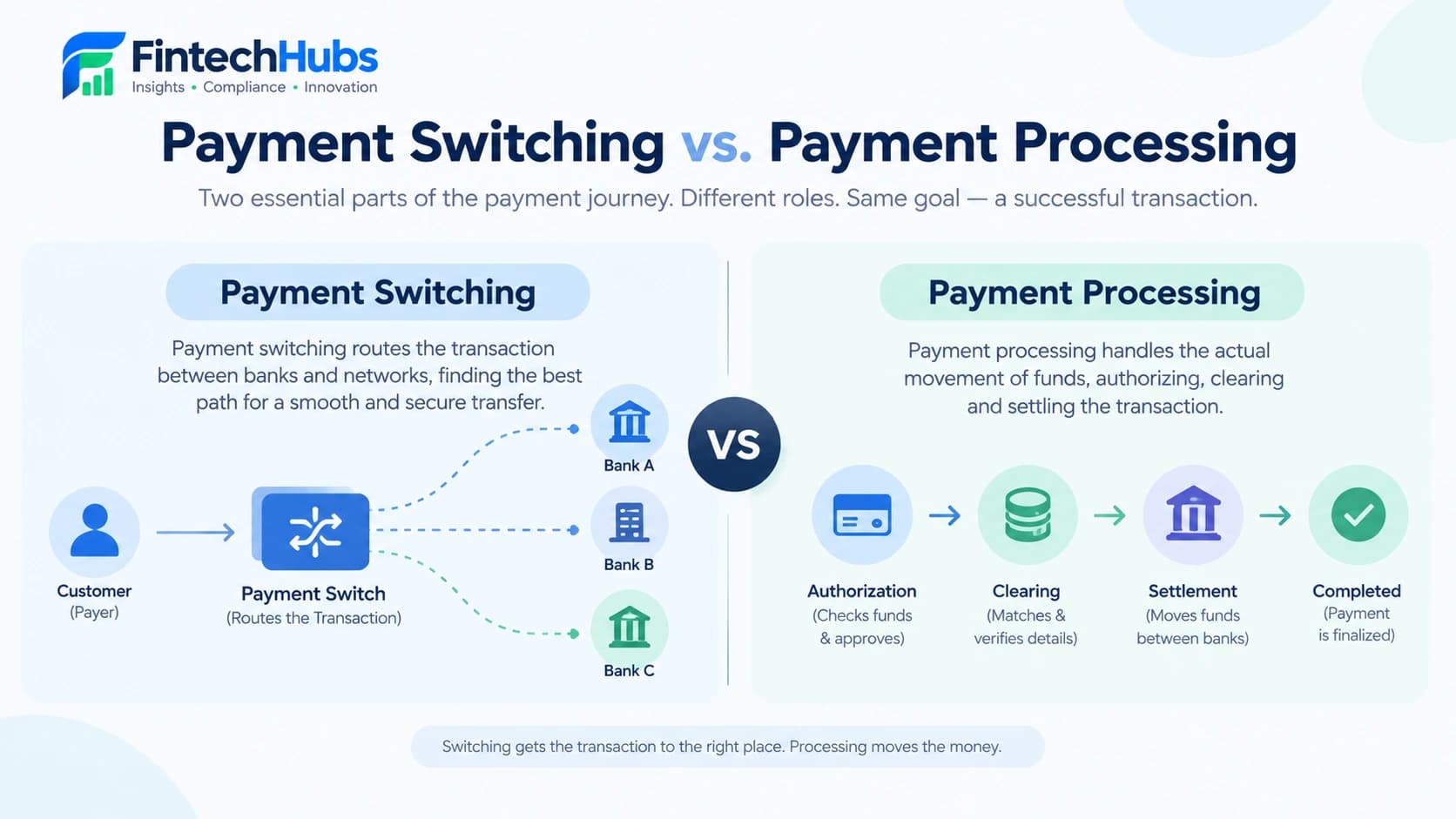
In simple terms, a payment switch is the traffic controller that routes transaction messages between the right parties, while a payment processor is the service that handles the full lifecycle of a payment on behalf of a merchant, bank, or other client. In practice, the two overlap, and one company may perform both roles. This guide explains each, shows where they differ, and helps businesses understand which capabilities they actually need.
This article is for general informational and educational purposes only. It does not constitute financial, legal, technical, or compliance advice. Terminology varies by region and provider, and no vendor is endorsed.
The Payments Ecosystem at a Glance
A typical card or electronic payment involves several participants:
Cardholder or payer: The person or business making the payment
Merchant or payee: The business receiving the payment
Acquirer (merchant bank): The institution that provides the merchant account and receives funds on the merchant's behalf
Issuer: The bank that issued the card or holds the payer's account
Card network or scheme: The rules and infrastructure connecting issuers and acquirers
Payment gateway: The technology that securely captures payment details online or at the point of sale
Payment processor: The entity that handles transaction processing for acquirers, merchants, or issuers
Payment switch: The system that routes transaction messages to the correct destination
Different markets and business models combine or separate these roles in different ways.
What Is Payment Processing
Payment processing is the end-to-end handling of a payment transaction so that funds move from the payer to the payee. It generally includes:
Authorization: Checking whether the payment can be approved
Fraud and risk checks: Applying rules and models before approval
Clearing: Exchanging final transaction details between acquirer and issuer
Settlement: Moving the funds between institutions
Reconciliation and reporting: Matching transactions and providing statements
Chargeback and dispute handling: Managing payment disputes
There are two common perspectives:
Acquiring-side processing: Serving merchants, handling their transactions, settlements, and reporting.
Issuing-side processing: Serving card issuers, handling authorization requests, account management, card management, and statements for cardholders.
What Is Payment Switching
Payment switching is the real-time routing of transaction messages between connected parties such as acquirers, issuers, card networks, ATMs, point-of-sale terminals, mobile apps, and other switches. A payment switch receives a request, decides where it should go based on rules (for example, the card number range, transaction type, or network), forwards it, receives the response, and sends it back to the originator.
A switch is primarily concerned with:
Connectivity: Maintaining links to many endpoints
Routing: Deciding the destination
Translation: Converting between message formats
Interoperability: Letting different systems and institutions exchange messages
National and regional switches often connect domestic banks so that a customer of one bank can use another bank's ATM or pay at any participating merchant.
Payment Switching vs. Payment Processing: Side-by-Side Comparison
Dimension | Payment Switching | Payment Processing |
|---|---|---|
Core role | Routes transaction messages between parties | Handles the full transaction lifecycle for a client |
Main question answered | "Where should this message go?" | "Can this payment be approved, settled, and reconciled?" |
Typical customers | Banks, networks, processors, ATM and POS operators | Merchants, acquirers, issuers, fintechs |
Scope | Connectivity, routing, translation | Authorization, risk, clearing, settlement, reporting, disputes |
Timing focus | Real-time message exchange | Real-time authorization plus batch clearing and settlement |
Account relationship | Usually with institutions, not end merchants | Often includes merchant or issuer accounts |
Value-added services | Routing rules, load balancing, interoperability | Fraud tools, reporting, settlement management, customer support |
Handles funds? | Typically does not hold funds itself, though some operators run settlement | Often manages settlement flows and funds movement coordination |
Examples of operators | National switches, interbank networks, ATM networks | Acquirer processors, issuer processors, payment service providers |
The distinction is conceptual: switching is about moving messages, processing is about completing payments. Many providers do both.
How a Card Transaction Flows End to End
The customer pays: A card is tapped, inserted, or entered online.
Gateway or terminal captures data: The details are encrypted or tokenized and sent onward.
The processor receives the request: The acquiring processor applies checks and prepares an authorization message.
Switch routes the message: A payment switch (which may be part of the processor or the network) identifies the issuer or network and forwards the message.
Network connects acquirer and issuer: The card network passes the request to the issuer.
Issuer decides: The issuer, often via its issuer processor, checks funds, risk, and card status, and returns approve or decline.
Response returns: The response travels back through the switch and processor to the merchant in seconds.
Clearing: Later, transaction details are exchanged for final posting.
Settlement: Funds move from issuer to acquirer and then to the merchant, minus fees.
Reconciliation and disputes: Reports are produced and any chargebacks are handled.
Switching is most visible in steps 4 to 7, while processing spans the whole sequence.
Core Functions of a Payment Switch
Message routing: Direct requests to the correct issuer, acquirer, network, or service
Protocol and format translation: Convert between formats such as ISO 8583 and API-based or ISO 20022 messages
Endpoint connectivity: Connect ATMs, POS terminals, mobile apps, and host systems
Load balancing and failover: Keep traffic flowing if a link or host fails
Stand-in processing: Approve or decline on behalf of a host that is temporarily unavailable, under predefined rules
Transaction logging: Capture detailed message logs for audit and troubleshooting
Interchange and fee rules (where applicable): Apply network or scheme rules
Security functions: Encryption, key management, and message authentication
Monitoring: Track performance, latency, and approval rates in real time
Support for multiple payment types: Cards, instant payments, wallets, and bank transfers
Core Functions of a Payment Processor
Authorization handling: Build, send, and manage authorization requests and responses
Risk and fraud management: Velocity rules, device signals, and machine learning models
Tokenization and data protection: Reduce the handling of raw card data
Clearing and settlement management: Prepare files, reconcile, and coordinate funding
Merchant onboarding and underwriting (for acquiring services)
Account and card management (for issuing services), including statements and limits
Reporting and reconciliation tools: Transaction, settlement, and fee reports
Chargeback and dispute management
Compliance support: Security standards, network rules, and regulatory reporting
Customer support and operational services
Payment Switch vs. Gateway vs. Processor vs. Orchestrator
Component | Primary Role | Typical Audience |
|---|---|---|
Payment gateway | Securely captures and transmits payment details from a website, app, or terminal to the processor | Merchants |
Payment processor | Manages authorization, clearing, settlement support, and reporting | Merchants, acquirers, issuers |
Payment switch | Routes messages between endpoints and networks and translates formats | Banks, processors, networks |
Payment orchestration platform | Connects a merchant to multiple processors and gateways, with routing, retries, and analytics | Merchants with complex payment needs |
Acquirer | Holds the merchant account and receives funds | Merchants |
Issuer | Provides cards or accounts to consumers and approves transactions | Consumers and businesses |
Payment facilitator or PSP | Aggregates merchants under its own master merchant account and provides a bundled service | Small and mid-sized merchants |
Orchestration and switching are related: both route, but a switch usually routes at the infrastructure and institution level, while orchestration routes at the merchant business level to optimize cost and conversion.
Messaging Standards and Technology
ISO 8583: Long-standing standard for card transaction messages between terminals, acquirers, networks, and issuers
ISO 20022: Richer, structured messaging standard used by many modern payment systems
REST and JSON APIs: Common for online, mobile, and fintech integrations
Proprietary network protocols: Specific to card networks or national schemes
Hardware security modules (HSMs): Protect cryptographic keys and PIN data
Tokenization and encryption: Reduce the exposure of sensitive data
Cloud and microservices architectures: Support scalable, resilient switching and processing
Event streaming and real-time analytics: Monitor and react to transaction flows
Many providers maintain legacy and modern interfaces side by side, so translation is a common switch function.
Types of Payment Switches
National or domestic switches: Connect banks within a country for ATM, POS, and interbank payments.
Card network switches: Operated by card schemes to connect issuers and acquirers globally.
Bank or issuer switches: Internal routing platforms inside a large bank.
Processor-operated switches: Built into a processor's platform to route among hosts and networks.
Instant payment switches: Connect participants in real-time payment systems.
Mobile money and wallet switches: Connect wallet providers, agents, and banks.
Enterprise or merchant switches: Large retailers or fintechs routing among acquirers.
Types of Payment Processors
Acquiring processors: Serve acquirers and merchants with authorization, clearing, and settlement support.
Issuer processors: Manage card programs, authorization decisioning, and cardholder accounts for banks and fintechs.
Payment service providers and facilitators: Bundle gateway, processing, and merchant onboarding for smaller merchants.
Alternative payment processors: Specialize in bank transfers, wallets, buy-now-pay-later, or local payment methods.
Enterprise or in-house processors: Large organizations running their own processing.
Cross-border processors: Support multi-currency and international acceptance.
Who Needs Which: Use Cases by Business Type
Business Type | Typically Needs | Notes |
|---|---|---|
Small online merchant | Payment processing through a PSP or gateway | Switching is handled behind the scenes |
Large e-commerce or marketplace | Processing across multiple providers, possibly orchestration | May manage routing and failover |
Bank or credit union | Issuer processing, a payment switch, access to national or network switches | May outsource or run in-house |
Fintech or neobank | Issuer processing, card program management, API connectivity | Often built on partner infrastructure |
ATM or POS network operator | A switch for connectivity and routing | Focus on uptime and interoperability |
Government or national payment scheme | National switch infrastructure | Interoperability and policy goals |
Telecom or wallet operator | A switch connecting wallets, agents, and banks | Often integrates mobile money and bank rails |
Retail chain | Processing plus in-store terminal connectivity | May use a switch to connect multiple acquirers |
Benefits of Each Model
Benefits of payment switching
Interoperability among institutions and channels
Resilience through failover and load balancing
Lower integration burden: connect once to reach many parties
Flexibility to add new networks and payment methods
Better visibility of traffic and performance
Benefits of payment processing
Complete, managed handling of the payment lifecycle
Reduced operational burden for merchants and issuers
Access to fraud tools, reporting, and settlement services
Faster time to market through bundled services
Support for dispute and compliance processes
Challenges and Risks
For switches
High availability demands: downtime can disrupt many institutions
Latency sensitivity: authorization must complete in seconds
Integration complexity across legacy and modern systems
Concentration risk when many participants depend on a single switch
Capacity planning for peak volumes
For processors
Fraud and chargeback exposure
Regulatory and network compliance requirements
Margin pressure from competition and interchange rules
Vendor lock-in for clients
Settlement and reconciliation errors
For both
Cybersecurity threats
Data protection and privacy obligations
Operational resilience and disaster recovery
Managing multiple standards and protocols
Security and Compliance Considerations
PCI DSS: Security standard for handling card data; applies to many switches and processors
Network and scheme rules: Operating requirements set by card networks and national schemes
Data encryption and key management: Secure message transmission and key lifecycle
Tokenization: limit exposure of card numbers
Strong customer authentication and fraud controls: Especially for online transactions
Anti-money laundering and sanctions controls: Screening and monitoring obligations in many setups
Operational resilience rules: Supervisory expectations for critical payment infrastructure
Data protection laws: Privacy requirements for personal and transaction data
Licensing and registration: Some switches and processors need regulatory approval depending on the jurisdiction
Audit and logging: Traceability of transactions and system changes
Requirements vary by country and role. Consult qualified professionals.
Cost Structures and Business Models
Switching revenue models
Per-message or per-transaction switching fees
Participation or membership fees
Licensing for switch software
Managed service fees
Processing revenue models
Per-transaction fees plus a percentage of volume
Interchange-plus, tiered, or flat-rate pricing for merchants
Monthly or platform fees
Fees for chargebacks, refunds, cross-border, or additional services
Issuer processing fees per account, per card, or per transaction
Fees may include pass-through costs charged by networks and issuers. Merchants should request transparent, itemized pricing.
How to Choose
Clarify your role: Are you a merchant, issuer, acquirer, network operator, or fintech?
Define needs: Do you need message routing and connectivity, end-to-end processing, or both?
Check coverage: Supported countries, currencies, payment methods, and networks.
Evaluate reliability: Uptime history, redundancy, and disaster recovery.
Assess security and compliance: Relevant certifications and regulatory standing.
Look at integration effort: API quality, documentation, and support for legacy and modern protocols.
Understand pricing fully: Include fees for exceptions and cross-border activity.
Consider scalability: Capacity for peak events and growth.
Review reporting and tools: Reconciliation, analytics, and dispute management.
Plan for flexibility: Avoid lock-in where possible, for example through orchestration or multi-provider setups.
Future Trends
Cloud-native and API-first switching and processing platforms
Growth of instant and account-to-account payments, requiring real-time switching beyond cards
Wider ISO 20022 adoption across switches and processors
AI-driven fraud detection and smart routing to improve approval rates and reduce costs
Tokenization and network tokens reducing the exposure of raw card data
Convergence of roles, with processors, gateways, switches, and orchestrators blending in unified platforms
Cross-border interlinking of domestic switches and instant payment systems
Greater focus on operational resilience and regulatory oversight of critical payment infrastructure
Embedded finance increasing demand for flexible processing and switching services
Frequently Asked Questions
1. What is the main difference between payment switching and payment processing?
Switching routes transaction messages to the correct destination, while processing manages the full lifecycle of a payment, including authorization, risk checks, clearing, settlement, and reporting.
2. Is a payment switch the same as a payment gateway?
No. A gateway captures and securely transmits payment details from a merchant to a processor. A switch routes messages between institutions, networks, and systems.
3. Can one company provide both switching and processing?
Yes. Many processors operate their own switches, and many switch operators offer processing services.
4. Do merchants need a payment switch?
Most small and mid-sized merchants do not need to operate one. They use a gateway or processor that handles routing behind the scenes. Very large merchants may use switching or orchestration to manage multiple acquirers.
5. Does a payment switch hold funds?
Typically a switch routes messages and does not hold customer funds, though some operators also run clearing and settlement under their scheme rules.
6. What is ISO 8583?
It is a long-standing standard for formatting card transaction messages between terminals, acquirers, networks, and issuers, and it remains widely used in switching.
7. How is payment orchestration different from a payment switch?
Orchestration helps a merchant route payments among multiple processors and gateways to optimize cost and conversion. A switch routes messages at the infrastructure level between institutions and networks.
8. What is stand-in processing?
It is when a switch or network approves or declines a transaction on behalf of an unavailable issuer, using pre-agreed rules, so payments can continue during outages.
9. Who regulates payment switches and processors?
It depends on the country. Central banks, financial regulators, and payment system authorities may oversee them, along with network rules and security standards such as PCI DSS.
10. How do I know whether I need a switch or a processor?
If you need to accept or issue payments and want a managed end-to-end service, you need a processor. If you operate infrastructure connecting many banks, terminals, or systems and need routing and interoperability, you need a switch.
Conclusion
Payment switching and payment processing are complementary but distinct. A switch is the routing and connectivity layer that gets messages to the right place quickly and reliably, while a processor delivers the broader service of completing a payment, from authorization through settlement and reporting. Understanding the difference helps businesses choose the right partners, interpret contracts and fees, and design resilient payment architectures. As instant payments, cloud platforms, and smarter routing reshape the industry, the lines between switches, processors, gateways, and orchestrators will keep blurring, but the underlying questions remain the same: where should this payment go, and how do we complete it safely, quickly, and cost-effectively?
Disclaimer: This article is provided for general informational and educational purposes only. It does not constitute financial, legal, technical, or compliance advice. Terminology and regulatory requirements vary by provider and jurisdiction; verify details with qualified professionals and official sources.
Share this article
Related Articles
Soft vs Hard Declines: Advanced Payment Recovery Guide
Soft vs hard declines explained: Visa and Mastercard retry rules, smart retries, network tokens, 3-D Secure, dunning, recovery metrics, and 10 FAQs.
Interlinking Instant Payment Systems Across Countries
How countries link instant payment systems: bilateral links, Nexus, UPI-PayNow, risks, compliance, operations, a rollout roadmap, and 10 FAQs.
PCI DSS 4.0.1: Technical Requirements for Modern Payments
PCI DSS 4.0.1 explained: 12 requirements, MFA, payment page scripts, cloud and API compliance, scope reduction, a rollout roadmap, and 10 FAQs.