
Insurtech: How Technology Is Transforming Insurance
Discover how Insurtech is transforming insurance with digital solutions, AI, automation, personalized coverage, faster claims, and improved customer experiences.
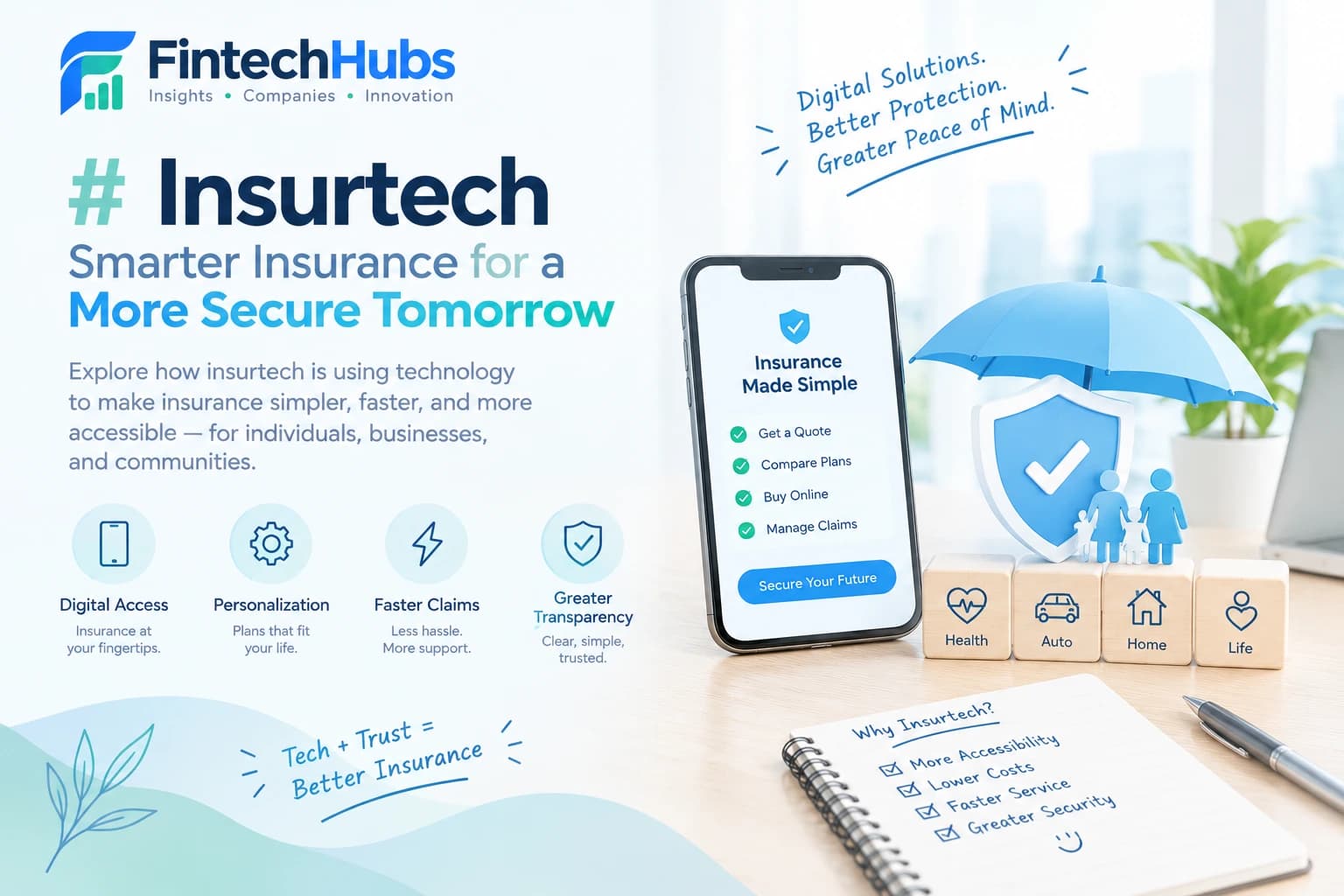
Insurtech: A Complete Guide to Financial Technology in 2026
Insurance has always been built on a simple promise: pay a small amount regularly so that a much larger loss is covered if something goes wrong. For most of its history, that promise came wrapped in paperwork, slow claims processes, and pricing based on broad averages rather than an individual's actual risk. Insurtech set out to change that, and by 2026 it has succeeded in ways that touch nearly every part of how insurance is priced, sold, and delivered.
This guide explains what insurtech actually is, why it matters so much to both consumers and the insurance industry itself, and walks through every major branch of the space, from usage based and parametric insurance to AI powered underwriting and embedded coverage built directly into everyday apps.
What Is Insurtech
Insurtech is the use of technology to improve, automate, or reinvent how insurance is designed, priced, sold, and serviced. It includes fully digital insurance companies built from the ground up around technology, as well as software and data tools that traditional insurers use to modernize their existing operations.
Insurtech generally falls into two broad categories. The first involves full stack digital insurers that hold their own insurance license and sell policies directly to customers, competing head on with traditional carriers. The second, and increasingly larger, category involves technology companies that partner with existing insurers, supplying software, data, and infrastructure that power underwriting, claims, and distribution behind the scenes. Many of the most successful insurtech companies today fall into this second category, acting as technology partners to the industry rather than direct competitors within it.
Why Insurtech Matters
Insurtech matters because it addresses problems that the traditional insurance industry left unresolved for a very long time.
It makes pricing fairer and more personal: Traditional insurance often priced people based on broad group averages, meaning a careful driver could pay the same rate as a reckless one simply because they shared similar demographics. Usage based and data driven pricing models let insurers reward genuinely lower risk behavior with lower prices, rather than relying on generalizations.
It speeds up claims dramatically: A process that once took days or weeks to review and settle can now happen in minutes for straightforward claims, thanks to automated damage assessment and AI powered claims review. This matters enormously to a policyholder dealing with the stress of an accident, a flooded home, or a medical emergency.
It closes coverage gaps: Climate related disasters, cyber incidents, and gig economy work have created risks that traditional insurance products were never designed to cover well. Insurtech has introduced new, more flexible products specifically built to address these modern risks.
It reaches people at the exact moment they need coverage: Embedded insurance places relevant coverage directly inside the purchase or activity that creates the risk, such as travel insurance offered during flight booking, rather than requiring a person to separately research and buy a policy in advance.
It forces the entire industry to modernize: Even large, well established insurers have had to invest heavily in their own digital capabilities and data science teams because customers now expect the same speed and personalization from an insurance company that they get from any other digital service.
A Brief History of Insurtech
Insurance itself has used data and actuarial science for centuries, but the technology used to deliver it changed very little for most of the twentieth century. Basic online quote tools appeared in the late 1990s, allowing people to compare prices without calling an agent, but the underlying underwriting and claims process behind the scenes remained largely manual.
The real insurtech movement began in the early 2010s, as a new generation of startups applied mobile apps, data science, and cleaner user experiences to an industry that had changed little in decades. Early insurtech companies focused mainly on simplifying the buying experience for renters and auto insurance, while telematics devices began allowing insurers to price auto policies based on actual driving behavior rather than demographic assumptions alone.
Through the late 2010s, artificial intelligence and the Internet of Things expanded insurtech's reach into claims automation, smart home monitoring, and health focused wearables. By the 2020s, insurtech had matured from a wave of standalone startups into a deeply integrated part of the broader insurance industry, with a majority of established insurers now actively partnering with insurtech companies rather than treating them purely as disruptive competitors. Now, in 2026, artificial intelligence has become central to nearly every part of the insurance value chain, and parametric and embedded models are reshaping how coverage is designed and sold in the first place.
The Core Branches of Insurtech
Insurtech is best understood as a collection of distinct approaches, each addressing a different part of how insurance works.
Digital First Insurance Carriers
Digital first insurers are built entirely around online and mobile channels, offering policies that can be quoted, purchased, and managed without ever speaking to a human agent. These companies typically compete on speed, transparency, and simplicity, often presenting pricing and coverage details in far plainer language than traditional insurance documents, while using automated underwriting to issue a policy within minutes rather than days.
Usage Based and Telematics Insurance
Usage based insurance prices a policy according to actual, measured behavior rather than broad demographic categories. In auto insurance, this typically involves a telematics device or smartphone app that tracks driving behavior, such as speed, braking patterns, and mileage, allowing safer drivers to pay less. Similar principles now extend into home insurance through smart home sensors that monitor for water leaks or fire risk, and into health and life insurance through wearable devices that track activity and other health indicators, with policyholders often receiving discounts for maintaining healthy habits.
Parametric Insurance
Parametric insurance pays out automatically when a predefined, measurable event occurs, such as a hurricane reaching a certain wind speed or rainfall exceeding a specific threshold, rather than requiring a traditional claims assessment of actual damage. This model has become especially important for climate related risks, since it allows affected policyholders to receive payment within days rather than waiting for a lengthy damage assessment process, and it gives insurers a more predictable way to price coverage for increasingly severe and frequent weather events.
Embedded Insurance
Embedded insurance places relevant coverage directly inside the purchase, booking, or platform where the underlying risk actually arises, such as device protection offered during a phone purchase, trip insurance offered during flight booking, or a gig worker's income protection built directly into the platform they work through. This approach removes the friction of a separate insurance purchase entirely, and it has become one of the fastest growing distribution channels in the industry, since it reaches customers at precisely the moment a need for coverage becomes obvious.
On Demand and Micro Insurance
On demand insurance allows a person to activate coverage for a short, specific period, such as insuring a single item for one trip or turning on coverage only while actively using a shared vehicle, rather than committing to a traditional annual policy. Micro insurance extends this flexibility to very small, affordable coverage amounts, often aimed at people in developing markets who need protection against a specific risk but cannot afford, or do not need, a full traditional policy.
AI Powered Underwriting
Artificial intelligence has transformed how insurers assess risk, analyzing a much wider range of data than a traditional underwriter could review manually, and returning a pricing decision in seconds rather than days. These models can meaningfully improve both accuracy and speed, though insurers increasingly face regulatory pressure to ensure their AI underwriting remains explainable and free from unintended bias, since an opaque algorithm making pricing decisions raises the same fairness concerns as a human underwriter would.
AI Driven Claims Automation
Claims processing has seen some of the most dramatic improvements from insurtech, with AI systems now able to review photos of vehicle or property damage, cross check policy details, and approve straightforward claims automatically within minutes. This has cut processing times that once took days down to a fraction of that, while AI powered anomaly detection simultaneously flags claims that show signs of potential fraud for closer human review, improving both speed and accuracy at the same time.
Managing General Agents and Delegated Authority Models
Managing general agents, often supported by insurtech platforms, are given the authority by an insurance carrier to underwrite and bind certain types of policies on the carrier's behalf, typically within a specific niche or specialty area. This delegated authority model allows a technology focused company to bring deep expertise and modern underwriting tools to a specific type of risk, such as cyber insurance or a particular commercial industry, without needing to become a fully licensed insurance carrier itself.
Health Insurance and Telehealth Integration
Health focused insurtech increasingly integrates insurance coverage directly with digital health services, allowing a policyholder to access virtual doctor consultations, prescription management, and health monitoring tools as part of their coverage rather than as a separate service. This integration benefits both sides, giving insurers better, more continuous health data while giving policyholders faster, more convenient access to care.
Cyber Insurance
Cyber insurance has grown into its own specialized branch of insurtech, addressing a risk that barely existed as an insurable category a couple of decades ago. Modern cyber insurance providers increasingly combine coverage with active risk monitoring tools that help a business identify and fix security weaknesses before an incident occurs, shifting the insurer's role from purely paying for damage after a breach toward actively helping prevent one in the first place.
Blockchain Enabled Insurance
Blockchain technology is being applied to insurance in a still developing but increasingly practical way, particularly to automate parametric payouts through smart contracts that release funds automatically once a predefined condition is verified on chain. Blockchain is also being explored as a way to improve data integrity and reduce fraud, since a shared, tamper resistant record can make it much harder to submit duplicate or fraudulent claims across multiple insurers.
Insurance Marketplaces and Comparison Platforms
Digital insurance marketplaces let consumers compare quotes from multiple insurers side by side, bringing far greater price transparency to a market that historically relied heavily on individual agents presenting limited options. These platforms have shifted meaningful buying power toward consumers, forcing insurers to compete more directly and openly on price and coverage terms than they did when most policies were sold through a single agent relationship.
The Technology Powering Insurtech
Several underlying technologies show up repeatedly across nearly every branch of insurtech described above.
Artificial intelligence and machine learning: Now support underwriting, claims automation, fraud detection, and customer service simultaneously, often within the same platform, dramatically improving both the speed and consistency of decisions across the entire insurance process.
Internet of Things devices: Including telematics units, smart home sensors, and wearable health devices, provide the real time, individualized data that makes usage based pricing possible in the first place.
Cloud native core systems: Allow insurers to launch new products and connect with distribution partners far more quickly than the legacy mainframe systems many traditional carriers still rely on internally.
Open APIs: Let insurers plug their products directly into other platforms, forming the technical foundation behind embedded insurance and the growing network of partnerships between insurtech companies and established carriers.
Regulation of Insurtech
Insurance remains one of the most heavily regulated industries in any economy, and insurtech companies must operate within the same core requirements around solvency, consumer protection, and fair pricing that apply to traditional insurers. As AI has taken on a larger role in underwriting and pricing, regulators in a number of regions have introduced specific requirements for transparency, requiring insurers to be able to explain how an algorithm arrived at a particular risk assessment or price, rather than treating the model as an unexplainable black box.
Insurers offering parametric and embedded products must also navigate rules around how coverage is described and sold, since these newer, more flexible product structures do not always fit neatly into insurance regulations that were originally written with traditional annual policies in mind.
Challenges and Risks in Insurtech
The rapid growth of insurtech has not eliminated every risk. Data privacy concerns are significant, since usage based and IoT driven insurance products depend on continuously collecting detailed personal data, including location, driving behavior, and in some cases health information. Algorithmic bias remains a real concern in AI underwriting, since a model trained on historical data can unintentionally learn and repeat unfair pricing patterns if it is not carefully monitored. Climate risk concentration continues to challenge insurers as extreme weather events become more frequent and severe, sometimes forcing insurers to pull back coverage entirely from high risk areas regardless of how sophisticated their pricing technology has become. Funding and profitability pressure has also affected a number of insurtech companies that relied heavily on rapid growth and did not have enough real claims data to build sufficiently accurate pricing models early on.
The Future of Insurtech in 2026 and Beyond
Several clear themes are shaping the next phase of insurtech. Agentic AI is beginning to handle increasingly complex underwriting and claims tasks with less direct human involvement, compressing the time between a customer requesting a quote and actually receiving coverage. Parametric insurance continues to expand well beyond climate risk into new areas such as cyber incidents and gig economy income protection, wherever a clear, measurable trigger can replace a lengthy traditional claims process. Embedded insurance keeps spreading further into everyday apps and platforms, and partnerships between insurtech companies and traditional carriers continue to deepen, with collaboration increasingly seen as the primary path to innovation rather than pure disruption from outside the industry.
At the same time, the fundamentals of insurance have not changed. Coverage still needs to be priced fairly, claims still need to be paid honestly, and trust remains the industry's most valuable asset. The insurtech companies and insurers succeeding in 2026 are the ones building genuine improvements on those fundamentals rather than treating new technology as a substitute for them.
Final Thoughts
Insurtech has moved from a wave of scrappy startups challenging a slow moving industry into a deeply integrated part of how insurance actually works today. Understanding the major branches of this space, from usage based and parametric insurance to embedded coverage, AI driven claims automation, and delegated underwriting models, helps consumers recognize better, fairer options and helps businesses identify where genuine opportunity still exists in one of the most consequential corners of financial technology. The companies that last in this space will be the ones that use their technology to make insurance more transparent, more responsive, and more genuinely tailored to real risk, rather than simply faster to sell.
Share this article
Related Articles
Stablecoins and Digital Currencies
A complete 2026 guide to stablecoins and digital currencies, covering types, the GENIUS Act, bank-issued coins, CBDCs, real use cases, and key risks.
Blockchain, Cryptocurrency, and Decentralized Finance
A complete 2026 guide to blockchain, cryptocurrency, and DeFi, covering stablecoins, tokenization, decentralized lending, regulation, and key risks.
Wealthtech & Robo-Advisors: Complete Guide 2026 | Fintechhubs
Explore wealthtech and robo-advisors in 2026 how automated investing works, its key branches, benefits, risks, and where financial technology is headed.