Best Transaction Monitoring Software for Banks & Fintech
Compare the top 20 transaction monitoring software solutions for banks and fintech in 2026 features, deployment models, and buying criteria by business type.
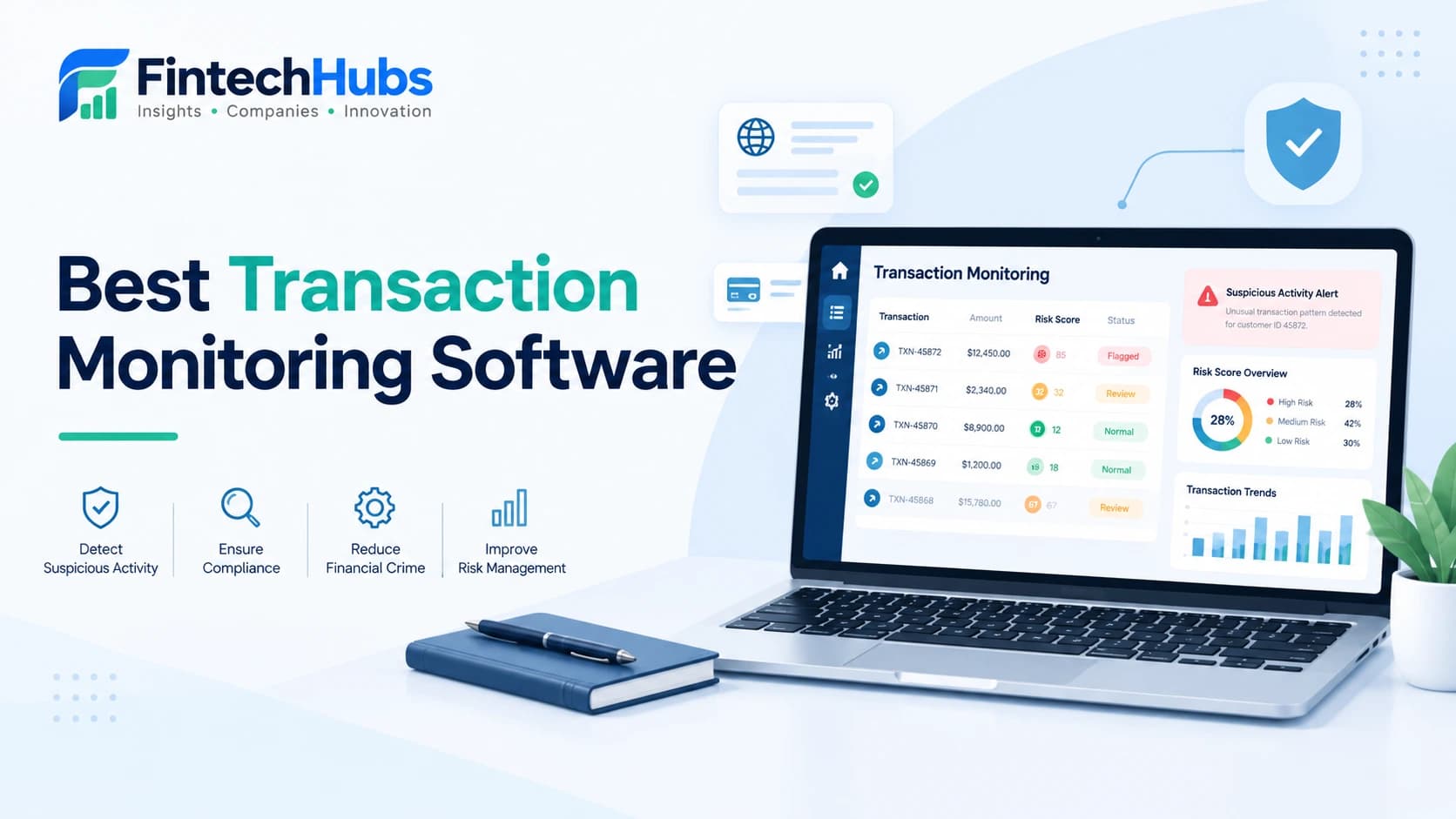
Best Transaction Monitoring Software for Banks and Fintech Companies in 2026
Not every transaction monitoring platform is built for every type of business. A global bank processing tens of millions of transactions daily, operating across dozens of regulatory jurisdictions, has fundamentally different requirements than a fast-growing fintech startup onboarding thousands of new users a week with a lean compliance team. Choosing the "best" transaction monitoring software in 2026 depends heavily on which category a business falls into and selecting a platform built for the wrong scale, budget, or operating model is one of the most common reasons compliance technology implementations underperform.
This guide approaches the question from that angle: rather than presenting a single flat ranking, it breaks down what banks need versus what fintechs need, highlights the types of platforms best suited to each segment, and walks through the broader considerations that should shape a selection decision in 2026.
This article is for general informational and educational purposes only. It does not constitute an endorsement, ranking, or guarantee of any specific vendor's performance, and does not constitute financial, legal, or compliance advice. Readers should verify current vendor capabilities, pricing, and regulatory suitability directly before making a purchasing decision.
What Is Transaction Monitoring Software
Transaction monitoring software analyzes financial transactions in real time or near real time to detect patterns associated with fraud, money laundering, sanctions violations, and other suspicious activity. It combines rules-based logic, statistical models, and increasingly machine learning to generate risk scores and alerts that compliance and fraud teams investigate, escalate, and — where required — report to regulators.
Why Banks and Fintech Have Different Monitoring Needs
Factor | Traditional Banks | Fintech Companies |
|---|---|---|
Transaction volume | Very high, often across legacy core systems | High but typically more API-native and cloud-based |
Regulatory maturity | Established, often multi-jurisdictional AML programs | Growing programs, frequently built from scratch |
Compliance team size | Larger, more specialized teams | Smaller, often generalist compliance staff |
Integration environment | Legacy core banking systems, batch processing common | Modern APIs, real-time data pipelines |
Customer risk profile | Broad mix, including long-standing relationships | Often higher-velocity, newer customer relationships |
Budget and procurement | Larger budgets, longer procurement cycles | Leaner budgets, faster decision-making |
Deployment preference | Mix of on-premises and cloud, often hybrid | Predominantly cloud-native, API-first |
These differences directly shape which platforms and features matter most to each segment.
How Transaction Monitoring Software Works
Data Ingestion: Transaction data is pulled from core banking, payment processing, or API-based transaction streams.
Rule and Model Application: Transactions are scored using configurable rules and, increasingly, machine learning models trained on historical patterns.
Alert Generation: Transactions exceeding risk thresholds generate alerts for human review.
Case Management: Analysts investigate alerts using case management tools, gathering supporting evidence.
Reporting: Confirmed suspicious activity is documented and reported to relevant regulators as required.
Feedback and Tuning: Investigation outcomes feed back into the system to refine detection accuracy and reduce false positives over time.
Key Selection Criteria for Banks
Scalability for high transaction volumes: Across multiple business lines and geographies.
Deep integration capability: With legacy core banking systems, including batch processing where required.
Multi-jurisdictional regulatory support: Including configurable rules aligned to different regulatory regimes.
Enterprise-grade case management: Supporting large compliance teams and complex escalation workflows.
Robust model governance and validation tooling: Given heightened regulatory expectations for large institutions.
Vendor track record and stability: Given the long-term, mission-critical nature of the deployment.
Support for consortium or shared intelligence data: Where available, to detect cross-institutional fraud patterns.
Key Selection Criteria for Fintech Companies
Cloud-native, API-first architecture that integrates quickly with modern tech stacks.
Speed of deployment: Given fintech need to stand up compliance programs quickly, often under regulatory or partner bank requirements.
No-code or low-code rule configuration: Reducing dependence on engineering resources for ongoing tuning.
Cost structures suited to smaller transaction volumes and leaner budgets: Including usage-based or tiered pricing models.
Strong out-of-the-box detection models: Given smaller compliance teams may have less capacity for extensive manual tuning.
Support for digital onboarding risk signals: Such as device intelligence and behavioral biometrics, reflecting fintech typically higher proportion of new digital customers.
Responsive vendor support: Given smaller internal teams rely more heavily on vendor partnership for implementation and troubleshooting.
Software Well-Suited to Large Banks and Enterprise Institutions
Enterprise-grade platforms such as NICE Actimize, SAS Anti-Money Laundering, Oracle Financial Services Crime and Compliance Management, and BAE Systems NetReveal have long track records serving large, multi-jurisdictional financial institutions. These platforms are generally built to handle very high transaction volumes, integrate with complex legacy infrastructure, and support the extensive model governance and regulatory reporting requirements large banks typically face. They often involve longer implementation timelines and larger budgets, reflecting the scale and complexity of the institutions they serve.
Software Well-Suited to Fintech, Neobanks, and Digital-First Businesses
Cloud-native platforms such as Unit21, Hawk AI, Napier AI, Lucinity, and Sardine have been built with digital-first businesses in mind, emphasizing fast API integration, configurable no-code rule-building, and pricing models more accessible to growing companies. Feedzai and Featurespace also serve fintechs alongside larger institutions, offering machine learning-driven detection with flexible deployment options. These platforms typically prioritize rapid time-to-value and lower ongoing maintenance burden compared to legacy enterprise systems.
Software Well-Suited to Crypto and Digital Asset Businesses
Businesses operating in or exposed to cryptocurrency including exchanges, custodians, and banks with digital asset clients typically require specialized blockchain transaction monitoring capabilities. Chainalysis and Elliptic are prominent providers in this space, offering tools to trace and risk-score transactions across public blockchains, supporting compliance obligations specific to digital asset activity. ThetaRay has also built a reputation for AI-driven detection applicable to cross-border and correspondent banking risk, which increasingly intersects with digital asset flows.
Top 20 Transaction Monitoring Software Solutions: Comparison Table
The table below summarizes twenty notable transaction monitoring platforms referenced throughout this guide, organized for quick side-by-side comparison. This is an informational overview, not an independently verified or performance-ranked comparison — capabilities, pricing, and deployment options change frequently, so readers should confirm current details directly with each vendor.
# | Vendor | Best Suited For | Deployment Model | Core Strength | Typical Use Case |
|---|---|---|---|---|---|
1 | NICE Actimize | Large banks, enterprise institutions | On-premises / hybrid / cloud | Broad financial crime suite | AML, fraud, and case management at scale |
2 | SAS Anti-Money Laundering | Large banks, insurers | On-premises / cloud | Advanced statistical analytics | Enterprise AML programs with complex modeling needs |
3 | Feedzai | Banks and fintechs | Cloud | Real-time ML-driven fraud detection | High-velocity payment fraud prevention |
4 | ComplyAdvantage | Fintechs, mid-size institutions | Cloud / API | AML data and screening integration | Combined transaction monitoring and sanctions screening |
5 | Featurespace | Banks and fintechs | Cloud / hybrid | Adaptive behavioral analytics | Real-time fraud and financial crime detection |
6 | FICO Falcon Fraud Manager | Banks, card issuers | On-premises / cloud | Long-standing card fraud scoring | Card and payment fraud detection |
7 | Oracle FCCM | Large, multi-jurisdictional banks | On-premises / cloud | Enterprise-grade compliance suite | AML, case management, regulatory reporting |
8 | BAE Systems NetReveal | Banks, insurers | On-premises / hybrid | Established financial crime detection | AML and fraud detection at enterprise scale |
9 | ACI Worldwide (Fraud Management) | Banks, payment processors | On-premises / cloud | Real-time payment fraud detection | Global payment processing fraud prevention |
10 | Quantexa | Large banks, government, insurers | On-premises / cloud | Entity resolution and graph analytics | Detecting hidden networks and complex fraud |
11 | Napier AI | Fintechs, mid-size institutions | Cloud | Explainable, configurable ML | AML transaction monitoring with compliance transparency |
12 | Lucinity | Fintechs, banks | Cloud | AI-assisted investigation tools | Reducing analyst workload in case review |
13 | Hawk AI | Fintechs, digital banks | Cloud-native | Reduced false positives via ML | Fast-growing digital-first compliance programs |
14 | ThetaRay | Banks, correspondent banking | Cloud / hybrid | Cross-border risk detection | Correspondent banking and cross-border AML |
15 | Sardine | Fintechs, digital-first businesses | Cloud / API | Device intelligence + behavioral biometrics | Onboarding fraud and transaction risk combined |
16 | Unit21 | Fintechs, startups | Cloud / no-code | Configurable workflows without engineering | Fast-deploying compliance for growing companies |
17 | Alessa | Money services businesses, mid-size institutions | On-premises / cloud | AML, screening, and case management | Mid-market AML compliance programs |
18 | Verafin | Community banks, credit unions | Cloud | Purpose-built for smaller institutions | AML and fraud detection for regional banks |
19 | Chainalysis | Crypto exchanges, digital-asset-exposed banks | Cloud / API | Blockchain transaction tracing | Cryptocurrency compliance and risk scoring |
20 | Elliptic | Crypto exchanges, financial institutions | Cloud / API | Blockchain analytics and risk scoring | Digital asset transaction monitoring |
Top 20 Transaction Monitoring Software Solutions: Individual Profiles
1. NICE Actimize: One of the most established names in financial crime risk management, offering a comprehensive suite spanning transaction monitoring, fraud detection, and AML case management. Widely deployed at large, multi-jurisdictional banks that need breadth and depth across financial crime functions in a single ecosystem.
2. SAS Anti-Money Laundering: Built on SAS's long-standing analytics foundation, this platform pairs transaction monitoring with advanced statistical modeling, appealing to institutions with sophisticated in-house data science and compliance analytics capabilities.
3. Feedzai: A risk management platform known for real-time, machine learning-driven fraud and AML detection across banking and payment channels, often favored by institutions prioritizing adaptive, data-science-forward detection methods.
4. ComplyAdvantage: Primarily recognized for AML data, sanctions, and watchlist screening, with transaction monitoring capabilities that integrate closely with its broader screening infrastructure — a natural fit for businesses wanting unified AML data and monitoring.
5. Featurespace: Specializes in adaptive behavioral analytics, continuously learning from transaction patterns to detect fraud and financial crime in real time across both banking and payments use cases.
6. FICO Falcon Fraud Manager: A long-standing, widely deployed fraud detection platform, particularly well known in card issuing and payment fraud scoring, with decades of production use across the banking sector.
7. Oracle Financial Services Crime and Compliance Management (FCCM): An enterprise-grade suite designed for large, complex financial institutions needing transaction monitoring, AML case management, and regulatory reporting within a unified platform tightly integrated with broader Oracle financial services infrastructure.
8. BAE Systems NetReveal: A financial crime detection platform with a strong presence among banks and insurers, offering transaction monitoring and AML capabilities built for complex, enterprise-scale deployments.
9. ACI Worldwide (Fraud Management): Focused on real-time payment fraud detection, this platform is widely used by banks and payment processors operating large-scale, global payment infrastructure.
10. Quantexa: Distinguished by its entity resolution and graph analytics capabilities, Quantexa helps institutions connect seemingly unrelated data points to uncover hidden networks behind complex fraud and money laundering schemes.
11. Napier AI: A newer-generation AML and transaction monitoring platform built around configurable, explainable machine learning models, appealing to compliance teams that need to clearly justify alerts to regulators.
12. Lucinity: Combines transaction monitoring with AI-assisted investigation tools designed specifically to reduce the manual workload on compliance analysts during case review.
13. Hawk AI: A cloud-native AML and fraud detection platform with a strong focus on reducing false positives through machine learning, popular among digital-first banks and fintechs scaling quickly.
14. ThetaRay: Specializes in AI-driven detection for correspondent banking and cross-border payment risk, an increasingly important niche as cross-border and digital asset flows grow in complexity.
15. Sardine: Combines device intelligence, behavioral biometrics, and transaction monitoring in a single platform, reflecting the onboarding-to-transaction continuum that many fintechs need to manage fraud risk holistically.
16. Unit21: A no-code risk and compliance platform that allows compliance and risk teams to configure monitoring rules and investigation workflows without heavy engineering involvement, well suited to fast-growing companies with lean technical teams.
17. Alessa: An AML compliance platform offering transaction monitoring, watchlist screening, and case management, commonly used by mid-size financial institutions and money services businesses.
18. Verafin: Widely used by community and regional banks and credit unions, Verafin's platform is purpose-built for smaller institutions that need robust AML and fraud detection without enterprise-scale complexity.
19. Chainalysis: A leading blockchain analytics provider, widely used by cryptocurrency exchanges and financial institutions with digital asset exposure to trace fund flows and assess risk across public blockchains.
20. Elliptic: Another prominent blockchain analytics and risk-scoring provider, offering transaction monitoring tools specifically designed for cryptocurrency and digital asset compliance programs.
As with all vendor information in this guide, the details above reflect a general, publicly available understanding of each provider's positioning and are not sponsored, independently audited, or presented as a definitive ranking. Businesses should request current product demonstrations, pricing, and references directly from vendors as part of their own due diligence process.
Core Technologies Shaping 2026 Monitoring Platforms
Explainable AI: Increasingly demanded by regulators and internal audit functions to justify alert generation.
Graph-based entity resolution: Connecting related accounts and transactions to detect coordinated fraud or laundering networks.
Real-time payment rail monitoring: Driven by the continued global expansion of instant payment systems.
Behavioral biometrics and device intelligence: Increasingly integrated into fintech-focused platforms to strengthen fraud detection at onboarding and transaction stages.
Consortium data sharing models: Allowing institutions to benefit from shared fraud intelligence while preserving customer data privacy.
Generative AI-assisted investigation tools: Helping analysts summarize alerts and draft regulatory filings more efficiently.
Why It Matters
Selecting transaction monitoring software that does not fit an institution's scale, infrastructure, or compliance maturity creates real operational risk: enterprise systems can be prohibitively complex and slow to deploy for a fast-moving fintech, while lighter-weight platforms may lack the governance rigor a large bank's regulators expect. Matching the platform to the institution is not a secondary consideration it is often the single biggest determinant of whether a transaction monitoring program succeeds operationally and satisfies regulatory expectations.
Benefits of Getting the Right Fit
Faster time to value: Particularly important for fintechs operating under growth and regulatory pressure.
Lower total cost of ownership: Avoiding paying for enterprise capabilities a smaller business does not need, or under-investing in capabilities a large institution genuinely requires.
Stronger regulatory outcomes: As fit-for-purpose platforms are more likely to meet the specific expectations of regulators overseeing that size and type of institution.
Better analyst experience: Reducing alert fatigue and improving investigation efficiency when the platform's detection approach matches the institution's actual risk profile.
Easier scaling: When the chosen platform's architecture and pricing model can grow alongside the business.
Challenges and Limitations
Vendor selection complexity: The number of available platforms and overlapping feature claims can make side-by-side comparison difficult without structured evaluation criteria.
Integration risk: Particularly for banks connecting to legacy core systems, integration can take significantly longer than initially planned.
False positive management: Both banks and fintech face the ongoing challenge of tuning systems to minimize unnecessary alerts without missing genuine risk.
Talent and staffing constraints: Especially for fintech building and retaining skilled compliance analysts to operate monitoring systems effectively remains a persistent challenge.
Keeping pace with evolving typologies: Fraud and money laundering techniques evolve continuously, requiring ongoing model and rule updates regardless of platform choice.
Regulatory and Compliance Considerations
Jurisdiction-specific AML requirements: Should shape platform configuration, particularly for institutions operating across multiple regulatory regimes.
Model validation expectations: Are generally higher for large banks, which should favor platforms with strong governance and documentation capabilities.
Suspicious activity reporting integration: Should be verified for the specific jurisdictions in which a business operates.
Data residency and privacy requirements: May influence whether cloud-based or on-premises deployment is appropriate.
Third-party risk management obligations: Increasingly emphasized by regulators, require careful vendor due diligence regardless of institution size.
Regulatory expectations vary by jurisdiction and institution type; businesses should consult qualified compliance professionals and current regulatory guidance before finalizing a platform selection.
Best Practices for Implementation
Start with a clear risk assessment: To define the specific typologies and volumes the system must detect.
Involve both compliance and engineering teams: In vendor evaluation to assess both regulatory fit and technical integration feasibility.
Request proof-of-concept testing: Against real or representative transaction data before committing to a platform.
Plan for a tuning period: After go-live, since most systems require calibration to the institution's specific customer base.
Document governance processes: For rule changes and model updates from the outset, particularly for regulated institutions.
Build in scalability from day one: Especially for fintech anticipating rapid transaction volume growth.
Future Trends for 2026 and Beyond
Continued convergence of fraud and AML functions: Into unified financial crime platforms.
Growing adoption of real-time, cross-border payment monitoring: As instant payment infrastructure expands globally.
Increased regulatory expectations around AI explainability: Shaping how vendors design and document their detection models.
Expansion of consortium-based fraud intelligence sharing: Particularly among fintech seeking to match the fraud-fighting scale of larger institutions.
Growing specialization in digital asset monitoring: As banks increasingly serve clients with cryptocurrency exposure.
Greater use of generative AI: To support investigation efficiency and regulatory reporting across both bank and fintech deployments.
Frequently Asked Questions
1. Is there a single "best" transaction monitoring software for all businesses?
No the right platform depends heavily on an institution's transaction volume, infrastructure, regulatory obligations, and compliance team size, which differ significantly between large banks and fintech.
2. Why can't fintech simply use the same software as large banks?
Enterprise platforms built for large banks are often more complex, slower to deploy, and more expensive than necessary for a fintech's transaction volume and team size, making lighter, cloud-native platforms a better fit for most fintech.
3. Do banks need different regulatory capabilities than fintech?
Often yes — large banks frequently operate across multiple jurisdictions and face more extensive model governance expectations, requiring more robust configuration and documentation capabilities than many fintech need.
4. How important is integration capability when choosing a platform?
Very important a platform that cannot integrate efficiently with existing core banking or payment infrastructure can significantly delay implementation and increase costs, regardless of its detection capabilities.
5. Are cloud-native platforms suitable for banks as well as fintech?
Increasingly yes many banks are migrating toward cloud-native compliance infrastructure, though institutions with strict data residency or legacy system constraints may still require hybrid or on-premises options.
6. What role does machine learning play in modern transaction monitoring?
Machine learning helps detect evolving, subtle fraud and money laundering patterns beyond static rules, and can help reduce false positives, though it typically works best in combination with rules-based logic and human oversight.
7. How long does implementation typically take?
Implementation timelines vary significantly — cloud-native platforms designed for fintech may be operational within weeks, while enterprise deployments at large banks can take many months due to integration complexity.
8. Is pricing typically based on transaction volume?
Many vendors use volume-based or tiered pricing models, though enterprise platforms serving large banks may use custom pricing structures reflecting the scope of the deployment.
9. How often should transaction monitoring rules and models be reviewed?
Most institutions review and tune rules and models on an ongoing basis, with formal comprehensive reviews typically conducted at least annually or whenever significant changes in risk profile or regulatory requirements occur.
10. Should crypto-exposed businesses use a separate monitoring platform?
Businesses with meaningful cryptocurrency exposure typically benefit from specialized blockchain transaction monitoring tools in addition to, or integrated with, their traditional transaction monitoring systems.
Conclusion
The "best" transaction monitoring software in 2026 is not a single universal answer; it depends on whether a business operates at the scale and complexity of a large bank, the speed and leanness of a fintech, or the specialized requirements of digital asset compliance. Banks generally benefit from enterprise-grade platforms built for scale, multi-jurisdictional complexity, and rigorous model governance, while fintech are typically better served by cloud-native, API-first platforms that can be deployed quickly and tuned without heavy engineering overhead. Understanding these differences and evaluating vendors against the specific needs of the institution rather than a generic feature checklist remains the most reliable path to selecting a platform that performs well operationally and satisfies regulatory expectations.
Disclaimer: This article is provided for general informational and educational purposes only. Vendor mentions do not constitute an endorsement, ranking, or guarantee of performance. Readers should independently verify current features, pricing, and regulatory suitability directly with each vendor, and consult qualified compliance and legal professionals before selecting or implementing a transaction monitoring solution.
Share this article
Related Articles
AML Screening Explained: Process, Types, Tools and Best Practices
Learn what AML screening is, why it matters, how the process works, what lists and checks are involved, common challenges, and how to build an effective screening program.
FinTech Software Development: Solutions, Benefits & Trends
Fintech software development explained: services, architecture, PCI DSS and DORA compliance, delivery process, pricing models, partner checklist, and FAQs.
Predictive Financial Analytics: AI Forecasting in 2026
Learn how predictive financial analytics and AI are transforming forecasting in 2026, from cash flow and credit risk to scenario planning and best practices.