
Best AML Software in 2026: Top Compliance Tools Ranked
Explore the best AML software for 2026 compare top anti-money laundering tools for KYC, transaction monitoring, screening, and regulatory reporting.
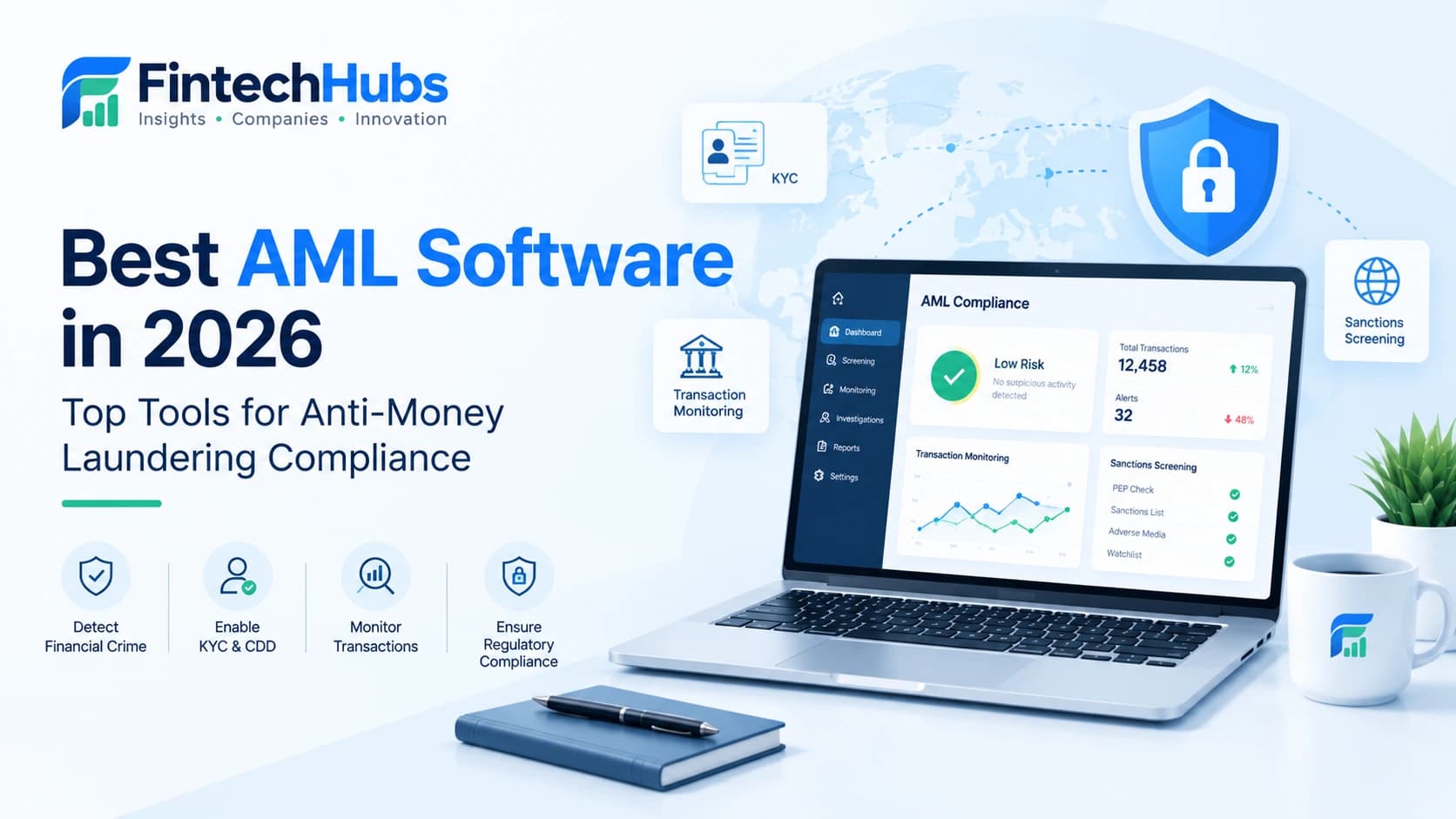
Best AML Software in 2026: Top Tools for Anti-Money Laundering Compliance
Anti-money laundering compliance has grown from a narrow regulatory obligation into a broad operational discipline touching customer onboarding, transaction monitoring, sanctions screening, case investigation, and regulatory reporting. As financial crime grows more sophisticated and regulators raise expectations for proactive risk detection, choosing the right AML software has become one of the most consequential technology decisions a financial institution or fintech can make.
This guide provides a comprehensive look at AML software in 2026: what it does, how it works, the core modules a complete solution should include, and a comparison of notable providers across the market, along with the regulatory context and best practices that should inform a selection decision.
This article is for general informational and educational purposes only. It does not constitute an endorsement, ranking, or guarantee of any specific vendor's performance, and does not constitute financial, legal, or compliance advice. Readers should verify current vendor capabilities, pricing, and regulatory suitability directly before making a purchasing decision.
What Is AML Software
AML software refers to technology platforms designed to help financial institutions and regulated businesses detect, prevent, investigate, and report money laundering and related financial crime. Unlike narrower transaction monitoring tools, complete AML software suites typically combine several interconnected functions: customer due diligence and risk scoring, ongoing transaction monitoring, sanctions and watchlist screening, case management, and regulatory reporting — forming an end-to-end compliance infrastructure rather than a single point solution.
How AML Software Works
Customer Onboarding and Risk Scoring: New customers are screened and assigned an initial risk score based on factors such as geography, industry, and transaction patterns expected at onboarding.
Ongoing Due Diligence: Customer risk profiles are periodically reviewed and updated, with enhanced due diligence applied to higher-risk customers.
Transaction Monitoring: Transactions are continuously analyzed using rules and machine learning models to detect patterns associated with money laundering.
Sanctions and Watchlist Screening: Customers and transactions are screened against government sanctions lists, politically exposed persons (PEP) lists, and adverse media sources.
Alert Generation and Case Management: Suspicious activity generates alerts that are investigated within a case management workflow, incorporating supporting evidence and documentation.
Regulatory Reporting: Confirmed suspicious activity is documented and filed with relevant financial intelligence units through formal suspicious activity reports or equivalent filings.
Audit and Governance: The system maintains comprehensive records of monitoring rules, alerts, investigations, and reporting to support internal audit and regulatory examination.
Core Modules of a Complete AML Software Suite
Customer Due Diligence (CDD) and Know Your Customer (KYC): Identity verification and customer risk assessment at onboarding.
Enhanced Due Diligence (EDD): Deeper investigation applied to higher-risk customers, such as politically exposed persons or those in high-risk jurisdictions.
Transaction Monitoring: Real-time or near real-time analysis of transactions for suspicious patterns.
Sanctions and PEP Screening: Checking customers and transactions against relevant government and international watchlists.
Adverse Media Screening: Searching news and public records for negative information associated with a customer.
Case Management: Workflow tools supporting investigation, documentation, and escalation of suspicious activity.
Regulatory Reporting: Automated generation and filing of suspicious activity reports and related regulatory submissions.
Audit Trail and Governance Tools: Comprehensive logging of system activity to support internal and regulatory audits.
Key Features to Evaluate in 2026
Machine learning-enhanced detection: Capable of identifying evolving laundering typologies beyond static rules.
Explainability: Providing clear reasoning behind alerts to satisfy both internal investigators and regulatory examiners.
Integration flexibility: Connecting easily with core banking, payment processing, and digital onboarding systems via APIs.
Scalability: Supporting growth in transaction volume and customer base without proportional increases in false positives or staffing.
Multi-jurisdictional regulatory support: Including configurable rules aligned to different countries' AML requirements.
Unified platform architecture: Combining CDD, monitoring, screening, and reporting rather than requiring multiple disconnected tools.
Configurable workflows: Allowing compliance teams to adjust rules and case management processes without extensive engineering support.
Top AML Software Solutions: Comparison Table
The following table summarizes notable AML software providers referenced in this guide. This is an informational overview, not an independently verified or performance-ranked comparison — features, pricing, and capabilities change frequently, so readers should confirm current details directly with each vendor.
Vendor | Best Suited For | Core Modules Covered | Notable Strength |
|---|---|---|---|
NICE Actimize | Large banks, enterprise institutions | CDD, monitoring, screening, case management, reporting | Comprehensive financial crime suite |
SAS Anti-Money Laundering | Large banks, insurers | Monitoring, analytics, reporting | Advanced statistical modeling |
Oracle FCCM | Multi-jurisdictional banks | CDD, monitoring, case management, reporting | Enterprise-grade, deeply integrated compliance suite |
BAE Systems NetReveal | Banks, insurers | Monitoring, case management, reporting | Established enterprise-scale detection |
ComplyAdvantage | Fintechs, mid-size institutions | Screening, monitoring | Strong AML data and sanctions screening integration |
Napier AI | Fintechs, mid-size institutions | Monitoring, screening, case management | Explainable, configurable machine learning |
Lucinity | Banks, fintechs | Monitoring, case management | AI-assisted investigation efficiency |
Hawk AI | Fintechs, digital banks | Monitoring, screening | Reduced false positives via machine learning |
ThetaRay | Banks, correspondent banking | Monitoring | Cross-border and correspondent banking risk detection |
Unit21 | Fintechs, startups | Monitoring, case management | No-code configurability |
Alessa | Money services businesses, mid-size institutions | CDD, monitoring, screening, case management | Mid-market AML program coverage |
Verafin | Community banks, credit unions | Monitoring, case management, reporting | Purpose-built for smaller institutions |
Chainalysis | Crypto exchanges, digital-asset-exposed institutions | Blockchain transaction monitoring | Blockchain tracing and risk scoring |
Elliptic | Crypto exchanges, financial institutions | Blockchain transaction monitoring | Digital asset compliance analytics |
Sumsub | Fintechs, digital-first businesses | KYC, onboarding screening | Streamlined digital identity verification |
Top AML Software Solutions: Individual Profiles
NICE Actimize: A long-established, comprehensive financial crime risk management suite covering customer due diligence, transaction monitoring, screening, and case management, widely deployed at large, multi-jurisdictional banks requiring breadth across AML functions.
SAS Anti-Money Laundering: Built on SAS's analytics heritage, combining transaction monitoring with advanced statistical modeling, appealing to institutions with strong in-house data science and compliance analytics capability.
Oracle Financial Services Crime and Compliance Management (FCCM): An enterprise suite integrating CDD, transaction monitoring, case management, and regulatory reporting, often chosen by large institutions already using broader Oracle financial services infrastructure.
BAE Systems NetReveal: A financial crime detection platform with a long track record among banks and insurers, offering monitoring and case management capabilities built for enterprise-scale deployments.
ComplyAdvantage: Recognized primarily for its AML data, sanctions, and watchlist screening capabilities, often paired with transaction monitoring for businesses wanting a unified AML data and screening foundation.
Napier AI: A newer-generation AML platform emphasizing configurable, explainable machine learning models, helping compliance teams clearly justify monitoring and screening alerts to regulators.
Lucinity: Combines AML monitoring with AI-assisted investigation tools designed to reduce analyst workload during case review and documentation.
Hawk AI: A cloud-native AML platform focused on reducing false positives through machine learning, popular among fast-growing digital banks and fintechs.
ThetaRay: Specializes in AI-driven detection for correspondent banking and cross-border payment risk, an increasingly significant AML use case as cross-border flows grow more complex.
Unit21: A no-code risk and compliance platform enabling configuration of AML monitoring rules and case management workflows without heavy engineering involvement, suited to lean compliance teams.
Alessa: An AML compliance platform offering due diligence, monitoring, screening, and case management, commonly used by mid-size institutions and money services businesses.
Verafin: Purpose-built for community and regional banks and credit unions, offering AML monitoring, case management, and reporting without enterprise-scale complexity.
Chainalysis: A leading blockchain analytics provider used by cryptocurrency exchanges and AML-regulated institutions with digital asset exposure to trace fund flows and assess laundering risk on public blockchains.
Elliptic: Another prominent blockchain analytics and risk-scoring provider, supporting AML compliance programs specific to cryptocurrency and digital asset activity.
Sumsub: A digital identity verification and onboarding platform widely used by fintechs to streamline KYC processes as the front end of a broader AML compliance program.
As with all vendor information in this guide, the details above reflect a general, publicly available understanding of each provider's positioning and are not sponsored, independently audited, or presented as a definitive ranking. Businesses should request current product demonstrations, pricing, and references directly from vendors as part of their own due diligence.
Types/Branches of AML Software
8.1 End-to-End AML Compliance Suites
Combine CDD, monitoring, screening, case management, and reporting within a single integrated platform, typically favored by larger institutions seeking a unified compliance infrastructure.
8.2 Transaction Monitoring-Focused Platforms
Specialize specifically in analyzing transactions for suspicious patterns, often integrated with separate screening or case management tools.
8.3 Sanctions and Watchlist Screening Platforms
Focus on screening customers and transactions against sanctions lists, PEP lists, and adverse media sources.
8.4 KYC and Digital Onboarding Platforms
Specialize in identity verification and customer risk scoring at the point of onboarding, forming the front end of a broader AML program.
8.5 Case Management and Investigation Platforms
Focus on streamlining the investigation workflow for compliance analysts, often integrating with other specialized AML tools.
8.6 Blockchain and Digital Asset AML Platforms
Specialize in tracing and risk-scoring cryptocurrency transactions, supporting AML compliance for exchanges and institutions with digital asset exposure.
8.7 No-Code/Configurable AML Platforms
Allow compliance teams to build and adjust monitoring rules and workflows without heavy engineering involvement, popular among fintechs and smaller institutions.
Core Technologies Powering AML Software in 2026
Machine learning and behavioral analytics: For detecting evolving money laundering typologies.
Graph analytics and entity resolution: Connecting related accounts and transactions to reveal hidden laundering networks.
Natural language processing: Used for adverse media screening and analysis of unstructured compliance documentation.
Explainable AI techniques: Helping investigators and regulators understand the reasoning behind automated alerts.
Cloud-native architecture: Enabling faster deployment and easier scaling compared to legacy on-premises systems.
APIs and integration frameworks: Connecting AML platforms to core banking, payment processing, and digital onboarding systems.
Generative AI tools: Increasingly used to assist investigators in summarizing case findings and drafting regulatory filings.
Why It Matters
Money laundering enables and conceals a wide range of serious criminal activity, and regulators worldwide continue to increase expectations for proactive detection and reporting. Failure to maintain an effective AML program carries significant consequences, including substantial financial penalties, reputational damage, and in serious cases, loss of operating licenses. Modern AML software allows institutions to meet these obligations at a scale and speed that manual compliance processes cannot achieve, while also supporting more consistent, defensible decision-making during regulatory examinations.
Industries and Use Cases
Banks and credit unions: Core AML compliance obligations across deposit, lending, and payment services.
Fintechs and neobanks: Building compliant AML programs that scale with rapid customer growth.
Cryptocurrency exchanges: Blockchain-specific AML compliance for digital asset transactions.
Money services businesses: AML compliance for remittance, currency exchange, and money transfer operations.
Insurance companies: AML monitoring applied to policy and claims-related transactions.
Payment processors: AML compliance across merchant transaction flows.
Wealth management and private banking: enhanced due diligence for high-net-worth and politically exposed clients.
Benefits of Implementing AML Software
Improved detection accuracy, identifying suspicious patterns at a scale manual review cannot match.
Regulatory compliance support, helping institutions meet due diligence, monitoring, and reporting obligations.
Reduced false positives, particularly with machine learning-enhanced platforms, improving analyst efficiency.
Faster investigations, through integrated case management and documentation tools.
Stronger audit readiness, with comprehensive logging supporting regulatory examinations.
Scalability, supporting growth in customer base and transaction volume without proportional compliance staffing increases.
Challenges and Limitations
Integration complexity, particularly when connecting to legacy core banking systems.
False positive management, requiring ongoing tuning to balance detection effectiveness against analyst workload.
Data quality dependency, since detection accuracy relies heavily on complete, accurate customer and transaction data.
Cost considerations, as comprehensive AML suites can represent a significant investment, particularly for smaller institutions.
Evolving typologies, requiring continuous model and rule updates as money laundering methods adapt.
Cross-border complexity, given varying AML regulatory requirements across jurisdictions for institutions operating internationally.
Talent and staffing constraints, particularly for smaller compliance teams managing increasingly sophisticated systems.
Regulatory Considerations
AML software must support compliance with applicable anti-money laundering laws and regulations, which vary by jurisdiction but generally include:
Customer due diligence and KYC requirements: Mandating identity verification and risk assessment at onboarding.
Suspicious activity reporting obligations: Requiring formal filings when suspicious activity is identified.
Sanctions compliance requirements: Mandating screening against relevant government and international watchlists.
Record-keeping obligations: Requiring institutions to maintain documentation of monitoring rules, alerts, and investigations.
Model governance expectations: Particularly for machine learning-based detection systems, requiring regular validation and testing.
Data privacy regulations: Governing how customer and transaction data is collected, stored, and used within AML systems.
Regulatory requirements vary significantly by jurisdiction and institution type; businesses should consult current regulatory guidance and qualified compliance professionals before implementing or modifying an AML program.
Best Practices for Selecting and Implementing AML Software
Define clear requirements: Upfront, including regulatory obligations, transaction volume, and existing system integration needs.
Involve compliance, risk, and technology teams: Jointly in vendor evaluation.
Request proof-of-concept testing against representative data before committing to a platform.
Prioritize explainability: To support both internal investigations and regulatory examinations.
Plan for an initial tuning period: To calibrate detection thresholds and reduce false positives.
Evaluate total cost of ownership: Including implementation, licensing, and ongoing staffing requirements.
Establish strong governance frameworks: For model validation, rule changes, and audit documentation from the outset.
Future Trends for 2026 and Beyond
Greater adoption of explainable AI, driven by regulatory and operational demand for transparency in automated detection.
Expansion of graph-based network analysis, improving detection of complex, multi-party laundering schemes.
Increased convergence of fraud and AML functions into unified financial crime platforms.
Growing specialization in digital asset AML compliance, as cryptocurrency adoption and related regulation expand.
Greater use of generative AI to assist investigators with case summarization and regulatory filing drafts.
Expansion of consortium-based data sharing, allowing institutions to collectively detect cross-institutional laundering patterns.
Continued regulatory emphasis on model governance, shaping how AML vendors design and document detection systems.
Frequently Asked Questions
1. What is AML software?
AML software refers to technology platforms designed to help financial institutions detect, prevent, investigate, and report money laundering and related financial crime, typically combining customer due diligence, transaction monitoring, screening, and reporting functions.
2. Is AML software required by law?
Regulated financial institutions in most jurisdictions are legally required to maintain AML compliance programs, though the specific technology requirements vary by jurisdiction and institution type.
3. What is the difference between AML software and transaction monitoring software?
Transaction monitoring is one component of a complete AML program; AML software often refers more broadly to an integrated suite covering due diligence, screening, case management, and reporting alongside transaction monitoring.
4. How does machine learning improve AML software?
Machine learning can detect subtle, evolving money laundering patterns beyond static rules and can help reduce false positives by learning from historical investigation outcomes.
5. Can small businesses and fintechs afford comprehensive AML software?
Yes, a growing number of cloud-based, no-code platforms are designed to be accessible to smaller businesses without the budget for large, enterprise-grade legacy systems.
6. What should businesses look for when selecting AML software?
Key considerations include detection accuracy, false positive rates, integration capability, explainability, regulatory reporting support, scalability, and total cost of ownership.
7. How does blockchain AML monitoring differ from traditional AML monitoring?
Blockchain AML monitoring analyzes transactions on public distributed ledgers, tracing fund flows across wallet addresses, whereas traditional AML monitoring analyzes transactions within conventional banking systems.
8. How long does AML software implementation typically take?
Implementation timelines vary based on system complexity and integration requirements, ranging from a few weeks for cloud-based platforms to many months for complex enterprise deployments.
9. Does AML software guarantee compliance with regulatory requirements?
No single software solution guarantees compliance; AML software significantly strengthens a compliance program but must be part of a broader framework including policies, trained staff, and governance oversight.
10. How often should AML monitoring rules and models be reviewed?
Most institutions review and tune AML rules and models on an ongoing basis, with comprehensive formal reviews typically conducted at least annually or whenever risk profiles or regulatory requirements change significantly.
Conclusion
Selecting the right AML software in 2026 requires looking beyond any single feature and evaluating how well a platform's due diligence, monitoring, screening, case management, and reporting capabilities fit an institution's specific regulatory obligations, transaction volume, and compliance team structure. From comprehensive enterprise suites built for large, multi-jurisdictional banks to cloud-native, configurable platforms designed for fast-growing fintechs, the AML software market in 2026 offers a wide range of options, making careful evaluation against an institution's actual risk profile and operational needs more important than ever.
Disclaimer: This article is provided for general informational and educational purposes only. Vendor mentions do not constitute an endorsement, ranking, or guarantee of performance. Readers should independently verify current features, pricing, and regulatory suitability directly with each vendor, and consult qualified compliance and legal professionals before selecting or implementing an AML software solution.
Share this article
Related Articles
AML Screening Explained: Process, Types, Tools and Best Practices
Learn what AML screening is, why it matters, how the process works, what lists and checks are involved, common challenges, and how to build an effective screening program.

FinTech Software Development: Solutions, Benefits & Trends
Fintech software development explained: services, architecture, PCI DSS and DORA compliance, delivery process, pricing models, partner checklist, and FAQs.
Predictive Financial Analytics: AI Forecasting in 2026
Learn how predictive financial analytics and AI are transforming forecasting in 2026, from cash flow and credit risk to scenario planning and best practices.