Embedded Finance Compliance Challenges
Embedded Finance Compliance Challenges | Key Risks & Solutions
Embedded finance is transforming the way businesses deliver financial services. Instead of requiring customers to visit a bank or use a separate financial application, companies can integrate payments, lending, insurance, banking, and other financial products directly into their existing platforms. A ride-hailing application can offer instant payments, an e-commerce marketplace can provide sellers with working-capital loans, and a software platform can give businesses access to digital banking services.
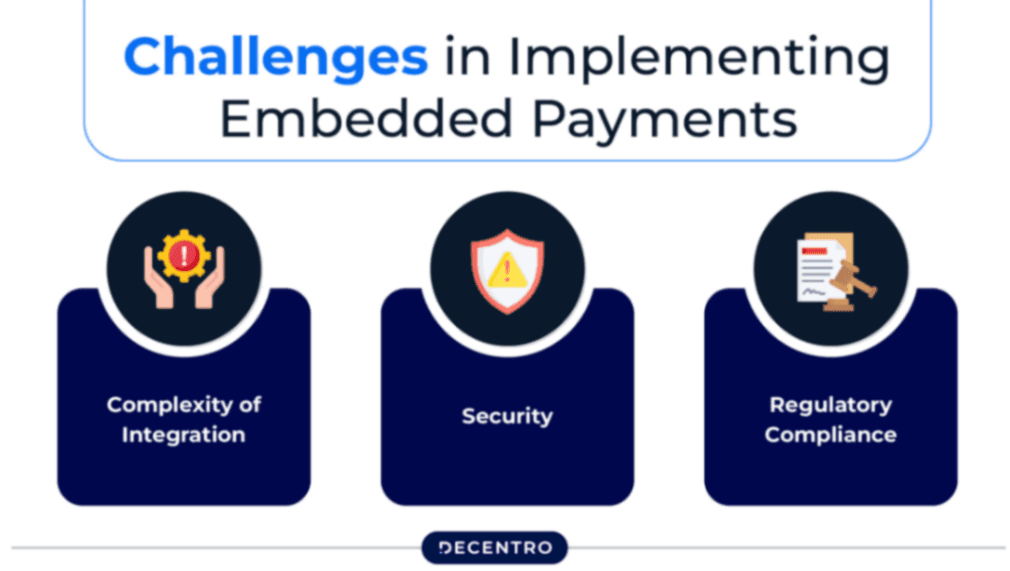
This rapid integration creates significant opportunities for businesses and consumers, but it also introduces complex compliance challenges. Financial regulation was traditionally designed around banks and other clearly defined financial institutions. Embedded finance blurs these boundaries by bringing regulated financial activities into non-financial companies and digital ecosystems. As a result, businesses must navigate regulations, responsibilities, technologies, and partnerships that can be difficult to manage.
1. Unclear Regulatory Responsibilities
One of the biggest compliance challenges in embedded finance is determining who is responsible for meeting regulatory requirements. An embedded finance arrangement may involve a technology company, a bank, a payment processor, a lender, and several other service providers.
Although the regulated financial institution may hold the relevant license, the customer often interacts primarily with the non-financial platform. This can create uncertainty about responsibility for activities such as customer verification, transaction monitoring, disclosures, complaints, and regulatory reporting.
Contracts can allocate responsibilities between partners, but regulators generally expect regulated institutions to maintain effective oversight of outsourced activities. Therefore, companies cannot assume that working with a licensed financial institution automatically transfers all compliance obligations to that partner.
2. Know Your Customer and Customer Identification
Know Your Customer (KYC) requirements are central to financial compliance. Financial institutions must establish who their customers are and assess risks associated with providing financial services to them.
Embedded finance makes KYC more complicated because financial products may be offered within a customer journey that was not originally designed for banking. A user may already have an account with an e-commerce platform, for example, but that does not necessarily mean the platform has collected all the information required for a regulated financial product.
Businesses must determine what customer information can be reused, what additional verification is necessary, and when enhanced due diligence is required. They must also ensure that identity verification processes are reliable enough to prevent fraud and comply with applicable regulations.
3. Anti-Money Laundering and Transaction Monitoring
Anti-money laundering (AML) requirements present another major challenge. Embedded payment and financial services can generate large volumes of transactions across multiple channels, making suspicious activity difficult to identify.
Traditional financial institutions typically have established AML systems, but non-financial platforms entering financial services may lack comparable infrastructure. They may need to monitor transactions, identify unusual behavior, screen customers against sanctions lists, and escalate suspicious activity appropriately.
The challenge becomes greater when several organizations share responsibility for a transaction. Data may be distributed between the platform, bank, payment provider, and other partners. Effective AML compliance therefore requires clearly defined responsibilities, appropriate data-sharing arrangements, and strong monitoring systems.
4. Data Privacy and Security
Embedded finance relies heavily on personal and financial data. Platforms may collect information about customers' identities, transactions, income, purchasing behavior, and financial preferences. This creates significant privacy and cybersecurity risks.
Companies must comply with applicable data-protection and privacy laws while ensuring that customer information is collected, stored, processed, and shared appropriately. They also need controls to prevent unauthorized access, data breaches, and misuse.
Third-party relationships create additional risks. When customer information moves between a technology platform and a financial institution, organizations must understand where data is stored, who can access it, how long it is retained, and for what purposes it may be used.
5. Consumer Protection
Consumer protection is another critical consideration. Financial products can have serious consequences for customers, particularly when they involve credit, insurance, or investment-related services.
Embedded finance can make financial products feel like ordinary features of an application. A customer may therefore accept a loan, payment service, or insurance product without fully understanding its terms.
Companies must provide clear disclosures, transparent pricing, appropriate consent mechanisms, and accessible complaint procedures. They should also ensure that marketing does not mislead customers or disguise important financial information.
6. Third-Party and Vendor Risk
Embedded finance ecosystems often depend on numerous third parties. These may include banks, payment processors, identity-verification companies, cloud providers, fraud-prevention services, and technology vendors.
Every additional partner introduces potential compliance and operational risks. A company may have strong internal controls but still experience a regulatory problem because a third-party provider failed to meet required standards.
Effective vendor management should therefore include due diligence, contractual requirements, ongoing monitoring, performance assessments, security reviews, and clearly defined incident-reporting procedures.
7. Licensing and Regulatory Change
Financial regulations differ significantly between jurisdictions. A business operating internationally may face different licensing, consumer-protection, AML, data-privacy, and reporting requirements in each market.
Furthermore, embedded finance is developing rapidly, and regulators continue to adapt their approaches. Rules governing payments, digital lending, open banking, artificial intelligence, outsourcing, and data protection can change over time.
Businesses must establish processes for monitoring regulatory developments and determining how changes affect their products. Compliance cannot be treated as a one-time exercise completed before a product launch.
8. Artificial Intelligence and Automated Decision-Making
Many embedded finance providers use artificial intelligence and automated systems for fraud detection, credit scoring, personalization, and risk assessment. While these technologies can improve efficiency, they create additional compliance concerns.
Companies need to understand how automated decisions are made and whether models produce inaccurate or discriminatory outcomes. Depending on the jurisdiction and product, customers may also have rights relating to transparency, explanations, human review, or correction of inaccurate information.
Strong model governance, testing, documentation, monitoring, and human oversight can help reduce these risks.
9. Building a Strong Compliance Framework
Organizations can address embedded finance compliance challenges by adopting a risk-based approach. The first step is to map the entire financial-service journey and identify every party involved. Companies should then determine which regulations apply and assign responsibility for each compliance obligation.
A strong framework should include customer identification, AML controls, data governance, cybersecurity, consumer protection, third-party oversight, incident management, regulatory reporting, and employee training.
Technology can also play an important role. Automated KYC systems, transaction-monitoring tools, compliance dashboards, and regulatory-change management platforms can help organizations manage large volumes of activity. However, technology should support—not replace—effective governance and human oversight.
Conclusion
Embedded finance offers businesses an opportunity to make financial services more convenient, accessible, and integrated into everyday digital experiences. However, the same integration that creates its commercial value also creates substantial compliance complexity.
The key challenge is not simply complying with financial regulations. It is coordinating compliance across technology platforms, financial institutions, customers, vendors, and multiple regulatory frameworks. Businesses that treat compliance as an afterthought may face regulatory penalties, financial losses, reputational damage, and loss of customer trust.
Successful embedded finance therefore requires compliance to be designed into products from the beginning. Clear accountability, effective partnerships, robust technology, strong data governance, continuous monitoring, and a customer-focused approach are essential. As embedded finance continues to expand, organizations that combine innovation with disciplined compliance will be best positioned to build sustainable and trusted financial ecosystems.
Share this article
Related Articles
API-Driven Regulatory Reporting: Transforming Compliance Through Automation
API-Driven Regulatory Reporting: Benefits, Automation & Compliance
The Role of RegTech in Digital Banking
RegTech in Digital Banking: Role, Benefits & Future

Rule-Based vs AI-Based Transaction Monitoring: Which Approach Is Better?
Rule-Based vs AI-Based Transaction Monitoring | Complete Guide